Ego Is the Enemy Quotes
by Ryan Holiday
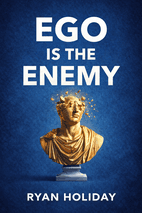
Looking for the best quotes from Ego Is the Enemy by Ryan Holiday? Below are the lines that stand out most across the book.
The quotes are organized by chapter, each with a short note on where it appears and why it stands out.
Top Quotes from Ego Is the Enemy
“In Ego Is the Enemy, Ryan Holiday writes us all a prescription: humility.”
Austin Kleon, author of Steal Like an Artist, in a blurb for the book.
It distills the book's core message into a single, memorable metaphor, making the antidote to ego feel both universal and actionable.
“I see the toxic vanity of ego at play every day and it never ceases to amaze me how often it wrecks promising creative endeavors.”
Marc Ecko, founder of Ecko Unltd and Complex, in a blurb for the book.
This line powerfully names the destructive effect of ego, giving readers a vivid warning that resonates with anyone who has witnessed creative work derailed by arrogance.
“Ego can be the enemy if we are unarmed with the cautionary insights of history, scripture, and philosophy.”
Dr. Drew Pinsky, host of HLN's Dr. Drew On Call, in a blurb for the book.
It frames ego not as an inevitable foe but as a conditional threat—one that can be neutralized by wisdom, which inspires readers to arm themselves with timeless knowledge.
“I would like to rip out every page and use them as wallpaper so I could be reminded constantly of the humility and work it takes to truly succeed.”
Channon Crawford, Olympic Gold Medalist, in a blurb for the book.
The visceral image of wanting the book's lessons on constant display captures how deeply the message resonates with high achievers, emphasizing the daily need for humility.
“This above all: to thine own self be true, And it must follow, as the night the day, Thou canst not then be false to any man.”
Shakespeare's Polonius speech to his son Laertes in Hamlet, which the author connects back to Isocrates' earlier advice.
This iconic line cuts to the heart of the chapter's message: personal integrity and self-awareness are the foundations of genuine success. It reminds readers that authenticity protects against the distortions of ego.
“Be natural and yourself and this glittering flattery will be as the passing breeze of the sea on a warm summer day.”
Sherman wrote this to his friend Grant as a warning against the praise and attention that comes with success.
The metaphor of flattery as a passing breeze perfectly captures the transience of external validation. It encourages readers to stay grounded and not let ego inflate from others' praise.
Quotes by Chapter
PART I: ASPIRE
“Among men who rise to fame and leadership two types are recognizable—those who are born with a belief in themselves and those in whom it is a slow growth dependent on actual achievement.”
A biographer's summary of Sherman's character and the distinction between ego-driven and achievement-based confidence.
This passage challenges the myth of innate, unshakable self-belief, arguing instead that true confidence must be earned through real accomplishments. It offers a powerful framework for evaluating one's own ambition.
“The ability to evaluate one’s own ability is the most important skill of all.”
The author's direct reflection after discussing Sherman's career and the dangers of ego.
Its stark simplicity makes it unforgettable—self-assessment is the cornerstone of growth. Without it, improvement is impossible, and ego blinds us to our own shortcomings.
TALK, TALK, TALK
“Mere gossip anticipates real talk, and to express what is still in thought weakens action by forestalling it.”
Quote from philosopher Kierkegaard as referenced by the author.
It explains how premature talk dissipates the energy needed for action.
“Silence is the respite of the confident and the strong.”
Author's assertion about the value of silence.
Empowers readers to embrace quiet strength.
“The only relationship between work and chatter is that one kills the other.”
Closing insight of the chapter.
A stark, memorable reminder that talk and work are mutually exclusive.
TO BE OR TO DO?
“If you go that way you can be somebody. You will have to make compromises and you will have to turn your back on your friends. But you will be a member of the club and you will get promoted and you will get good assignments.”
Boyd speaking to a young officer about one path at a fork in the road.
It starkly captures the Faustian bargain of chasing status over purpose, making the reader question whether the price of belonging is worth compromising integrity.
“But you won't have to compromise yourself. You will be true to your friends and to yourself. And your work might make a difference.”
Boyd describing the alternative path of doing meaningful work instead of seeking promotion.
This offers a compelling vision of integrity and impact, reminding us that real fulfillment comes from staying true to our values and contributing something lasting.
“Having authority is not the same as being an authority. Having the right and being right are not the same either.”
The author's reflection on how we confuse superficial markers with genuine accomplishment.
It delivers a crisp, memorable warning against conflating power with expertise or correctness, a lesson that applies across careers and life decisions.
“Impressing people is utterly different from being truly impressive.”
The author's continuation of the theme that appearances deceive.
This simple, aphoristic line cuts through ego-driven behavior, challenging readers to focus on substance over showmanship.
DON’T BE PASSIONATE
“Passion typically masks a weakness. Its breathlessness and impetuousness and franticness are poor substitutes for discipline, for mastery, for strength and purpose and perseverance.”
The author contrasts the destructive nature of unbridled passion with the steady qualities needed for real achievement.
It starkly reframes passion as a liability rather than a virtue, reminding readers that lasting success comes from discipline and purpose, not feverish enthusiasm.
“Purpose, you could say, is like passion with boundaries. Realism is detachment and perspective.”
The author defines purpose and realism as the antidotes to misguided passion.
This concise, memorable distinction helps readers replace vague passion with focused direction and clear-eyed assessment of reality.
“Leave passion for the amateurs. Make it about what you feel you must do and say, not what you care about and wish to be.”
The concluding advice of the chapter, urging a shift from self-indulgent passion to committed action.
It cuts through the cultural obsession with passion, offering a practical, ego-free approach to meaningful work.
“The pretense of knowledge is our most dangerous vice, because it prevents us from getting any better.”
From the earlier section on adopting a student mindset, the author warns against the illusion of knowing.
This line captures the core obstacle to growth—ego's refusal to admit ignorance—and challenges readers to embrace humility.
FOLLOW THE CANVAS STRATEGY
“Find canvases for other people to paint on. Be an anteambulo. Clear the path for the people above you and you will eventually create a path for yourself.”
The author advises newcomers to adopt the ancient Roman role of the anteambulo—one who clears the way for a patron.
This concise, actionable mantra encapsulates the chapter’s core strategy: selfless service leads to long‑term success, directly countering ego‑driven demands for immediate credit.
“Greatness comes from humble beginnings; it comes from grunt work. It means you're the least important person in the room—until you change that with results.”
The author summarizes Benjamin Franklin and Bill Belichick’s early careers as examples of the canvas strategy in action.
This line reframes drudgery as the essential foundation of achievement, offering a powerful antidote to entitlement and the impatience of ego.
“Because if you pick up this mantle once, you'll see what most people's egos prevent them from appreciating: the person who clears the path ultimately controls its direction, just as the canvas shapes the painting.”
The closing lines of the chapter explain why the canvas strategy remains powerful even after one has risen in rank.
This poetic metaphor flips the conventional wisdom on power, revealing that true influence comes from enabling others—a deeply counterintuitive and liberating insight.
RESTRAIN YOURSELF
“I have observed that those who have accomplished the greatest results are those who “keep under the body”; are those who never grow excited or lose self-control, but are always calm, self-possessed, patient, and polite.”
Booker T. Washington's words are quoted at the beginning of the chapter to set the theme.
This line encapsulates the chapter's central thesis that self-restraint is the foundation of great achievement, offering a timeless reminder that composure outweighs reactivity.
“Those who have subdued their ego understand that it doesn’t degrade you when others treat you poorly; it degrades them.”
The author reflects on the mindset of those who have mastered restraint.
It reframes humiliation as a reflection of the perpetrator's character, empowering readers to rise above petty treatment without losing self-worth.
“Instead, you must do nothing. Take it. Eat it until you're sick. Endure it. Quietly brush it off and work harder. Play the game. Ignore the noise; for the love of God, do not let it distract you.”
The author offers blunt advice on how to handle slights and frustrations while pursuing important goals.
The raw, imperative tone forces readers to confront the discomfort of restraint, making it a memorable call to resilience and focus.
“He learned early that the tightrope he walked would tolerate only restraint and had no forgiveness for ego.”
The author summarizes Jackie Robinson's hard-won lesson about the demands of his pioneering role.
The tightrope metaphor vividly conveys the precarious nature of high-stakes endeavors, reminding us that ego is an unaffordable luxury on the path to greatness.
GET OUT OF YOUR OWN HEAD
“A person who thinks all the time has nothing to think about except thoughts, so he loses touch with reality and lives in a world of illusions.”
Opening epigraph by philosopher Alan Watts that sets the chapter's theme.
It succinctly captures the core problem of being trapped in one's own mind, making it a memorable warning against overthinking.
“The idea that his task was relatively straightforward, that he just needed to get started, was almost too easy and too obvious to someone who had thought so much about it all.”
Describing why General George McClellan failed to take action despite having a simple task.
It illustrates how overthinking and grandiosity can paralyze even capable people, a relatable lesson for procrastinators and perfectionists.
“Living clearly and presently takes courage. Don't live in the haze of the abstract, live with the tangible and real, even if—especially if—it's uncomfortable.”
The author's concluding exhortation to embrace reality over illusion.
This direct, empowering call to action encourages readers to face discomfort and engage with the present, making it a powerful anchor for the chapter's message.
THE DANGER OF EARLY PRIDE
“Stoop, young man, stoop—as you go through this world— and you'll miss many hard thumps.”
Cotton Mather said this to a young Benjamin Franklin after Franklin hit his head on a low beam due to strutting proudly.
It serves as a timeless reminder that humility protects us from unnecessary pain and that pride blinds us to dangers above. The metaphor of stooping is both practical and profound.