Dopamine Kids Quotes
by Michaeleen Doucleff
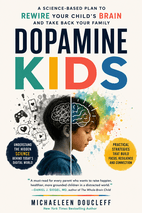
These lines get right to the heart of why we can’t put down our phones or stop scrolling. They explain the science behind that nagging urge to check, tap, and chase one more thing, and they make it feel personal. You’ll find big ideas tucked into everyday moments, from a child watching videos to a grown adult sneaking one more game.
What makes this book so quotable is how it reframes a familiar problem. It doesn’t shame you for your screen time. Instead, it gives you a new way to see what’s happening in your brain, and that shift in perspective sticks with you. These are the passages you’ll want to read twice and share with someone else.
Top Quotes from Dopamine Kids
“High levels of dopamine inside your brain don’t give you a surge of pleasure, as the old model claimed. Instead, dopamine gives you a surge of motivation.”
The narrator explains the finding that overturned James Olds's 1950s pleasure-center theory.
It reframes dopamine not as a happiness chemical but as a drive chemical, which helps explain compulsive screen use. Readers recognize that wanting and liking are not the same.
“The animals and people didn’t love the electrode. They didn’t feel constant pleasure. They felt a constant desire to tap, tap, tap. They felt a constant longing. A ceaseless wanting.”
The narrator summarizes what Berridge's experiments revealed about the rats' compulsive lever-pressing.
It transforms the familiar image of addiction from seeking pleasure to being trapped by wanting, which resonates with anyone who has felt unable to stop scrolling or snacking.
“It's no longer about catching the rabbit but only about chasing the rabbit. It's about chasing... forever.”
A neuroscientist summarizes what happens when wanting becomes untethered from liking.
It captures the exhausting, endless quality of compulsive chasing. The rabbit metaphor makes the loss of satisfaction visceral and unforgettable.
“As neuroscientist Mateusz Gola put it, you're chasing the feeling of chasing. You're stuck on a treadmill with a broken off switch.”
The author explains the endless wanting created by nonclosure in apps.
The broken-off-switch image makes the loss of control visceral. It explains why scrolling often continues even after the pleasure is gone.
“I know. You will always be almost at the next level. That’s how the game gets you to keep playing.”
The neuroscientist Jonathan Morrow tells his son why the game keeps him from stopping.
It exposes the ‘almost there’ promise at the heart of addictive apps. Any player who has said ‘one more level’ will recognize the trap.
“Somewhere along the way, my phone had turned into the equivalent of a phantom limb. I could sense its presence and yearned for it even after I amputated it.”
The author describes how addicted she felt to her phone even when it was physically distant.
The phantom-limb metaphor captures how a smartphone becomes psychologically wired into our sense of self. It makes the invisible pull of technology concrete and familiar.
“Why couldn't I spend sixty minutes in a garden and not desire an activity that literally short-circuited my ability to experience pleasure?”
The author asks this while reflecting on her frustration with phone cravings during gardening.
It names the bizarre self-awareness of compulsive screen use: knowing an activity is good for you while still craving something that dulls it. The question turns personal shame into a universal puzzle.
Themes Behind the Quotes
The quotes center on a simple but unnerving idea: we’re wired to want, not to be satisfied. Dopamine doesn’t deliver contentment; it creates an endless loop of craving. That’s why a game keeps promising that you are close, and why a phone buzz can pull you out of a quiet moment. The book keeps returning to how modern apps and foods exploit this loop by making the object of desire always feel one step away.
Another thread is that willpower isn’t the hero we think it is. Environments, cues, and habits do much more of the work, for better and for worse. When we build routines around whole foods and offscreen time, those choices can protect us. But when we surround ourselves with hyperpalatable snacks and endless feeds, our motivation gets pointed in the wrong direction. The answer isn’t just trying harder; it’s changing the signals around us.
Quotes by Chapter
Chapter 1: But She Loves It So Much
“As the scientists misinterpreted the rat's behavior (tap-tap-tap), I had completely misinterpreted Rosy’s behavior (watch-watch-watch). I had mixed up wanting and pleasure.”
The author reflects on her own misinterpretation of her daughter Rosy's screen behavior.
This line lets readers connect the science to the parenting story. It shows that even well-intentioned adults can confuse a child's craving with genuine joy.
“Instead, she was experiencing insane motivation.”
The author describes her realization about Rosy's intense emotions around cartoons after talking to neuroscientist Kent Berridge.
It overturns the assumption that kids binge screens because they enjoy them, revealing craving as motivation rather than pleasure. This reframing helps parents see limits as something other than deprivation.
Chapter 2: What’s Missing in Our Lives?
“Dopamine causes a very basic, very powerful kind of wanting that can give real urgency to your desire for things.”
Berridge explains why a thirsty jogger feels such an urgent pull toward lemonade.
It separates the intensity of wanting from actual liking. It reminds readers that cravings are designed to feel urgent, not rational.
“If you feel like you've almost reached your goal, or that you're getting close, you'll get the most dopamine of all.”
Neuroscientist Jonathan Morrow describes how near-goal feelings intensify motivation.
It explains why progress bars, streaks, and near-misses are so powerfully engaging. The feeling of almost getting there can matter more than the reward itself.
“Then your world can become dull and gray.”
Morrow warns about the emotional consequences of living in a dopamine-driven chase loop.
It names the quiet emptiness that follows overstimulation. The image of a dull and gray world haunts anyone who has felt joy drain from everyday life.
Chapter 3: The Most Addictive Screen on Earth
“I'm well past that point in my life, could be a grandmother. And what kind of Grandma would that be? Some idiot with no self-control, who becomes paralyzed, hypnotized—by what? A machine? The music? The lights? WHAT IS IT??”
Darlene, a slot machine player, writes in a recovery-group log after spending fifteen hours absorbed by an electronic slot machine.
It frames addiction as a loss of self: she measures the person she has become against the grandmother she could be, then answers with a devastating self-portrait.
“Is it about money? No. Is it about enjoyment? No. Is it about being trapped? Yes—it is about having lost the plot as to why you are there in the first place.”
Mollie, a woman who played video poker for more than a decade, answers when researcher Natasha Dow Schiill asks why she plays so often.
The rhythmic self-interrogation strips away conventional reasons for addiction and names the real phenomenon: being trapped in a loop whose original purpose has vanished.
“I fall asleep driving on the highway [and] having sex.... The only place I do not fall asleep is playing video poker.”
A woman with narcolepsy tells researcher Natasha Dow Schiill about the one activity that keeps her awake.
The juxtaposition of ordinary life with the screen’s grip makes the addiction stark: a person can nod off while driving or having sex, but a gambling app holds her attention completely.
“We don’t have that for technology... And we're affecting like a billion people, right?”
Tristan Harris tells a tech conference audience that the industry has no equivalent of the Hippocratic Oath.
It captures the disturbing realization that tech has enormous power without a duty of care. Readers recognize the scale and the lack of accountability.
Chapter 4: The App Builder’s Recipe for Addiction
“These ingredients can put children (and adults) into a trancelike state in which they lose track of time and the consequences of actions.”
The author describes the effect of Natasha Dow Schiill’s four addictive design ingredients.
It names the eerie, trance-like pull that parents observe in real life. It also broadens the warning beyond kids to adults.
“Social media and news sites are “roulette wheels of emotions,” Melnikoff said.”
Psychologist David Melnikoff describes the emotional unpredictability of social feeds.
The roulette metaphor captures the addictive uncertainty that keeps people scrolling. It distills the stakes in one vivid image.
Chapter 5: Phone Noise and Phantom Limbs
“Cues are signals in our environment that we connect to a pleasant reward in life or to an activity that helps us survive (or at least gives us the impression that it helps us survive).”
The author explains the neuroscience term 'cue' after describing Schultz's experiments.
This sentence makes an academic concept feel relevant by connecting cues to survival and perception. The parenthetical reminds us how easily our brains can be fooled by modern shortcuts.
“But over time, as we use an app frequently or snack on cookies regularly, the neurons stop caring as much about what's on our phone or how the cookies taste. Instead, our dopamine neurons—and all the motivation they spark—turn their attention to what's happening beforehand.”
The author explains why repeated rewards train the brain to crave the anticipation more than the reward itself.
It overturns the popular idea that we are addicted to the payoff itself. Recognizing that the cue matters more than the reward helps explain why we reach for our phones almost automatically.
Chapter 6: What’s Better than Willpower?
“Habits did something special, and with such simplicity. They had essentially replaced self-control. Out of habit, participants ate more carrots than candy.”
This is the chapter epigraph by habit researcher Wendy Wood.
It suggests that habits can outperform conscious self-control. This sets up the chapter's challenge to willpower-centric parenting.
“It’s our reaction to these cues—and not our willpower—that largely determines our weight and BMI, recent studies have shown.”
The author summarizes research on food cues and body weight.
It shifts responsibility from individual willpower to environmental cues. This is a liberating but uncomfortable idea for parents.
“We choose and eat these foods not necessarily because they give us the most pleasure but because they generate the strongest cues.”
The author explains why ultraprocessed foods capture children's attention.
This is a counterintuitive insight: pleasure is not the main driver, cues are. It helps explain why children devour foods they do not even prefer.
“Over time, the ultraprocessed foods do exactly what activities on screens do: They squeeze out the foods that actually make us feel good. They wear down our willpower until we don’t even consider the whole and minimally processed food options sitting on our dinner plate.”
The author draws a parallel between ultraprocessed foods and screen activities.
It connects two familiar parenting battles into one unifying pattern. It points toward changing the environment rather than building willpower.