Dopamine Kids Interactive Mindmaps for Dopamine Kids (Free)

Dopamine Kids — Interactive Mindmaps

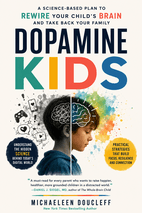
Dopamine Kids by Michaeleen Doucleff Book Cover

by Michaeleen Doucleff

Michaeleen Doucleff's Dopamine Kids reveals why children crave screens and ultraprocessed foods despite feeling miserable afterward, dismantling the pleasure-center myth and exposing the neuroscience of wanting versus liking. Written for parents trapped in daily battles, it offers a science-based path beyond willpower toward environmental changes that restore genuine satisfaction.

On Insta.page you also get an Apply This Book tool that lets you combine insights from up to 3 books to solve your specific situation.

Chapter mindmaps

Free preview: chapters 1–4 are fully interactive. Click any node to expand or collapse. Subscribe to unlock the rest.

Chapter 1: But She Loves It So Much

Key concepts: Chapter 1: But She Loves It So Much

Chapter 1: But She Loves It So Much

The Dismount Problem

  • Rosy's screen time ends in nightly tantrums
  • Begging and trance misread as love
  • Ending sessions triggers rage, not sadness

The 1954 Pleasure Center Mistake

  • Olds found rats self-stimulate electrodes obsessively
  • Dopamine wrongly labeled the molecule of pleasure
  • Canon persisted into the 1980s

Dopamine Encodes Wanting, Not Liking

  • Berridge blocked dopamine; rats still enjoyed sugar
  • Super-dopamine rats overate but showed no pleasure
  • Dopamine drives desire and motivation, not joy

Rosy Reframed as Wanting Loop

  • Show's cliffhangers spike dopamine periodically
  • Abrupt stop triggers thwarted wanting, not lost pleasure
  • Tantrums are failed dismounts from desire loop
  • Pattern mirrors addiction to wine, shopping, porn

Family Dream List as Replacement

  • Removing habits requires identifying replacements
  • List pairs values with concrete behaviors
  • Posted on fridge as daily reminder
  • Aligned activities become high-value hobbies

Values into Specific Behaviors

  • Values cannot be scheduled; actions must be named
  • Commit to cooking one meal weekly, eating together daily
  • Children help fill list; they desire what they've experienced
  • Repeated exposure builds wanting

Seven Fundamental Needs

  • Dopamine circuitry drives children toward needs
  • Products fake satisfying needs but block them
  • Research across cultures and 100+ experts
  • Each mini-chapter covers one overlooked need

Chapter 2: What’s Missing in Our Lives?

Key concepts: Chapter 2: What’s Missing in Our Lives?

Chapter 2: What’s Missing in Our Lives?

The Wanting-Liking Gap

  • Wanting and enjoying are not the same experience
  • Dopamine drives wanting; hedonic hotspots drive liking
  • Gap between them causes dissatisfaction
  • Random rewards intensify wanting, not liking

Sign Tracking and Dullness

  • Chasing signs instead of rewards
  • Aah neurotransmitters never released
  • World becomes dull and gray
  • Problem is too little pleasure, not too much

The Boredom Mistake

  • Replacing screens with nothing creates boredom
  • Boredom correlates with depression and unhealthy eating
  • Strategy is backwards, says neuroscientist Gola
  • Tolerating pauses comes easier with satisfying hobbies

The Real Reward

  • Answer is more excitement, not less
  • Real reward: caught wave, adrenaline run, savored meal
  • Nobody wants less pleasure, especially children
  • Void reinforces cravings you hoped to extinguish

Work We Choose and Redirection

  • People enjoy hard, voluntary tasks (Csikszentmihalyi)
  • Baking slows want-reward loop, adds five satisfactions
  • Effortful activities cannot become addictive
  • Redirect existing drive toward related quality activity

Eudaimonia and Purpose

  • Well-being depends on doing what matters to others
  • Even toddlers desire to help
  • Purpose buffers teens against social media pull
  • Protects children from anxiety and depression

Counterfeit Purpose and Task Rabbits

  • Video game missions are counterfeit purpose
  • No real person helped, no lasting skill gained
  • Treat children as soon-to-be competent contributors
  • Train child as task rabbit for autonomy and purpose

Chapter 3: The Most Addictive Screen on Earth

Key concepts: Chapter 3: The Most Addictive Screen on Earth

Chapter 3: The Most Addictive Screen on Earth

The Machine Zone

  • Gamblers skip meals, bathroom breaks, even soil chairs
  • Video poker replaced tables, generating 70-90% of casino revenue
  • Players lose track of time and stop wanting to win
  • Schüll's research tracked the trance-like state

Persuasive Design

  • Fogg's 2002 book argued computers exploit fundamental needs
  • Promises of belonging, adventure, and progress drive engagement
  • Machines act like Skinner boxes with prompts and rewards
  • Tech giants ran massive experiments to maximize screen time

No Oath for Technology

  • Tristan Harris asked if engineers felt uneasy at Habit Summit
  • Medicine has the Hippocratic oath; tech has nothing comparable
  • Facebook kept users 'sucked in' for twenty minutes
  • Even experts like Harris couldn't resist the tricks

Children as Vulnerable

  • Fogg flagged children as the most obvious vulnerable group
  • Kids lack brain circuitry to escape reward-chasing loops
  • States sued Meta and TikTok over addictive features
  • TikTok's child limit cut usage by under 1 percent

The Parent Counterfact

  • Parents can aim habit science at healthy routines
  • AI supercomputers calculate perfect videos from user behavior
  • Teenagers still ask for help, therapist Bob Keane noted
  • Parents hold more power than corporations

The Dolphin, Not the Crab

  • Align habits with child's desires, not forced activities
  • Forced activities produce a sluggish 'crab'; aligned ones, a 'dolphin'
  • Micro-celebrations wire habits quickly
  • Art room example: celebration made drawing a permanent habit

Offline Planning and Touch

  • Offline planning channels screen energy into drafts and construction
  • Gaming correlates with loneliness; online friends can't replace touch
  • Roughhousing bonds families and wires nervous systems
  • Skin neurons release dopamine with soft caress; virtual friends can't

Chapter 4: The App Builder’s Recipe for Addiction

Key concepts: Chapter 4: The App Builder’s Recipe for Addiction

Chapter 4: The App Builder’s Recipe for Addiction

The Problem: Apps vs. Human Flourishing

  • Parents can't judge which designs grip hardest
  • Need a standard separating harmful hooks from fun
  • Schüll's slot machine research applied to apps
  • Loot boxes found in 60% of top iPhone games

The Four-Ingredient Addiction Recipe

  • Solitude: screens replace social interaction
  • Bottomless nonclosure: no natural stopping point
  • Speed: faster cycles extend play time
  • Big promises, withheld rewards: false wins and near misses

Negative Emotion and Pseudo-Rewards

  • Wheel weighted toward fear, disappointment, negativity
  • Bad mood lingers after screen time
  • Apps promise friendship, purpose, mastery they can't deliver
  • Pseudo-rewards are hollow shadows of real experience

Sign Tracking and the 3Ps Antidote

  • Sign trackers chase cues of reward, not reward itself
  • Keep activities that leave you satisfied, not craving
  • 3Ps: price, people, purpose as antidotes
  • Visible end results help break craving loops

Price: Adding Cost to Screen Time

  • Rosy's movie binge required written summaries
  • Price added belonging and accomplishment
  • Habit broke without tantrums
  • Cost slows the wanting loop

People: Restoring Human Connection

  • Apps grip hardest in solitude
  • Bright-line rule: no exceptions allowed
  • Dessert only when friends came for dinner
  • Rules should start tiny and clear

Purpose: The Most Important Antidote

  • Name purpose before opening any app
  • Define fulfilling videos, then create something
  • Teens: identify goal, write rule, celebrate to habituate
  • Swap shallow screen activity for offline equivalent
You've reached the end of the free mindmaps

Next chapter: “Chapter 5: Phone Noise and Phantom Limbs” is locked

See every chapter of Dopamine Kids as an interactive mindmap — and unlock all 500+ book summaries with audio and AI Q&A.

$0.00 due today · 7 days free, then $89.99/year ($7.49/mo) · Cancel anytime before day 7

Continue exploring Dopamine Kids