Deuce Themes
by Kimberly Brown
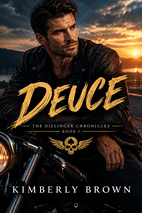
Underneath its plot, Deuce is really wrestling with how loyalty, protection, and retribution get tangled up with control and secrecy. The Dillingers call violence justice, hide danger behind respectable surfaces, and let attraction, threat, and trauma bleed into Salima's relationships.
Here you'll find family loyalty through violent protection, induction, and collective retaliation; vigilante killings framed as punishment for abusers, traffickers, and corrupt figures; Deuce's control through guns, money, orders, and claims on Salima; danger hidden behind the club's locked door and charity benefit, plus selective truth; attraction mixed with danger and distrust; and Salima's nightmares after the Aura raid and kidnapping. Symbols include the Dillinger crest and motto, that rusted steel door, finger snapping, and the Dillinger Foundation.
Major Themes in Deuce
Family loyalty and protection
The Dillingers define loyalty through violent protection, induction rituals, and collective retaliation against anyone who harms one of their own. Deuce's pursuit of Salima also becomes a family matter as his relatives help furnish her apartment and later rally for her rescue. Salima's care for her mother and Shar's ride-or-die friendship extend the theme beyond blood family.
- Deuce interrogates and stabs Jeremih, reveals that Mia is his sister, and lets Mia kill him after Jeremih abused her.
- Pops inducts Mia with a family crest chain, a gold beretta, and house keys, praising her first kill.
- After Salima's abduction, Deuce's family gathers in the warehouse, he says Salima is his woman and Y'all are family, and they launch the raid to bring her home.
Vigilante justice and retribution
The book repeatedly frames killing as moral punishment for abusers, traffickers, and corrupt figures, while also showing the family's comfort with violence. Deuce presents himself as an executioner of those he judges deserving, and the narrative links his crimes to protection of victims. Retribution also expands to corrupt officials and business enemies.
- The masked man and his crew kill the men at the club, and an officer tells Salima the dead men were bad and deserved what they got.
- Deuce and Maceo confront, restrain, torture, and kill Jasper Stark over his trafficking of underage girls, with Deuce injecting him with taipan venom.
- Deuce forces Judge Willis to confess and write a suicide note, later kills Pearson and Mirron, and Jaeda plants evidence that they fled the country.
Power, control, and possessiveness
Deuce exercises control through guns, money, orders, and public claims of ownership, especially toward Salima. Salima resists being ordered around and insists on independence, but the relationship repeatedly returns to Deuce's terms. The same pattern appears in the family's criminal hierarchy and in Deuce's public displays.
- Deuce takes Salima's phone to call himself, erases the call so she cannot block him, and tells her to answer when he calls.
- Deuce stands armed at the pool table to keep other men from looking at Salima and later fingers her in public until she climaxes.
- Stanley tells Salima she is his point, blank, and the fucking period and threatens to murk any other man who comes near her.
- Deuce refuses Salima's attempt to break up, saying she cannot get rid of him.
Secrecy, hidden danger, and selective truth
The story repeatedly shows danger hidden behind respectable surfaces, from the club's locked door to the family's philanthropy and criminal business. Characters also practice selective truth with loved ones, hiding money, guns, pasts, and violent plans. Secrets eventually surface and reshape relationships.
- Boss warns Salima that the locked rusted steel door is off limits, and Sweets says Boss offers discreet services to select patrons that she suspects are drugs.
- Salima lies to her mother that Deuce only returned her lost ID and hides both the gun incident and the $10,000.
- Deuce tells Jasper that what is done in the dark will come to the light and leaves the file for Jasper's family to find.
- Mrs. Navarro reveals that Iman Navarro was Blake Dillinger's right-hand and that Blake paid his medical bills.
Attraction mixed with danger and distrust
Salima is drawn to Deuce even while recognizing his violence, control, and criminal reputation. Their relationship develops through confrontations, boundary pushing, and acts of care that make distrust and desire coexist. The notes repeatedly frame danger itself as part of the attraction.
- Salima calls Deuce an arrogant, gun pointing asshole but admits she would not mind running into his fine ass again.
- After Deuce takes her phone and commands her to answer, Salima is furious but admits her panties were instantly ruined and wonders why there is thrill in danger.
- At Pico's, Salima says Deuce oversteps like a muthafucka and wants a man who can be soft, while Deuce says he likes her fire and kisses her despite her threat to slap him.
Trauma and its aftermath
Violence leaves lasting fear and psychological damage, especially for Salima after the Aura raid and her kidnapping. The book shows her nightmares, inability to eat, avoidance of therapy, and fear for Deuce's safety. The trauma of the trafficked children is also explicitly acknowledged.
- Salima pleads that she is somebody's daughter at gunpoint, and later an officer says the children will never be the same.
- After her kidnapping, Salima replays the blood, gunshots, and the kickback of the gun, and she cannot eat or face Deuce without reliving that night.
- Salima has headaches, vomiting, fatigue, and nightmares, but refuses to see a doctor or therapist because she does not want to relive being kidnapped.
- Salima says Deuce being far away terrifies her now that they have Darlyn, and she hugs him a little longer and tighter after jobs.
Symbols and Motifs
Dillinger family crest and motto
The crest chain marks induction into the family and its criminal legacy, while the motto turns revenge into a formal code of justice.
- Pops inducts Mia with a family crest chain, a gold beretta, and house keys.
- The family crest motto reads: Revenge is an act of passion; vengeance is an act of justice.
The locked rusted steel door at Aura
It represents the hidden exploitation and secrecy beneath the club's public surface, especially the trafficking of children.
- Boss tours Salima and warns her that a locked rusted steel door is off limits.
- When the power goes out and armed men order people out, Salima hides behind the previously locked door.
- The masked man locks Salima in a room with about thirty children, who say men pay to be with them.
Finger snapping
It functions as a family signal for order, control, and communication, often used to stop conflict or command attention.
- Jaeda snaps her fingers to stop Deuce and Salima from arguing and explains the family's finger-snapping habit.
- Mia stands defensively until Jaeda snaps her fingers and she sits back down.
- Samir snaps her fingers and agrees with Salima's statement about men.
The Dillinger Foundation and charity benefit
They symbolize the family's dual nature, showing public philanthropy and community respect alongside criminal violence and retribution.
- Salima researches the Dillinger Foundation and finds evidence of the family's community work.
- Deuce reflects that his family does philanthropy while also using violence and illegal dealings.
- The Dillinger Foundation benefit raises money for families of children from the pedophile ring while Deuce plans to kill Detective Pearson and his father.