Design Love In Quotes
by Marcus Buckingham
As an Amazon Associate, we earn from qualifying purchases.
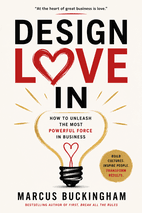
The quotes below come from Marcus Buckingham's book Design Love In, a guide to creating experiences that foster deep commitment and engagement. You will find lines that challenge conventional management thinking, celebrate individuality, and redefine what it means to lead. Each quote distills a core insight about how to design for human flourishing.
What makes this book so quotable is its blend of research, real world examples, and sharp observation. The ideas are both simple and profound, often turning familiar assumptions upside down. Whether you are a manager, teacher, or entrepreneur, these quotes offer memorable takeaways you can apply immediately.
Top Quotes from Design Love In
“While so many corporate systems, when laid bare, were designed to grind uniqueness down and make each person conform, the best managers in the world rejected this notion.”
The author contrasts the dehumanizing tendency of corporate systems with the countercultural approach of great managers.
It starkly names the systemic pressure to homogenize people, making the manager's role a defiant act of humanity—a memorable call to resist that pressure.
“Love is... the deep and unwavering commitment to the flourishing of a human.”
The author defines love as used throughout the book.
This concise definition reframes love as an active, moral force, giving readers a powerful lens for evaluating experiences.
“We are relentlessly and mildly crushed by a world that doesn’t want us, or even need us, to be us.”
Describing the chronic stress and alienation of modern life.
It captures the pervasive sense of dehumanization many feel, making the reader feel seen and understood.
“The people are the point; the work is the instrument.”
Contrasting with the American Management Association's old slogan.
This inverted slogan is memorable and challenges the instrumental view of people in organizations.
“To get people to do what you want them to do, you first have to get them to feel what you want them to feel.”
The author explains why creating specific feelings is essential for leaders to influence others productively.
This concise principle reframes leadership from action-driven to emotion-driven, offering a powerful and actionable insight for anyone seeking to motivate people.
“No touchpoint is neutral. No touchpoint leaves you at zero. Each one draws you ina little bit toward love in your heart for the experience, or it repels you.”
The author explaining the MET (Maximize Every Touchpoint) tool.
It powerfully illustrates that every interaction has a cumulative impact, urging leaders to design every detail intentionally rather than leaving it to chance.
“They said with their clapping: We see you. You mattered here. You still matter.”
Author interprets the meaning of the clapping from coworkers lining the hallways.
Simple and direct, this affirmation of human worth cuts through corporate numbness and reminds us that acknowledgment is a form of love.
Themes Behind the Quotes
One central theme is the radical embrace of individual uniqueness. The best managers reject conformity and instead build systems that let each person's strengths shine. Another theme is the power of experiences to shape behavior and outcomes. Every interaction, or touchpoint, either draws people in or pushes them away, so leaders must deliberately design for positive emotions.
A third theme redefines love as a deep commitment to helping others flourish, not as sentimentality. This requires clarity, authenticity, and the courage to stand against practices that make people feel small. Ultimately, the book calls for a shift from controlling people to crafting experiences that make them feel seen and valued.
Quotes by Chapter
Introduction: What Now Must Leaders Do?
“The best managers in the world saw each person as unique, and all their strategies were, fundamentally, an effort to capitalize on this uniqueness.”
The author reflects on the core finding from his earlier research on great managers.
This line captures the radical insight that exceptional leadership is about embracing individuality, not enforcing conformity, which is both inspiring and actionable.
“Leadership is the craft of shaping the experiences that shape human behavior.”
The author introduces his reframed definition of leadership as experience-making.
This concise, powerful statement redefines leadership from directive to experiential, offering a new lens that is both profound and practical for anyone in a leadership role.
“He is an experience-maker who has mastered the deliberate design of the most powerful force in business.”
The author describes Josh, the leader he observed, after witnessing his interactions with employees and customers.
It encapsulates the book's central thesis—that love can be intentionally designed—and inspires leaders to see their work as the deliberate creation of deep connection.
1: Experiences Drive Behaviors Drive Outcomes
“Intuitively you understand this sequence: experiences drive behaviors drive outcomes.”
The author states this as a core premise of the chapter.
It succinctly captures the book's central thesis, making it memorable and actionable for leaders.
“When it comes to experiences—yours, your team’s, your students’, your customers’, your patients’—4s are not 5s.”
The author challenges the common assumption that 4s and 5s are similar.
This highlights that only extreme positive experiences (5s) drive significant outcomes, not above-average ones.
“If you want extreme positive outcomes, you need to create extreme positive experiences.”
The author summarizes the data-driven conclusion from research.
It provides a clear, direct directive for leaders seeking high performance and loyalty.
“Your 5s are the very things that make your life's journey worthwhile.”
The author reflects on the personal meaning of 5-star experiences.
It personalizes the concept, making it relatable and inspiring readers to identify their own 5s.
2: Loving versus Unloving
“Loving experiences make you feel bigger. Unloving experiences make you feel smaller.”
Introducing the DLI lens for evaluating experiences.
Provides a simple, actionable framework that empowers readers to identify and seek loving experiences.
3: The Five Feelings of Love
“White light, he discovered, wasn't mysteriously monolithic. It was constructed from the combination of the frequencies of the other colors. As with light, so with love.”
The author uses Newton's prism experiment to introduce the idea that love can be broken down into distinct components.
This elegant metaphor makes a complex psychological concept instantly understandable and memorable, framing the entire chapter's approach.
“The very best at anything involving other humans live in a world of “It depends.””
The author describes how top doctors, teachers, and leaders tailor their approach to each individual's unique story.
This pithy statement captures the essence of personalization and significance, challenging one-size-fits-all thinking and resonating with anyone who values individual care.
“Clarify your world so that you no longer feel disoriented and helpless. Give you control of your surroundings, your direction, your tools. This is the first sign of love.”
The author describes the feeling of control as the first ingredient of love in an experience.
It vividly describes the proactive role of a leader in providing clarity and agency, making an abstract concept concrete and actionable for designing loving experiences.
5: Design Love In for Your Customers
“The only surefire way to excel as a leader is to excel as a maker of experiences for your people.”
The author argues that traditional competency lists are invalid, and instead leadership success comes from designing experiences.
This line reframes leadership from a set of skills to a creative, relational practice—making it accessible and actionable for any leader.
“Authenticity in the leader breeds confidence in the followers. Because authenticity is the cousin of predictability. And predictability is the foundation of followership.”
The author explains why leaders who are authentic and self-aware inspire trust and enable others to follow them into the unknown.
It reveals a simple causal chain that demystifies how leaders earn followership, turning abstract authenticity into a concrete mechanism of confidence-building.
“You can never love something too much: as the research reveals, the more vivid your loves are, the more engagement you'll create in your people.”
The author debunks the myth that strengths become weaknesses when overused, citing data linking vivid passions to higher team engagement.
This liberates leaders from the fear of being 'too much' and encourages them to double down on what they uniquely love, which paradoxically draws others in.
“Love in the heart of someone else is kindled by the flames of your own loves—for specific activities, for deeply held beliefs, for repeatable customs.”
After describing how Josh D'Amaro built his ABCs (Attitudes, Beliefs, Customs) and the 'Josh Effect'.
This line captures the central metaphor of the book—that genuine love and passion in a leader naturally ignite the same in others.
6: The Three Disciplines to Design Love In
“Since love is the deep and unwavering commitment to the flourishing of a human, the human's flourishing is the moral starting point and ending purpose for everything.”
The author defines love as a foundational concept for designing experiences.
This line crisply defines love in a business context, shifting from emotion to a moral commitment, making it both actionable and profound for leaders.
“When you mandate love into a touchpoint, you get from us the opposite of love. You get suspicion and all the negative behaviors that come with it.”
The author warns against forcing loving behaviors, using Starbucks' cup-writing mandate as an example.
It highlights the paradox that forced authenticity backfires, a crucial insight for anyone trying to implement genuine experience design.
“Designing love in means first designing noise out.”
During the 'Walk the Stage' discipline, the author emphasizes removing clutter before adding anything new.
Simple and actionable, this line encapsulates a key principle: simplification is an act of love that clears the way for genuine connection.
“The truth about love—and the key to designing it in to experiences—is that clarity is loving.”
The author concludes that clarity gives customers control, the first step toward love.
This aphoristic statement ties together love, design, and clarity, offering a memorable takeaway for leaders seeking to create meaningful experiences.
7: Your Road to DLI Mastery
“So many things become obvious once you start thinking about the person actually going through the experience.”
Arin McClune reflecting on redesigning maternal health experiences at Blue Cross Blue Shield.
This quote highlights how shifting focus to the user's perspective reveals simple yet transformative improvements, a core insight of DLI.
“Genuine intent is a scarce, and for us humans, a very valuable resource: getting the best ROI requires careful design.”
The author comparing Disney's hugging rule to Starbucks' coffee-cup scribble tactic.
It succinctly argues that authenticity, not just action, drives emotional connection and that genuine intent must be deliberately designed.
“Walk the stage, pinpoint your MMOs, use the five feelings as your creative blueprint, and you too will come up with activations that lead to more love in the experiences, and the better outcomes that follow.”
The author summarizing the MMO (Major Missed Opportunities) tool and its application.
This concise action plan encapsulates the chapter's practical wisdom, motivating readers to apply the DLI framework for tangible results.
Epilogue: A Stand in the Hallways
“It was a stand against resignation. Against disposability. Against the idea that it’s acceptable for coworkers to be erased quietly and cleanly, like rounding errors.”
Author describes the spontaneous applause by State Department employees as laid-off colleagues exited the building.
This line captures the moral rejection of treating people as disposable, making a powerful case for seeing coworkers as humans rather than costs.