Deep Work Quotes
by Cal Newport
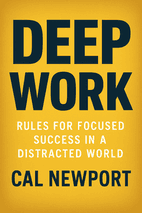
This collection gathers the most memorable lines from Cal Newport's book on focused work. You will find sharp observations about attention, willpower, and the traps of modern distraction. Newport's writing sticks with you because it blends honest critique with actionable insight. His quotes often cut through the noise of productivity culture, making them easy to share and reflect on. Whether you are a knowledge worker or a creative, these passages offer a clear lens to rethink how you spend your time and energy.
Top Quotes from Deep Work
“The key question will be: are you good at working with intelligent machines or not?”
Economist Tyler Cowen summarizes the challenge for workers in the new economy.
This direct, provocative question encapsulates the central economic divide, forcing readers to confront whether they have the skills to thrive alongside technology.
“To learn hard things quickly, you must focus intensely without distraction.”
The author synthesizes research on deliberate practice and myelination to state a core principle.
It is a clear, actionable takeaway that directly links deep concentration to the ability to acquire valuable skills in a fast-changing economy.
“Who you are, what you think, feel, and do, what you love—is the sum of what you focus on.”
Science writer Winifred Gallagher summarizes her research on attention in her book Rapt.
This line captures the core insight that our identity and happiness are shaped by what we choose to attend to, a powerful reframing of how we view our daily choices.
“You don't need a rarified job; you need instead a rarified approach to your work.”
The author refutes the idea that only certain jobs are meaningful, emphasizing approach over job title.
It empowers knowledge workers by shifting focus from external job status to internal dedication, making meaning accessible to anyone.
“The ability to concentrate intensely is a skill that must be trained.”
The author summarizes the key insight from Adam Marlin's experience.
This succinct statement reframes focus as a learnable ability rather than a fixed trait, motivating readers to deliberately practice concentration.
“People who multitask all the time can’t filter out irrelevancy. They can’t manage a working memory. They're chronically distracted. They initiate much larger parts of their brain that are irrelevant to the task at hand... they're pretty much mental wrecks.”
Stanford professor Clifford Nass summarizes his research findings on chronic multitaskers in a 2010 NPR interview.
The vivid, blunt language makes the cognitive damage of constant distraction unforgettable, serving as a stark warning against the allure of multitasking.
“To master the art of deep work, therefore, you must take back control of your time and attention from the many diversions that attempt to steal them.”
The author sums up the necessity of reclaiming focus after describing Baratunde Thurston's experiment.
This line encapsulates the core demand of the book in a single actionable directive, making it a rallying cry for readers seeking to improve their concentration.
Themes Behind the Quotes
A central theme is the distinction between deep and shallow work. Deep work requires intense concentration on challenging tasks, while shallow work consists of low value distractions like email and meetings. Another theme is the fragility of willpower. Newport argues that focus is a limited resource that must be protected with routines and rituals, not left to good intentions. Burnout and mental fatigue come from constant multitasking, which fragments attention and reduces the quality of output. The book also criticizes the false equation of busyness with productivity. Instead, it champions the idea that true success comes from stretching your mental capacity to its limits during extended periods of uninterrupted effort. Ultimately, these quotes push you to reclaim control over your time and attention from the many diversions that compete for them.
Quotes by Chapter
Chapter 1: Deep Work Is Valuable
“Hearing a succession of mediocre singers does not add up to a single outstanding performance.”
Economist Sherwin Rosen uses this metaphor to explain why talent is not substitutable in winner-take-all markets.
The vivid, relatable imagery makes the economic concept of imperfect substitution instantly understandable and memorable.
“Let your mind become a lens, thanks to the converging rays of attention; let your soul be all intent on whatever it is that is established in your mind as a dominant, wholly absorbing idea.”
Dominican friar Antonin-Dalmace Sertillanges offers this advice on cultivating deep intellectual focus.
This poetic and powerful metaphor for concentrated attention beautifully captures the essence of deep work and its role in mastering complex ideas.
Chapter 2: Deep Work Is Rare
“Twitter is crack for media addicts. It scares me, not because I’m morally superior to it, but because I don’t think I could handle it. I'm afraid I'd end up letting my son go hungry.”
George Packer, a New Yorker staff writer, explaining why he does not use Twitter.
This quote memorably captures the addictive and distracting nature of social media, using a vivid metaphor and personal fear to illustrate its potential harm to deep work.
“The Principle of Least Resistance: In a business setting, without clear feedback on the impact of various behaviors to the bottom line, we will tend toward behaviors that are easiest in the moment.”
Cal Newport introducing the Principle of Least Resistance.
It succinctly explains a fundamental human tendency to choose the easiest path in the absence of metrics, which undermines the pursuit of deep work.
“Busyness as Proxy for Productivity: In the absence of clear indicators of what it means to be productive and valuable in their jobs, many knowledge workers turn back toward an industrial indicator of productivity: doing lots of stuff ina visible manner.”
Cal Newport's definition of the tendency to equate visible busyness with productivity.
This concept resonates because it identifies a common but misguided behavior in modern knowledge work, helping readers recognize counterproductive habits.
“Technopoly eliminates alternatives to itself in precisely the way Aldous Huxley outlined in Brave New World,” he argued in his 1993 book on the topic. “It does not make them illegal. It does not make them immoral. It does not even make them unpopular. It makes them invisible and therefore irrelevant.”
Neil Postman, a late communication theorist, warns about the dangers of a technopoly in his 1993 book.
This quote captures the insidious nature of technological ideology—it doesn't outright ban alternatives but renders them invisible, making it a powerful critique of how society now unquestioningly embraces all things Internet.
Chapter 3: Deep Work Is Meaningful
“The best moments usually occur when a person’s body or mind is stretched to its limits in a voluntary effort to accomplish something difficult and worthwhile.”
Psychologist Mihaly Csikszentmihalyi, describing the conditions for flow states based on his experience sampling method studies.
It articulates the counterintuitive truth that challenge and deep effort, not relaxation, lead to the most fulfilling experiences.
“A wooden wheel is not noble, but its shaping can be.”
The author argues that the meaning of work comes from the skillful process, not the mundane outcome.
This line succinctly captures the core philosophy of craftsmanship—that the act of shaping, not the product, provides meaning. It challenges readers to find nobility in their own work approach.
Rule #1: Work Deeply
“The goal of the machine,” David explained, “is to create a setting where the users can get into a state of deep human flourishing—creating work that's at the absolute extent of their personal abilities.”
Architecture professor David Dewane explains the purpose of the Eudaimonia Machine while sketching its layout.
This quote captures the aspirational essence of deep work—achieving full human potential through focused effort. It frames productivity as a path to flourishing, not just output.
“Your will, in other words, is not a manifestation of your character that you can deploy without limit; it's instead like a muscle that tires.”
The author summarizes Roy Baumeister's research on willpower depletion.
This vivid analogy makes the concept of limited willpower intuitive and memorable. It helps readers understand why relying on mere intention to work deeply is unsustainable.
“The key to developing a deep work habit is to move beyond good intentions and add routines and rituals to your working life designed to minimize the amount of your limited willpower necessary to transition into and maintain a state of unbroken concentration.”
The author introduces the core principle behind the strategies for cultivating deep work.
This sentence provides a practical, actionable framework for building a deep work routine. It shifts focus from motivation to systematic design, which is both empowering and realistic.
“If I organize my life in such a way that I get lots of long, consecutive, uninterrupted time-chunks, I can write novels.”
Neal Stephenson explains why he avoids correspondence to protect his productivity.
This quote succinctly reveals the non-linear relationship between uninterrupted time and creative output. It justifies radical choices like ignoring email by showing the direct payoff in meaningful work.
Rule #2: Embrace Boredom
“You cannot consider yourself as fulfilling this daily obligation unless you have stretched to the reaches of your mental capacity.”
The rabbi of Adam Marlin, a member of the Knesses Yisroel congregation, explains the requirement of daily Talmud study.
This line powerfully defines deep work as an obligation to push one's cognitive limits, making it a memorable standard for anyone seeking meaningful concentration.
“This consistent strain has built my mental muscle over years and years. This was not the goal when I started, but it is the effect.”
Adam Marlin describes the benefits he noticed in his professional life after years of daily Talmud study.
It encapsulates the idea that deep work is a long-term training process that yields unexpected dividends, resonating with anyone who has invested in a difficult practice.
Rule #3: Quit Social Media
“The notion that you would quit the Internet is, of course, an overstuffed straw man, infeasible for most (unless you're a journalist writing a piece about distraction).”
The author critiques the binary choice between quitting the internet and accepting distraction.
With sharp wit, it exposes the absurdity of the all-or-nothing mindset, freeing readers to pursue a more balanced middle ground.
“If you don't attempt to weigh pros against cons, but instead use any glimpse of some potential benefit as justification for unrestrained use of a tool, then you're unwittingly crippling your ability to succeed in the world of knowledge work.”
The author explains the harmful consequences of the any-benefit mindset toward network tools.
It powerfully reframes casual social media usage as a strategic liability, forcing readers to reckon with hidden costs they often ignore.
“There's a lot of communication in my life that’s not enriching, it's impoverishing.”
Author Michael Lewis explains why he avoids Twitter, prioritizing deep work over constant accessibility.
This stark, personal admission resonates with anyone who feels drained by endless digital chatter, validating the desire to say no.
Conclusion
“People should enjoy the weather in the summer.”
Jason Fried, cofounder of 37signals, in a blog post announcing the company's permanent four-day workweek from May through October.
This simple, human-centered statement reframes productivity as a balance between work and life, reminding us that time for enjoyment is not a luxury but a valid priority.
“You're lucky if you get a few good hours in between all the meetings, interruptions, web surfing, office politics, and personal business that permeate the typical workday.”
Jason Fried explains why reducing official working hours can actually increase productivity by cutting out shallow work.
It vividly captures the universal experience of a fragmented workday, making readers realize how little of their time is truly spent on meaningful, focused effort.
“The shallow work that increasingly dominates the time and attention of knowledge workers is less vital than it often seems in the moment.”
The author summarizes the lesson from 37signals' experiments about the overestimated importance of shallow tasks.
It delivers a sobering, counterintuitive truth that challenges our daily urgency, encouraging readers to reevaluate what truly matters in their work.
“What percentage of my time should be spent on shallow work?”
Newport suggests asking your boss this question to set a shallow work budget.
It's a simple but profound question that forces a direct confrontation with how much time is wasted on low-value tasks, making the abstract concept of shallow work measurable.