Deep Work Key Takeaways
by Cal Newport
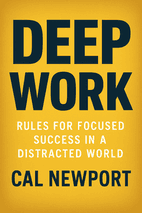
5 Main Takeaways from Deep Work
Schedule uninterrupted focus blocks to maximize productivity and quality.
By batching intense focus periods, like Adam Grant's method, you minimize distractions and attention residue, leading to higher output. This challenges the assumption that constant connectivity is necessary, proving depth enhances effectiveness in most professions.
Cultivate deep work as a rare skill to gain a competitive advantage.
In a culture obsessed with shallow activities, prioritizing deep work makes you stand out. As Newport argues, its scarcity in today's technopoly increases its value, allowing individuals to leverage it for personal and professional benefits.
Master concentration through structured practice and mental discipline.
Concentration is a skill that enables extraordinary productivity, as seen in Bill Gates's focus. Techniques like productive meditation and training attentional control through activities like card memorization boost your ability to work deeply.
Implement shutdown rituals and embrace boredom to sustain deep work.
Regular breaks and downtime recharge mental focus, while a shutdown ritual manages clutter for true relaxation. Embracing boredom by redirecting focus during idle moments strengthens your concentration muscle for more productive sessions.
Replace social media with structured leisure to enrich focus and life.
Planning leisure activities in advance prevents defaulting to social media habits. Structured hobbies, reading, and in-person socializing provide mental energy through engagement, reducing distractions and improving focus for deep work.
Executive Analysis
The five takeaways collectively form Newport's central thesis: deep work is a high-value, rare skill that can be cultivated through intentional habits to achieve extraordinary results in a distracted world. By scheduling focus, embracing boredom, and quitting social media, individuals transform productivity and find meaning, challenging modern work culture's emphasis on shallow connectivity.
This book matters because it provides an actionable blueprint for elite performance in knowledge work, blending productivity advice with cognitive science. For readers, it offers evidence-based strategies to combat distraction, promising not just increased output but also greater satisfaction by mastering focus in an age of constant interruption.
Chapter-by-Chapter Key Takeaways
Deep Work Is Valuable (Chapter 1)
Batching intense focus periods—like Adam Grant's method—boosts productivity by minimizing distractions and leveraging the intensity formula.
Attention residue from task-switching reduces performance, making uninterrupted deep work essential for quality output.
Exceptions exist for roles like executives, where distraction is inherent, but these are specific and not generalizable to most jobs.
Challenge assumptions about connectivity; many professions can benefit from incorporating more depth without compromising effectiveness.
Try this: Audit your work habits to identify and batch tasks requiring intense focus, challenging the assumption that constant connectivity is necessary for your role.
Deep Work Is Rare (Chapter 2)
Deep work is often sidelined by cultural pressures to engage in shallow, Internet-centric activities, even when these don't align with core job functions.
The "technopoly" mindset, fueled by Internet-centrism, promotes distraction over depth by making alternative approaches seem irrelevant.
Individuals can leverage this trend by prioritizing deep work, as its scarcity in today's environment enhances its value and personal benefits.
Try this: Resist cultural pressures toward shallow work by deliberately prioritizing deep work sessions, leveraging its scarcity for personal and professional gain.
Deep Work Is Meaningful (Chapter 3)
Email Management: Adopt a "don't respond" default for emails that are ambiguous, uninteresting, or inconsequential to reduce inbox overload and preserve focus.
Deep Work's Power: Concentration is a skill that enables extraordinary productivity, as demonstrated by historical and personal examples like Bill Gates and the author's academic achievements.
Personal Application: Strategies like scheduling deep work blocks, using isolated environments, and mentally engaging with problems during downtime can significantly boost output and meaning in professional and creative pursuits.
Try this: Implement a 'don't respond' default for low-value emails and schedule deep work blocks in isolated environments to cultivate your concentration skill.
Rule #1: Work Deeply (Chapter 4)
Downtime enables unconscious problem-solving, leading to better insights on complex issues.
Regular breaks recharge mental focus, essential for sustaining deep work.
Evening work is often low-value, so shutting down preserves energy for more important tasks.
A shutdown ritual manages mental clutter, ensuring true relaxation and improved productivity.
Try this: Establish a daily shutdown ritual to clear mental clutter and schedule regular breaks to recharge, preserving energy for high-value deep work tasks.
Next chapter: “Rule #2: Embrace Boredom” is locked
Keep learning from Deep Work — and unlock all 600+ book summaries with audio, mindmaps and AI Q&A.
$0.00 due today · 7 days free, then $89.99/year ($7.49/mo) · Cancel anytime before day 7
plus sales tax where applicable