Deep Listening Key Takeaways
by Emily Kasriel
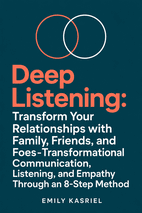
5 Main Takeaways from Deep Listening
**Safety and self-awareness come before good listening always**
Deep listening begins before the first question: choose privacy and enough time, let the speaker set the agenda, and steady your own mood, memories, and scripts. Without those conditions, people hear dismissal before they hear curiosity and keep the important material back.
**Name the listening trap and choose a new move**
Kasriel names traps such as scanning for a comeback, rushing to fix, correcting from expertise, and equating attention with submission. Catch the pattern as it runs, ask whether the person wants comfort, a plan, or silence, and treat your first judgment as a guess rather than a verdict.
**Hold silence and warm gaze to reach what's deeper**
Wait three to ten seconds after someone stops, keep your eyes soft rather than staring, and use nods or small sounds to stay on the same thought. Silence and steady gaze are not empty; they are where half-finished sentences, underlying dread, and more honest accounts form.
**Treat your interpretation as a draft, never a verdict**
Offer your reading of someone's meaning as a draft they can confirm or correct, and revise it when irritation, retreat, or small talk signals a miss. Reflect a rejected view in its own terms and make room for pain before reassurance, especially when you hold more power.
**Practice ethical listening with clear limits and review**
Explain confidentiality, reporting duties, and scope before sensitive conversations; stop if someone overshares; and let safety outrank secrecy when harm is possible. Protect solitude, decide your capacity in advance, review encounters with feedback, and carry the practice into disagreements.
Executive Analysis
Kasriel’s central argument is that deep listening is not a passive courtesy or a trick for winning agreement but a trainable relational discipline. The five takeaways trace a sequence: create safety and self-awareness, spot the traps that hijack attention, use silence and gaze to make room, reflect tentative understanding rather than fixed verdicts, and practice ethically within clear limits. Together these move listening from a personality trait to a repeatable capacity that bends to the conversation—whether with family, colleagues, opponents, or strangers.
The book matters because it treats attention as consequential: people withhold what matters until they feel recognized, and a single well-listened conversation can defuse conflict, improve decisions, and preserve relationships even when positions do not move. It sits usefully between communication self-help, leadership practice, and conflict-resolution literature, offering concrete steps alongside reflective exercises. Its practical promise is not that you will always agree, but that you can become safer to talk to, more curious under pressure, and more honest about the ethical limits of what you can hear.
Chapter-by-Chapter Key Takeaways
Introduction (Introduction)
Listening the way Mandela did can defuse a confrontation without granting a single demand; an hour of genuine attention did more than any podium speech.
The strain in families, workplaces and public argument comes more from a failure to invest in hearing others than from a shortage of opinions.
People often hold back what matters to them because they expect to be dismissed, so feeling recognized, not agreed with, is what reopens the channel.
Believing listening is pointless when you are sure you are right turns disagreement into avoidance or shouting, and it quietly drives people further apart.
Try this: Recognize that withheld concerns often reflect anticipated dismissal, then offer genuine, non-agreeing attention before you argue or demand; even one hour of feeling heard can defuse a confrontation more than a speech.
What Is Deep Listening? (Chapter 1)
Set up the conditions before the conversation. Let the other person set the agenda, find privacy, and allow enough time for attention to settle. The room and the pace shape what can be said.
Start with your own state. Then bring steady attention, curiosity and eye contact to help the speaker feel safe. Don’t treat these as boxes to tick.
Wait through silence. Reflect back the emotional core before asking the next question. Summaries can help the speaker find thoughts they hadn’t formed yet.
Leave room for what’s unsaid and for your own reactions. Accept that you’ll meet this unevenly. It’s not a persona to perform.
Try this: Set the conditions before speaking—let the speaker set the agenda, choose privacy, and allow time—then steady yourself, wait through silence, reflect the emotional core, and leave room for what is unsaid.
Why We’re Not Listening – Eight Traps That Catch Us Out (Chapter 2)
Catch the pattern as it runs: if you are scanning for a comeback, explaining instead of hearing, correcting from expertise, rushing to a fix, or treating attention as submission, name it and choose a different move.
Before you answer a problem, ask what kind of support the person wants: comfort, a plan, or silence. Handing that choice back keeps the problem theirs.
Separate giving attention from agreeing or obeying. You can listen fully without giving up a point or surrendering authority, and saying so plainly can make you safer to talk to.
Check the scripts you carry about gender and seniority. They can make you expect submission from some speakers and dominance from others, and either expectation costs you information.
Treat your first judgment as a guess, not a verdict. Stay curious long enough for the person in front of you to contradict the label.
Try this: Name the trap in the moment—scanning for a comeback, fixing, correcting, or treating attention as submission—then ask what support the person wants and treat your first judgment as a guess, not a verdict.
How Deep Listening Will Enrich Your Life (Chapter 3)
Agree on clear listening rules with someone you disagree with: stay in the moment, stay curious, paraphrase what matters most to them, and hold your interruptions. That structure can preserve the relationship even when neither position moves.
Treat listening as a trainable skill rather than a fixed trait. Short structured practice can produce measurable gains in connection, openness, and even business performance.
If you lead, invite others to speak before you state your own view. The group may find a better method, and people who feel heard contribute more.
Listen without waiting for the favor to be returned. Caring too much about what listening will get you pulls your attention off the speaker and weakens the relationship you are trying to build.
Expect good listening to change the story you hear. Speakers who feel deeply attended to share more honest and useful accounts, which strengthens trust and improves decisions.
Try this: Agree on listening rules with someone you disagree with, practice the skill rather than waiting for talent, invite others to speak before you do, and listen without keeping score of what it gets you.
Step One: Create Space (Chapter 5)
People won't open up on command — the setting has to feel safe first, and a familiar place often works better than an official one.
Small signals matter: people judge a space in a fraction of a second, so agree on time, privacy, and purpose up front.
Room layout, light, and sound all shape a conversation — even seating angle and distance can help or hurt.
Treating each meeting as one that won't happen again (ichigo ichie) turns small acts of care into real openings.
Gentle surroundings, a shared walk, and room to play with ideas all help people speak freely — and you have to clear your own head before you can truly listen.
Try this: Create a safe space deliberately by agreeing on time, privacy and purpose, choosing familiar and gentle surroundings, clearing your own head, and treating each meeting as a one-time encounter.
Step Two: Listen to Yourself First (Chapter 6)
Before you try to listen to anyone else, locate your own mood, memories and agenda, because whatever stays unconscious in you will take over your attention and turn curiosity into judgment.
When someone makes you feel small, angry or absolutely certain you are right, ask whether you are reacting to them or to an old family role, then deliberately return yourself to the present.
Give the frightened or defensive part of yourself a private hearing: ask what it is protecting, thank it, and negotiate with it rather than trying to silence it, so it stops taking over the conversation.
If grief or fear from your own life surfaces mid-conversation, say so, step away to feel it fully, and come back only once you can hear the other person again.
Where trauma or overwhelming emotion could make this inner work unsafe, do it with a therapist or counsellor and keep a simple steadying anchor ready for turbulent moments.
Try this: Locate your own mood, memories and agenda before listening; when strong reactions arise, check whether an old family role is speaking, give that defensive part a private hearing, and return to the present.
Step Three: Be Present (Chapter 7)
Let thoughts and feelings come and go, and rest in the calm underneath instead of straining to clear your mind.
Practice your centering method in everyday moments, so the skill feels familiar before the stakes rise.
Ask whether the speaker's words or tone have touched something uncomfortable, and separate that from a real call on your attention, like a child who needs you.
Name your intention before you listen, and decide whether you are there to win the point or to care for the relationship.
A wandering mind takes something from the speaker too. A half-attended story arrives thinner and less clear, and a phone kept in view signals disagreement even in silence.
Try this: State your intention—relationship over winning—and practice centering in calm moments so that when the speaker's tone touches a sore spot, you can let thoughts pass and keep your attention on them.
Step Four: Be Curious (Chapter 8)
Treat the other person's view as something you cannot predict from your own, so the conversation becomes an encounter with their world instead of a rehearsal of yours.
When a judgement surfaces mid-listen, notice it, hold it for a moment, then set it down; striving to have no critical faculties at all reads as blame and leaves people defensive.
Ask the people you meet what they would be curious about in your position, and let their answer redirect your questions rather than following your prepared list.
Declare your standpoint plainly, then set your own aim aside long enough to hear the other out, since goals of this kind tend to arrive by an indirect route and not by pressing for them.
Give respect to the person rather than to their record or opinions, and budget patience for anyone working harder than you to say what they mean; Hasson's brain imaging shows listeners' activity coming to mirror a storyteller's, most strongly where understanding runs deepest, so feeling heard is a measurable event and not just a courtesy.
Try this: Treat the other person's view as unpredictable, hold judgments lightly, ask what they would be curious about in your position, and respect the person while budgeting patience for anyone struggling to speak.
Step Five: Hold the Gaze (Chapter 9)
Let your eyes go soft and stay warm rather than lock into a stare, because people will not hand over a fear they sense you cannot hold.
Follow the rhythm of looking away and back: when the speaker returns to your eyes, answer with a nod or a small sound so the two of you stay fixed on the same thought.
Sit at the speaker's level, mirror their posture, and let a genuine smile through, since a smiling listener draws out more than bare facts.
Trust tone over face: ask what the speaker's tone stirs in you before deciding your next move, and read gestures and nervous habits as unreliable rather than as signs of lying.
Give your own gaze and body only light attention, drop self-judgement, and hold your hunches until the speaker has had room to finish and the quiet has settled.
Try this: Soften your gaze, sit at the speaker's level, follow the rhythm of looking away and back, and trust tone over facial gestures while dropping self-judgment about how you look.
Step Six: Hold the Silence (Chapter 10)
When a confession stirs outrage in you, withhold both condemnation and comfort until the whole account is out; the room you leave is what allows the other person to reach honesty on their own.
Wait three to ten seconds after the speaker stops, holding a warm gaze instead of filling the gap, and treat that gap as the place where their next thought forms.
Use the pause to check whether your attention has slid from what is being said to who is saying it, and to step back from matters that felt close and personal a moment ago.
Own the arrogance inside every interruption, which assumes your next question deserves more room than anything the speaker might still say.
Offer quiet deliberately, carrying curiosity, respect and acceptance of the person even where you reject their views, and shorten it for anyone who experiences silence as withdrawal.
Try this: Wait three to ten seconds after the speaker stops, withhold both condemnation and comfort during a confession, and treat every interruption as arrogance so the next thought has room to form.
Step Seven: Reflect Back (Chapter 11)
Treat your first reading of someone's meaning as a draft: offer it back, let them confirm or correct it, and keep revising through hesitant agreement until their meaning and yours line up.
Take a flash of irritation, a tightened expression or a sudden retreat to small talk as a signal that your guess missed, then revise it instead of defending it.
Reflect a view you reject in its own terms before you argue with it; understanding it more fully can sharpen your own position without converting you.
Make room for someone's pain before you offer reassurance, especially with children, so comfort does not land as a denial of what they feel.
Spend the most effort reflecting when you hold more power in the conversation, because being heard matters most to the person with fewer chances to speak.
Try this: Offer your reading of their meaning as a draft, let them confirm or correct it, revise when you see irritation or retreat, and reflect pain before reassurance—especially when you hold more power.
Step Eight: Go Deeper (Chapter 12)
Treat the first, polished account as a doorway rather than the room itself, and keep listening for the more personal story that actually shapes how someone thinks and feels.
Attend to the quiet evidence: a shift in how someone refers to themselves, a feeling about a feeling, a half-finished sentence, or a stretch of silence can matter more than the loudest point, so leave room for it.
When a specific fear dominates, ask what larger dread sits underneath, since addressing the surface concern may miss what is actually causing distress; do the same with an opponent's convictions by finding the story their feelings tell about fairness, which you can respect without sharing.
Give your interpretation time and test it in a later conversation, then turn the same attention on yourself: ask privately what is happening for you and what you stand to lose, handling what you find with patience, especially where vulnerability or a power gap is involved.
Try this: Listen past the polished first account for self-reference shifts, half-finished sentences and silence; ask what larger dread sits beneath a specific fear, then test your interpretation later and turn the same curiosity inward.
Deep Listening Ethics (Chapter 13)
Treat a disclosure as something shared with you for a purpose, not as material you're free to pass around or use later.
Before the conversation, explain how you'll handle what you hear, including any duty to report or share it more widely, so the speaker can choose what to reveal.
If someone seems to have gone further than they intended, stop and give them room to withdraw. Don't push them to keep going.
When what you hear suggests a risk of harm, let safety come before keeping quiet, and be open with the person about what you do next.
Set the scope of your listening by what you can handle and your own capacity, and call in specialist help or step back when the problem or the repetition exceeds either.
Try this: Explain confidentiality, reporting duties and scope before sensitive conversations, stop if someone overshares, let safety outrank secrecy, and call in specialists when the issue exceeds your capacity.
Deep Listening Risks to You (Chapter 14)
Decide ahead of time how much listening you can handle in a heavy conversation, and stop or step away when strain shows up.
See your role as being present, not curing anyone, and point the speaker toward more support when the burden is more than you can safely carry.
Expect that some disclosures will leave you knowing things you can't discard and may require action. Decide in advance what you'll do if that point comes.
Protect time away from others as something you need in order to listen, not a luxury. Solitude restores what heavy conversations use up.
Treat deep listening as a choice with real limits. Refuse or pause when danger, publicity, recording, manipulation, or a one-way exchange makes it unsafe. If you do go ahead with abhorrent views, respect the person without respecting the belief.
Try this: Decide your listening limits in advance, see your role as present rather than curing, plan for disclosures that require action, protect solitude, and pause when danger, manipulation or one-way exchange makes listening unsafe.
Questions to Begin (Chapter 15)
Notice when what you already know is shaping the conversation, and set it aside so the conversation can surprise you.
Ask broad questions that let the other person choose the ground, and ask for a specific story rather than a position.
Check your motive before asking and admit mixed or uncomfortable feelings to yourself; bias you don't examine will shape the questions you choose.
Once the other person has had room to be understood, speak your view even if it differs; holding back your perspective can leave people without direction.
When your turn comes, answer from a thoughtful place rather than a knee-jerk reaction, leave room for silence, and name a shared difficulty or small uncertainty.
Try this: Ask broad, story-inviting questions with your own bias checked, set aside what you already know so you can be surprised, then speak your differing view once the other person has had room to be understood.
How Did Your Deep Listening Go? (Chapter 16)
Give each listening encounter protected time and real feedback: notes scribbled while it is fresh, what the speaker reports about being understood, and your own reactions, all reviewed for what shifted in them, in you and in the relationship.
Lead the review with what you handled well and meet stumbles with the same curiosity you gave the speaker; harsh judgments train you to stop noticing your own lapses, and expecting to improve is part of improving.
Zoom out regularly from single conversations to patterns: which skills come easily, which you dodge, whose voices you consistently miss, and which pieces of feedback keep recurring.
Aim the reflection at situations where it changes something, recurring arguments, unspoken feeling, people unlike you, and carry the insight into the next conversation instead of letting it sit unused.
Try this: Review each listening encounter while fresh: lead with what went well, gather feedback on whether the speaker felt understood, zoom out to recurring patterns, and carry one insight into the next conversation.
Conclusion (Conclusion)
Treat the eight steps as one capacity that bends to fit the conversation in front of you, not a checklist to work through in order.
Set up a reciprocal arrangement with a friend where you each take a turn being heard, and when a hard conversation is coming, spend two minutes briefing them to play the other person so the worst of the material has already surfaced once before it counts.
Start the practice for whatever reason gets you started, then let the motive drop away; once being present with someone stops feeling like a technique, the encounter is worth having for its own sake.
Take the practice into rooms where you disagree, strangers included, because that's where the shortage of listening does the most damage and where a single conversation can change a relationship.
When judging, assuming or interrupting come back, treat each return as the next repetition rather than a verdict on your progress.
Try this: Use the eight steps as one flexible capacity, rehearse hard conversations with a reciprocal listening partner, and take the practice into disagreements with strangers—treating every lapse as another repetition.