David and Goliath Quotes
by Malcolm Gladwell
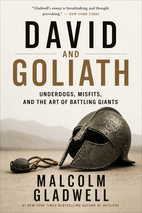
This collection brings together the most striking lines from Malcolm Gladwell's David and Goliath. Each quote captures a moment where conventional wisdom gets turned upside down. You will find reflections on power, disadvantage, and the hidden strengths that come from struggle. Gladwell makes you see underdogs in a new light. These quotes are thought provoking and easy to share because they challenge our assumptions about success and failure.
The book is quotable because it blends storytelling with surprising insights. Gladwell takes familiar stories and reveals unexpected lessons. Whether discussing giants or adversity, each line carries weight. Readers find inspiration, controversy, and a fresh perspective on winning against the odds.
Top Quotes from David and Goliath
“Giants are not what we think they are. The same qualities that appear to give them strength are often the sources of great weakness.”
The author's thesis statement explaining the book's core argument.
It succinctly summarizes the book's main insight about power and vulnerability, challenging readers to rethink their assumptions about strength.
“The fact of being an underdog can change people in ways that we often fail to appreciate: it can open doors and create opportunities and educate and enlighten and make possible what might otherwise have seemed unthinkable.”
The author describing the positive potential of facing overwhelming odds.
This passage inspires by reframing disadvantage as a catalyst for growth and achievement, a hopeful message that resonates with anyone facing challenges.
“There is a set of advantages that have to do with material resources, and there is a set that have to do with the absence of material resources—and the reason underdogs win as often as they do is that the latter is sometimes every bit the equal of the former.”
The author summarizes the lesson from Lawrence's campaign and underdog victories.
It encapsulates the central thesis of the book—that disadvantages can become advantages—challenging conventional wisdom about power.
“David refused to engage Goliath in close quarters, where he would surely lose. He stood well back, using the full valley as his battlefield.”
The author compares Ranadivé's full-court press to David's strategy against Goliath.
This vivid analogy makes the strategic principle clear and resonant, reinforcing that underdogs must change the rules of engagement.
“The second, more intriguing, possibility is that they succeeded, in part, because of their disorder—that they learned something in their struggle that proved to be of enormous advantage.”
The author's speculation on why successful entrepreneurs are often dyslexic.
It encapsulates the central argument of the chapter—that sometimes a disorder can be an advantage.
“I wasn't born that way. This was forced upon me.”
Rosemary Lawlor says this at the opening of the chapter, reflecting on how the Troubles transformed her.
It captures the tragic transformation of ordinary people into victims of circumstance. The stark simplicity makes it unforgettable.
Themes Behind the Quotes
The quotes repeatedly challenge conventional understanding of strength. Gladwell suggests that advantages come with hidden costs while weaknesses can open doors. Stories highlight how those without resources develop unique strategies and resilience. The theme of turning obstacles into opportunities appears, especially around learning disabilities and personal struggle. Desperation leads to creative solutions the powerful never consider.
A second theme is legitimacy. Punishment and authority only work when perceived as just. The way rules are enforced matters more than severity. The book also questions assumptions about risk. Underdogs often succeed because they take chances that seem reckless. These themes show a world where expected outcomes are not always likely.
Quotes by Chapter
Introduction: Goliath
“Am Ia dog that you should come to me with sticks?”
Goliath's taunt to David when he sees him approaching with a shepherd's staff.
This line captures Goliath's arrogance and his misunderstanding of David's unconventional weapon, setting up the central theme of misjudging opponents.
Chapter One: Vivek Ranadivé
“To play by David's rules you have to be desperate. You have to be so bad that you have no choice.”
The author explains why most coaches don't use the full-court press, but Ranadivé did because his team was desperate.
It highlights the counterintuitive idea that weakness can force innovation and courage, making it a memorable call to embrace limitations.
“Of course, you could as easily argue that in playing the press, a twelve-year-old girl learned much more valuable lessons—that effort can trump ability and that conventions are made to be challenged.”
The narrator reflects on the opposing coaches' criticism of Ranadivé's full-court press.
This line crystallizes the chapter's central theme: the power of challenging conventional wisdom and the idea that hard work can overcome apparent disadvantages.
Chapter Two: Teresa DeBrito
“People are ruined by challenged economic lives. But they're ruined by wealth as well because they lose their ambition and they lose their pride and they lose their sense of self-worth. It's difficult at both ends of the spectrum.”
The man from Hollywood, reflecting on how his wealth makes raising children harder than his father had it.
This line captures the counterintuitive idea that both poverty and extreme wealth can harm a person's character, resonating with anyone who has considered the true costs of privilege.
“My perfect number is eighteen: that's enough bodies in the room that no one person needs to feel vulnerable, but everyone can feel important.”
A teacher responding to a poll about ideal class size.
It articulates a precise, relatable sweet spot for classroom dynamics that balances intimacy with diversity, challenging the assumption that smaller is always better.
“I got a precise zero. In other words, there is no effect.”
Economist Caroline Hoxby describing her findings from a natural experiment on class size in Connecticut.
This blunt, counterintuitive result undermines a widely held belief about education policy and forces readers to reconsider what makes a good classroom.
“Like siblings in the backseat of a car. There is simply no way for the cantankerous kids to get away from one another.”
A teacher describing the problem with very small classes.
This vivid analogy makes the counterintuitive downsides of small classes instantly relatable and memorable.
Chapter Three: Caroline Sacks
“If I'd gone to the University of Maryland, I'd still be in science.”
Caroline Sacks says this at the opening of the chapter, reflecting on her decision to attend Brown University.
It captures the central tragedy of the chapter—a brilliant student forced out of science by the pressure of an elite institution. The line is direct and haunting, summarizing the cost of choosing prestige over fit.
“I had never gotten a B in an academic context before,” she said. “I had never not excelled.”
Caroline Sacks describes her shock after receiving a low B in chemistry, a course she had to retake.
This underscores the psychological blow of relative deprivation—her identity as a top student shattered. The repetition of 'never' emphasizes the total upheaval of her self-concept.
“It was just this feeling of overwhelming inadequacy.”
Caroline Sacks explains her experience in organic chemistry class, where she sat silently while classmates gave brilliant answers.
Simple and visceral, this line perfectly conveys the demoralizing effect of constantly comparing oneself to more advanced peers. It resonates with anyone who has felt out of their depth in a competitive environment.
“For a while, that is the only way I was looking at it, like I have completely failed. This has been my goal and I can't do it.”
Caroline Sacks agonizes over leaving science, feeling shame for giving up her lifelong passion.
It reveals the emotional toll of abandoning a dream, not due to lack of ability but due to the crushing weight of elite competition. Readers connect with her raw vulnerability and the false narrative of failure.
Chapter Four: David Boies
“You wouldn't wish dyslexia on your child. Or would you?”
The opening line of the chapter, posed as a rhetorical question by the author.
It immediately challenges conventional wisdom about dyslexia, setting up the theme that disadvantages can be desirable.
“Most people with a serious disability cannot master all those steps. But those who can are better off than they would have been otherwise, because what is learned out of necessity is inevitably more powerful than the learning that comes easily.”
The author's conclusion after discussing compensation learning in dyslexics like David Boies and Brian Grazer.
It articulates a profound insight about overcoming adversity, that forced adaptation can lead to greater strength.
“One of my strengths is presenting a case that they can understand.”
David Boies explaining his approach as a trial lawyer despite his dyslexia.
It shows a concrete example of turning a weakness into a professional strength.
Chapter Six: Wyatt Walker
“So they fired her. They fired my mother. I never forgave my mother for that.”
Jay Freireich describes how his mother dismissed the Irish maid who raised him after remarrying.
This raw, repetitive statement captures the profound betrayal and lasting anger from Freireich's childhood abandonment, illustrating how early trauma can shape a person's emotional landscape.
“I've been bombed!...I’'ve been bombed—me!”
A young woman in London writes in her diary after a nearby bomb explosion during the Blitz.
The exclamation and odd punctuation convey an unexpected, almost joyful exhilaration, powerfully illustrating MacCurdy's theory that remote misses can produce feelings of invincibility.
“Not for all the gold in China! There’s never been nothing like it! Never! And never will be again.”
A middle-aged laborer in a button-factory refuses evacuation after being bombed out of his house twice during the Blitz.
This defiant, exuberant declaration shows how a remote miss can transform a traumatic event into a source of thrill and pride, challenging assumptions about fear and resilience.
“You're suffering. You've got pain. I'm going to relieve your suffering. Are you gonna die? Maybe not. I see miracles every day.”
Jay Freireich argues against hospice care for terminally ill cancer patients.
The blunt, forceful optimism reveals Freireich's uncompromising determination to provide hope, a trait forged by his own harsh upbringing and a key to his success as a doctor.
Chapter Seven: Rosemary Lawlor
“Fear is an awful thing, and I remember being really, really scared.”
Rosemary Lawlor describes her terror as she and her husband fled their home with their baby.
The raw, childlike repetition of 'really' conveys the depth of her fear. It humanizes the chaos of the Troubles in a deeply personal way.
“But that’s precisely where they went wrong, because getting criminals and insurgents to behave turns out to be as dependent on legitimacy as getting children to behave in the classroom.”
The author summarizes the central flaw in the Leites and Wolf doctrine that power alone can control behavior.
It elegantly connects high-stakes counterinsurgency to everyday authority, making a profound point about fairness. The analogy is both simple and devastating.
“How you punish is as important as the act of punishing itself.”
The author explains the principle of legitimacy through a classroom example about parenting and discipline.
It distills a complex social truth into a memorable, nearly proverbial phrase. The insight applies to parents, teachers, and authorities alike.
Chapter Eight: Wilma Derksen
“I can’t save your life. But I'm going to do everything in my power to try and prevent this from happening to anybody else.”
Mike Reynolds makes a promise to his dying daughter Kimber after she is shot.
This line captures the emotional turning point of the story, where grief transforms into a determined mission that would reshape California's criminal justice system.
“I wasn’t really thinking much a nothing, you know,” Walker would say months later when asked about his state of mind that night. “When it happens, it happens, you know. It just happened suddenly. We were just out doing what we do. I mean, that's all I can tell you.”
Douglas Walker, one of the killers, describes his mindset during the murder of Kimber Reynolds.
This quote starkly reveals the irrational, impulsive nature of the criminals, directly challenging the logic of deterrence that underlies the Three Strikes law.
“It may simply be that those who stand ready today to take a chance, often on impulse, often while impaired, on what they view as a very small likelihood of an already very serious sanction will stand ready tomorrow to take the same chance on what they still view as a very small likelihood of a somewhat more serious sanction.”
Criminologist David Kennedy explains the limits of deterrence for impulsive offenders.
This line crisply articulates the inverted-U argument that increasing punishment beyond a point has no effect on the type of criminals who commit most violent crimes.