David and Goliath Key Takeaways
by Malcolm Gladwell
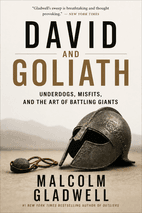
5 Main Takeaways from David and Goliath
Power is often an illusion; giants have hidden weaknesses.
Goliath's size gave him impaired vision, making him vulnerable to David's sling. Similarly, large organizations and dominant players often suffer from inflexibility, arrogance, or blind spots that underdogs can exploit.
Reframe your disadvantages as strategic assets.
David's lack of armor let him move fast and strike from distance. Vivek Ranadivé's undersized basketball team used a relentless full-court press to turn their speed into a weapon. Weakness is only weakness if you accept the rules of the giant.
More resources can backfire—the inverted-U curve rules.
Teresa DeBrito's small class of twenty-nine was more effective than a tiny class because interaction drives learning. Elite schools with abundant resources can crush confidence (Caroline Sacks). Too much of a good thing becomes harmful.
Relative standing beats absolute ability in career success.
Caroline Sacks left science because she felt inferior at a top university, despite being brilliant. Choosing a school or job where you can be near the top of a good environment often yields better outcomes than being average in a great one.
Adversity can forge the courage to break rules and innovate.
David Boies's dyslexia made him disagreeable and fearless of social disapproval—qualities needed to challenge norms. Early struggles can remove the fear of failure, enabling bold moves that others avoid.
Executive Analysis
Gladwell's central thesis is that conventional measures of power—size, resources, prestige—are deeply misleading. Underdogs win not by overcoming their disadvantages in the traditional sense, but by leveraging those disadvantages as asymmetric advantages, while giants often suffer from hidden vulnerabilities that nullify their apparent strengths. This idea connects through every takeaway: misreading power dynamics, the inverted-U curve of resources, the importance of relative standing, and the transformative potential of adversity all point to the same lesson—look beyond surface-level advantages and question the assumptions behind every contest.
This book matters because it challenges how we evaluate competition, education, career choices, and personal growth. It offers a pragmatic framework: stop thinking bigger is better, stop assuming the dominant player is unbeatable, and stop seeing your own limitations as permanent liabilities. In the genre of pop psychology and business literature, Gladwell stands out for weaving vivid narratives (David vs. Goliath, the full-court press, dyslexia) into counterintuitive arguments that readers can apply immediately to their own lives and decisions.
Chapter-by-Chapter Key Takeaways
Goliath (Introduction)
We consistently misread power dynamics, assuming that obvious strengths—size, resources, conventional advantage—tell the whole story, when unconventional approaches can completely change the equation.
The underdog's apparent weaknesses can be reframed as strategic advantages. David's lack of armor gave him speed and maneuverability; his shepherd's sling was a sophisticated weapon, not a primitive tool.
Giants often carry hidden vulnerabilities. What appears to make someone powerful may simultaneously create profound weaknesses—Goliath's size came with impaired vision, making him helpless against an opponent who refused to fight on his terms.
The stories we tell about overcoming odds are often backward. We romanticize improbable victories without understanding the tactical realities that made them not improbable at all but strategically sound.
Try this: Re-examine your perceived disadvantages by asking how they might let you move faster, avoid constraints, or attack where an opponent is blind.
Vivek Ranadivé (Chapter 1)
An underdog can
Try this: Devise a disruptive, unconventional strategy that plays to your unique strengths rather than trying to beat a stronger rival at their own game.
Teresa DeBrito (Chapter 2)
Very small classes can be worse than large ones: they kill discussion, drain energy, and rob struggling students of essential peers.
Teresa DeBrito’s experience with a class of twenty-nine showed that noise and interaction can be a powerful engine for learning, not a distraction.
Schools like Hotchkiss fall into the Goliath trap: assuming that what wealth buys always equals advantage, ignoring the inverted-U curve where too much of a good thing backfires.
Try this: Aim for group sizes or team structures that maximize interaction and energy—avoid extremes where noise or isolation kills momentum.
Caroline Sacks (Chapter 3)
Relative standing matters more than absolute ability. Comparing yourself to peers in a "big pond" can erode confidence and lead to dropping out, even if you are objectively talented.
Choosing a top-tier school can backfire. For many students, especially in science, attending a highly selective university decreases the likelihood of persisting in the major.
Better school ≠ better outcomes. Getting strong grades at a good school often leads to better career prospects than getting mediocre grades at a great school.
Disadvantages can be reframed. The upcoming section will explore how challenges and difficulties, when approached correctly, can actually foster growth.
Try this: Choose educational or professional environments where your relative standing will be high, even if the absolute prestige is lower, to build confidence and persistence.
Next chapter: “David Boies” is locked
Keep learning from David and Goliath — and unlock all 500+ book summaries with audio, mindmaps and AI Q&A.
$0.00 due today · 7 days free, then $89.99/year ($7.49/mo) · Cancel anytime before day 7