Crisis and Renewal Quotes
by S. Steven Pan
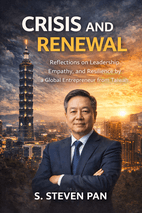
These quotes come straight from Crisis and Renewal, a book born from real leadership during tough times. Each line reflects the author's experience navigating business through storms and coming out stronger. You will find short, punchy truths here. Some are about people, some about purpose, and others about the quiet power of empathy. What makes this book so quotable is how it turns hard lessons into simple wisdom. The sentences stick with you because they feel earned, not invented. They are the kind of lines you underline, then share with a colleague over coffee.
Top Quotes from Crisis and Renewal
“When we reopened, we emerged stronger—not despite the crisis but because of it.”
The author reflects on reopening Silks Place Taroko after nine months of closure.
It encapsulates the book's central thesis that adversity can be a catalyst for transformation and growth.
“Without those painful molts— each challenge forcing us to shed outdated thinking—we never would have unleashed our organization's true potential.”
The author uses the butterfly metaphor to describe the company's evolution through crises.
It vividly illustrates that necessary pain and change are prerequisites for reaching one's full potential.
“When you have nothing, your beliefs become your strength.”
The author reflects on his father's journey from poverty to success and the values that guided him.
This succinct, universal truth resonates deeply because it distills a lifetime of hardship into a powerful mantra about inner conviction, inspiring readers to find strength in their principles.
“Culture trumps strategy, especially in crisis.”
The author recalls a pivotal conversation with UC Berkeley Dean Richard Lyons that reinforced his leadership philosophy.
This memorable aphorism challenges conventional business wisdom, asserting that foundational cultural values are more critical than tactical plans when facing uncertainty, making it highly quotable for leaders.
“Bring the best of the world to the local, and the best of the local to the world.”
This phrase appears as part of the SHG mission statement, summarizing the brand's global-local philosophy.
It is a concise, memorable mantra that captures the essence of cultural exchange and balanced globalization, inspiring both business leaders and travelers.
“The real voyage of discovery consists not in seeking new landscapes but in having new eyes.”
The chapter opens with this epigraph by Marcel Proust.
It sets the philosophical tone for the chapter, challenging readers to find meaning not through external change but through internal perspective.
“Empathy is the key to sustainability and resilience in business.”
The author reflects on the core lesson learned from leading Regent Taipei and SHG through crises.
This concise statement directly links emotional intelligence to long-term business success, challenging the traditional bottom-line focus.
Themes Behind the Quotes
One clear theme is resilience through crisis. Again and again, the quotes show that setbacks are not just obstacles but opportunities to shed old habits and grow. Another major thread is putting people first. Employee welfare, mutual respect, and empathy are treated not as soft ideals but as smart strategy. Ethical leadership also stands out, with a strong emphasis on win-win outcomes and staying true to core values even when it costs something.
A third theme ties hospitality to humanity. Whether the setting is a hotel or a factory, the idea that service is about presence and connection runs deep. Finally, sustainability appears not as a buzzword but as a natural extension of treating others well. The quotes link caring for ecosystems to caring for people, making the case that long term success depends on a generous, cyclical approach to business and life.
Quotes by Chapter
Prologue | Crisis as Catalyst
“This response wasn't extraordinary for our organization—it was business as usual.”
The author describes how the hotel staff handled the earthquake crisis without senior management.
This line powerfully conveys that exceptional crisis response can become routine when empathy and values are deeply embedded in company culture.
“Prioritizing employee welfare proved to be my best business decision.”
The author reflects on the decision to keep all employees during the COVID-19 pandemic.
This challenges the conventional profit-first mindset, showing that caring for people directly drives long-term business success.
Chapter 1 | Foundations
“Despite facing an adversary 260 times its geographic size with 60 times its population, Taiwan hasn't just survived—it has thrived as an island of resilience and land of entrepreneurs.”
The author describes Taiwan's geopolitical challenges and remarkable success despite overwhelming odds.
This line encapsulates the book's central theme of crisis leading to renewal, using vivid numerical contrast to highlight Taiwan's extraordinary resilience and entrepreneurial spirit.
“The best service remains invisible until needed.”
The author explains the cohost philosophy of Regent Taipei, where employees anticipate guests' needs unobtrusively.
This elegant inversion of visibility and value captures the essence of exceptional hospitality, offering a timeless principle that applies far beyond hotels to any service-oriented endeavor.
Chapter 2 | First Transformation (1998–2003)
“We don't do deals with our own companies,” I said. “In particular, this kind of ethically compromised proposal goes against everything the Pan family stands for.”
The author rejecting a related-party transaction proposed by Chairman Chen.
This line encapsulates the author's ethical conviction and commitment to corporate governance, making it a powerful stand against corruption.
“Of course, it would be possible to invest idle cash in new investments, but wouldn't it be better to focus on our core business and return this cash to our shareholders so they can make their own investments?”
The author explaining to the board his rationale for capital restructuring and asset-light model.
It succinctly articulates a shareholder-first philosophy and a strategic pivot that was ahead of its time.
“The aim is not only to meet expectations but to exceed them, outperforming competitors at every turn.”
Describing the standard for profit centers within the hotel.
It captures the relentless drive for excellence that defines the hotel's culture and competitive mindset.
“It is by earning the trust and loyalty of discerning local customers that Regent Taipei attracts international travelers.”
Conclusion about the hotel's restaurant strategy.
It reveals the counterintuitive insight that catering to locals is key to attracting international guests, a sustainable hospitality approach.
Chapter 3 | Global Expansion (2008–2018)
“Isn't a hotel just a modern version of the ancient guesthouse, and a hotel operator the equivalent of the innkeeper of old?”
The author reflects on naming the Silks brand after the Silk Road, drawing a parallel between hotels and ancient inns.
This rhetorical question beautifully connects modern hospitality to ancient tradition, evoking a sense of timelessness and romanticism that resonates with readers.
“Your environment doesn’t decide your success or failure but gives you an opportunity to discern your true character and realize change.”
This line appears under a photo taken at Silks Place Taroko, during a discussion of adversity and crisis.
It reframes challenges as opportunities for self-discovery and growth, offering a powerful, uplifting perspective that resonates deeply in uncertain times.
“Treat others as we would like to be treated, and always look for win-win outcomes.”
The author describes the philosophy that helped secure financing from Mega Bank during the Regent acquisition.
This simple ethical principle underscores the importance of mutual respect and collaboration, making it a universally relatable and quotable business lesson.
Chapter 4 | The Ultimate Test (2020–2021)
“People are the core of the hospitality industry. Whether the accommodations are luxurious or basic, the fundamental purpose of the sector is people providing services for other people.”
The author reflects on the essential nature of hospitality during the pandemic.
This line cuts through business jargon to remind readers that hospitality is ultimately about human connection, not luxury or amenities.
“If the outside world had changed overnight, our inner world needed to change too.”
The author describes the mindset shift required when the pandemic began.
It succinctly captures the necessity of internal transformation when external circumstances are beyond control.
“For me, a leader's most important task is to create an energy cycle within the company and ensure that the cycle is in constant motion.”
The author explains his leadership philosophy during the crisis.
It offers a powerful, dynamic vision of leadership as a generator of sustainable momentum rather than a top-down command.
“Shaking off the zero-sum mindset—where one person's win comes at another's expense—lets us focus instead on mutual benefit and collaboration, both of which are essential for survival in a post-pandemic world.”
The author describes the principles behind Regent Hotel Academy.
It directly challenges competitive thinking and advocates for collaboration as a practical survival strategy, resonating in any high-pressure environment.
Chapter 5 | Designing for Meaning
“Innovation must serve meaning.”
The author states this as the guiding principle that unites all of SHG's brands and operations.
This succinct line captures the book's core argument that innovation without a deeper purpose is hollow, making it highly quotable for leaders.
“To us, service is about systems—but hospitality is about presence.”
The author distinguishes between routine service and genuine hospitality while describing the philosophy of omotenashi.
It elegantly contrasts efficiency with emotional connection, a resonant insight for anyone in service industries.
“The reason why heaven and earth are able to endure and continue this long is because they do not live off, or for, themselves.”
The author quotes Laozi's Tao Te Ching while reflecting on the importance of embracing nature in business.
This ancient wisdom provides a timeless grounding for the chapter's theme of sustainable success through selflessness and coexistence.
Chapter 6 | Leading from Within
“T Regent Taipei, we don't just hire talent—we cultivate small bosses.”
The author describes the hotel's philosophy of empowering employees to think like owners.
This line captures the core theme of the chapter—turning employees into entrepreneurial leaders—and is both concise and memorable.
“It's about perceiving the unseen constraints of others while maintaining clarity on your own objectives.”
The author reflects on a negotiation insight gained during the Regent Taipei management contract talks.
It redefines empathy as a strategic tool, offering a fresh perspective on negotiation and leadership.
“The strongest ideas often find their way into other properties—not by mandate but through mutual respect and inspiration.”
The author explains the collaborative learning culture in the hotel group's meetings.
This line highlights how organic, respectful sharing drives innovation, making it an inspiring model for teamwork.
“My energy is best channeled toward in-depth discussions with a select few rather than toward managing a large number of people.”
The author explains his leadership approach after learning to empower others.
It illustrates the power of focus and delegation, a lesson that resonates with leaders seeking to scale their impact.
Chapter 7 | Legacy Through Sustainability
“If we wish to be treated with care and respect, then we must offer the same to our ecosystems. That, to me, is the heart of sustainability.”
The author explains how the golden rule extends beyond people to the environment.
It frames sustainability as a moral imperative rather than a corporate checklist, making the concept personal and actionable.