Crisis and Renewal — Interactive Mindmaps

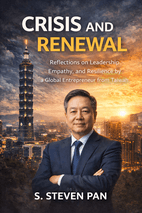
Crisis and Renewal by S. Steven Pan Book Cover

by S. Steven Pan

S. Steven Pan's Crisis and Renewal offers a philosophical exploration of empathetic leadership forged in geopolitical uncertainty, drawing from his experience as a Taiwanese entrepreneur. It provides a holistic guide for leaders navigating disruption and existential risk.

On Insta.page you also get an Apply This Book tool that lets you combine insights from up to 3 books to solve your specific situation.

Chapter mindmaps

Free preview: chapters 1–4 are fully interactive. Click any node to expand or collapse. Subscribe to unlock the rest.

Chapter 1: Prologue | Crisis as Catalyst

Key concepts: Prologue | Crisis as Catalyst

1. Prologue | Crisis as Catalyst

The 2024 Earthquake Crisis

  • Major earthquake severed communications, stranding hundreds at Silks Place Taroko
  • Staff self-organized emergency response without senior leadership on-site
  • Key personnel emerged as leaders: Paula Wu (rescue coordination), Cece Wu (guest services), Chen Kuan-ting (medical evacuations)
  • Initial hope arrived via mud-covered staff who brought safety confirmation and crucial information

Principles in Action: Fortress and Sanctuary

  • Hotel transformed into hub of compassion and efficiency during rescue operations
  • Staff provided physical care (meals, showers, laundry) and psychological support (counseling, trauma activities)
  • Response driven by golden-rule philosophy: treat others as you wish to be treated
  • Nine-month recovery resulted in no job losses and a strengthened team

Crisis as Catalyst for Transformation

  • Earthquake response reflects three-decade journey of turning threats into opportunities
  • Butterfly metaphor illustrates necessary vulnerability in shedding old forms for growth
  • Past crises (parent company bankruptcy, SARS, COVID-19) led to reinvention
  • Pandemic retention of all employees sparked innovation and significant profitability

Purpose-Driven Leadership Philosophy

  • Success depends on adaptive responses to setbacks and clear guiding purpose
  • SHG's purpose: creating harmony between culture, hospitality, and commerce
  • Values matter more than short-term profit for sustainable growth
  • Crisis met with empathy and purpose can catalyze innovation and mutual prosperity

Core Leadership Principles

  • Perceive crises as pivotal moments revealing opportunities for growth and cohesion
  • Empathy as practical leadership tool that empowers employees and builds loyalty
  • Continuous transformation essential like butterfly molting outdated models
  • Purpose-driven resilience enables principled decisions and lasting stakeholder value
  • True leadership shown through presence, trust in teams, and commitment to employee welfare

Chapter 2: Chapter 1 | Foundations

Key concepts: Chapter 1 | Foundations

2. Chapter 1 | Foundations

Taiwan's National Context of Resilience

  • Small island with 23 million people facing constant geopolitical and natural threats
  • History of adaptation through colonization, Japanese rule, and post-civil war refugee influx
  • Economic transformation from manufacturing hub to global semiconductor epicenter (TSMC)
  • National character forged by turning diplomatic isolation and crises into opportunities

Pan Hsiao-Rui: Personal Embodiment of Resilience

  • Orphan and war survivor who arrived in Taiwan as a young refugee in 1946
  • Pioneered Taiwan's shipbreaking industry by salvaging scuttled Japanese warships
  • Creative repurposing mindset: converted decommissioned U.S. plant into industrial gas company
  • Instilled foundational business lesson: finding 'hidden value in what others discard'

Selfless Leadership and National Contribution

  • Heeded government call to build Taiwan's first international hotel despite personal financial risk
  • Eight-year ordeal of setbacks culminating in The Regent Taipei opening
  • Motivation driven by contribution to Taiwan's economic future rather than profit
  • Leadership rooted in profound selfless empathy from difficult childhood experiences

Author's Multidisciplinary Path to Leadership

  • Childhood influences: model trains and LEGO fostered design thinking, grandmother taught frugality
  • U.S. education during diplomatic tensions honed resourcefulness and adaptability
  • Academic shifts from architecture to economics created layered perspective
  • Pivotal transition from unfulfilling Wall Street career to leading family hospitality business

Hotel as Miniature City: Innovative Business Philosophy

  • Reframed hotel as complex 24-hour 'miniature city' requiring orchestration of multiple elements
  • Pioneered independent profit centers for restaurants and shops before industry norms
  • Granted unique agility and brand identity through decentralized operational models
  • Crisis management approach: viewing challenges as opportunities for strategic reinvention

Organizational Resilience Through Human-Centric Leadership

  • True strength during adversity comes from empathy, courage, and attentiveness to team needs
  • Pandemic response: transformed hotel into urban resort for domestic tourism instead of cutting staff
  • Leadership philosophy extends beyond operations to personal and corporate development
  • Managing change through crises as catalysts for self-examination and philosophical reaffirmation

Core Philosophical Framework

  • Resilience as ability to recover and rebalance like solving complex puzzles
  • Genuine care for others (not strategic empathy) as bedrock of strong organizational culture
  • Techniques must adapt but core philosophy of empathy and value creation remains constant
  • Integration of personal development with corporate evolution through continuous transformation

The Father's Entry into Hospitality

  • Motivated by national necessity following Taiwan's 1970s diplomatic crises, not profit
  • Endured an eight-year ordeal of political delays, soaring costs, and partner withdrawal
  • Persevered by selling family properties before partnering with Tuntex Group
  • Embedded a sense of purpose and innovative resilience into the hotel's DNA from inception

The Foundation of Empathetic Leadership

  • Rooted in Pan Hsiao-Rui's difficult childhood and profound empathy
  • Defined by personal frugality combined with extraordinary generosity through philanthropy
  • Distinguishes 'selfless empathy' from 'strategic empathy' used for gain
  • Demonstrates that genuine empathy woven into corporate culture creates consistency between personal and professional values

The Author's Formative Journey

  • Shaped by eclectic childhood influences fostering design mindset and conservation ethic
  • Developed independence and resourcefulness during high school in the U.S.
  • Iterative academic path layered architecture, pre-med, and economics perspectives
  • Found Wall Street's single-minded pursuit of wealth unfulfilling despite early career success

Homecoming and Hotel as Miniature City

  • Returned to Taiwan in 1991 out of loyalty to become President of Regent Taipei
  • Came to view the hotel as a complex 24-hour 'miniature city' with multiple components
  • Shifted from shareholder value maximization to stakeholder-centric philosophy
  • Pioneered innovative business model with independent profit centers decades before industry adoption

Crisis Navigation and Organizational Resilience

  • Transformed potential catastrophes into sources of competitive advantage
  • Built reputation on ability to recover and rebalance through crises like solving a Rubik's Cube
  • Views hotel as dynamic lifestyle platform for cocreating value across multiple domains
  • During COVID-19, redirected energy to transform into innovative urban resort rather than cutting staff

Human-Centric Leadership Philosophy

  • True resilience rooted in empathy, courage, and attentiveness to others' needs
  • Extends to personal growth through expansion into related fields and international forums
  • Tested during crises where human-centric approach proved essential for survival and growth
  • Aligns personal development with organizational development through continuous learning

Philosophy of Change and Self-Examination

  • Evolved from hotel management to change management where embracing change catalyzes growth
  • Core philosophy must remain steadfast while techniques adapt to circumstances
  • Crises serve as powerful catalysts for breaking down preconceptions and unlocking new perspectives
  • First thirty years marked by three major transformations setting foundation for future exploration

Innovative Business Model Design

  • Independent profit centers create a lasting competitive advantage by decentralizing decision-making.
  • Agility and unique brand identity are fostered through autonomous, specialized units.
  • Structural innovation can be more defensible than product or service innovation alone.

Cultivating Organizational Resilience

  • Resilience is built by strategically reframing crises as opportunities for reinvention.
  • Adaptive capacity requires both structural flexibility and a proactive mindset toward disruption.
  • Long-term stability is achieved through continuous evolution, not static defense.

Foundations of Empathetic Leadership

  • Leadership grounded in empathy strengthens team morale and trust, especially during adversity.
  • Courage in decision-making must be balanced with compassion for team well-being.
  • Empathetic leadership fosters long-term organizational stability and employee retention.

Integration of Personal and Corporate Development

  • Personal growth and organizational evolution are deeply interconnected processes.
  • Continuous learning and cross-disciplinary engagement are necessary for holistic development.
  • Leadership effectiveness increases with self-awareness and philosophical clarity.

Philosophical Reaffirmation in Crisis

  • Crises provide invaluable moments for re-examining core values and purpose.
  • Strategic reinvention is driven by heightened self-awareness and clarity of mission.
  • Adversity can catalyze meaningful, lasting change for both individuals and organizations.

Chapter 3: Chapter 2 | First Transformation (1998–2003)

Key concepts: Chapter 2 | First Transformation (1998–2003)

3. Chapter 2 | First Transformation (1998–2003)

Clash of Philosophies and Corporate Governance Battle

  • Chairman proposed bailout via related-party transaction during Asian financial crisis
  • Author refused on principle: 'We don't do deals with our own companies'
  • Conflict between Western governance and traditional conglomerate practices
  • Forced leave and boardroom battle scuttled the bailout plan

Financial Gambit for Independence

  • Parent company's financial woes threatened hotel through joint venture guarantee
  • Orchestrated buyout of parent's stake at 30% premium (NT$5 billion)
  • Negotiated reciprocal deal to sever ties with failing Taichung project
  • Decision vindicated when parent group declared bankruptcy shortly after

Strategic Pivot Through Capital Restructuring

  • External shocks: 9/11 attacks cratered travel demand and stock price
  • Executed unprecedented capital reduction to return cash to shareholders
  • Boosted key financial metrics and established new benchmark for shareholder value
  • Pioneered new model in Taiwan's corporate landscape

Management Revolution: Profit Center System

  • Decentralized hotel into 20+ independent business units with own P&L
  • Overhauled organizational structure and internal cost allocation systems
  • Created internal transfer pricing framework
  • Forced departments to think like standalone businesses, revealing inefficiencies

Cultural Transformation and Entrepreneurial Mindset

  • Fostered culture of ownership among department heads ('small bosses')
  • Restaurant managers competed with city's best eateries, not just hotel guests
  • Instilled fiercely competitive and entrepreneurial mindset
  • Created agility that proved invaluable during 2003 SARS pandemic

Crisis Response and Adaptive Innovation

  • SARS pandemic prompted entrepreneurial pivots: rooms as offices, home delivery
  • Launched era of expansion beyond hotel walls (off-site restaurants)
  • Acquired Domino's Pizza master franchises for Taiwan and China
  • Created Silks Palace at National Palace Museum as cultural storytelling

Foundational Principles and Lasting Legacy

  • Empathy evolved from tactical response to core value and philosophical North Star
  • Battles cemented commitment to principle and governance
  • Resilience built on intangible foundation of character
  • Established that agility must be rooted in core values

External Crisis and Strategic Pivot

  • The 9/11 attacks devastated global travel, causing Regent Taipei's stock price to plummet below NT$10 from a purchase price of NT$25.
  • Financial pressure and the Taichung debacle inspired a radical rethinking of the business model toward asset-light operations.
  • In 2002, the author executed an unprecedented capital reduction for a profitable company, halving cash reserves from NT$4.3 billion to NT$2.1 billion and returning excess to shareholders.
  • This move boosted EPS and return on equity, setting a new precedent for corporate governance and shareholder value in Taiwan.

Implementation of the Profit Center System

  • The hotel decentralized into over twenty independent business units, each with its own financial statements and accountable managers.
  • This shift from a centralized 'captain of the ship' model faced intense resistance at all levels of the organization.
  • It required a complete redesign of organizational reporting lines, job roles, and systems for fair internal cost allocation.
  • Shared resources like atrium performances, lobby maintenance, and support departments (PR, HR, Accounting) needed new allocation methods.

Establishing Fair Internal Systems

  • Costs for shared amenities were allocated using weighted systems (like concert hall seating), square footage calculations, and guest counts.
  • A rigorous internal transfer pricing system was established, anchored to market prices.
  • This forced internal 'sellers' (like the central kitchen) to compete on quality and value with external vendors.
  • The system revealed hidden inefficiencies, leading to strategic decisions like outsourcing the underutilized limousine department.

Fostering a Competitive and Ownership Culture

  • Department heads became 'small bosses' with a powerful sense of ownership, empowering them to innovate and solve problems independently.
  • Restaurants were compelled to compete directly with top standalone eateries in the city, not just serve hotel guests.
  • Examples of innovation included F&B retail branching into TV shopping for mooncake sales, and the Brasserie buffet adding successful afternoon tea and late-night supper services.
  • This decentralized structure proved invaluable during the 2003 SARS pandemic, enabling quick pivots to new revenue streams.

Crisis Adaptation and Post-SARS Growth

  • During SARS, empowered teams pivoted by converting guest rooms into monthly leased offices and offering deep-cleaning services to homeowners.
  • F&B shifted to gourmet home delivery and banquet catering, demonstrating agility in crisis.
  • Post-SARS expansion included launching dedicated off-site F&B services with concepts like Wasabi, Spice Market, and Garden Villa.
  • Further diversification came through acquiring Domino's Pizza master franchises and opening Silks Palace at the National Palace Museum.

Empathy as Core Philosophy

  • The strategy of meeting clients where they were, both literally and figuratively, redefined the company's competitive strength.
  • Empathy evolved from a tactical response into the core value of SHG, guiding all staff, activities, and decisions.
  • It became the philosophical North Star for the group, rooted in treating others as one wishes to be treated.

Legacy of the First Transformation

  • The profit center system fundamentally altered the corporate mindset, fostering entrepreneurship and accountability.
  • Battles over corporate governance instilled an unwavering commitment to principle.
  • The era demonstrated that true business resilience is built on character, not just operational models.
  • Crisis forges unshakeable character—an intangible asset that becomes the ultimate foundation for future challenges.

Post-Crisis Strategic Expansion

  • Growth was driven by diversifying beyond core hotel operations into new Food & Beverage (F&B) ventures.
  • Strategic acquisitions, such as Domino's Pizza, were key to expanding the brand's reach and revenue streams.
  • This proactive extension of services demonstrated a shift from defensive survival to offensive growth.

Institutionalizing Empathy as Core Value

  • Empathy evolved from a crisis-management tactic to the organization's codified, central operating principle.
  • The value guided all leadership decisions and day-to-day operational practices.
  • This cultural shift was a deliberate strategy to unify and strengthen the organization from within.

Crisis as a Crucible for Organizational Identity

  • Enduring multiple challenges, including governance battles and a pandemic, tested the company's operational resilience.
  • These trials served to reveal and solidify the organization's fundamental character and values.
  • The period created a resilient cultural and strategic foundation essential for future growth.

Legacy of the First Transformation

  • The era established a proven playbook for navigating severe external shocks and internal conflicts.
  • It validated a leadership model centered on core human values rather than purely transactional management.
  • The transformation set a precedent for strategic agility, proving the necessity of adapting the business model to survive and thrive.

Chapter 4: Chapter 3 | Global Expansion (2008–2018)

Key concepts: Chapter 3 | Global Expansion (2008–2018)

4. Chapter 3 | Global Expansion (2008–2018)

Strategic Response to the 2008 Financial Crisis

  • Asia's relative stability allowed SHG to launch two new brands: Silks Place (cultural luxury) and Just Sleep (value boutique)
  • The launches served as both expansion and strategic hedge ahead of the Regent Taipei license expiration
  • Just Sleep targeted the growing wave of mainland Chinese tourists with budget-conscious luxury

Acquisition of Regent Hotels & Resorts

  • Seized opportunity during crisis to acquire global Regent brand from Carlson Group in 2010
  • Won high-stakes bidding war against giants like IHG with US$56 million offer
  • Success attributed to empathy—convincing sellers SHG would cherish Regent as a 'crown jewel'
  • Made SHG first Taiwanese company to own an international luxury brand outright

Defining and Structuring the Brand Identity

  • Articulated Regent DNA through twelve complementary dualities (e.g., 'global yet local')
  • Formalized mission: blend best of world with local, inspired by yin-yang philosophy
  • Established brand pyramid: Regent (global luxury), Silks (cultural luxury), Just Sleep (boutique base)

Innovative Financing Model: Hotel-Branded Residences

  • Developed model to sell luxury residences to fund hotel development during capital drought
  • Pioneered in Europe with Regent Porto Montenegro
  • Perfected at Regent Phu Quoc where villa sales during pandemic covered all costs
  • Transformed real estate into investment vehicle generating rental income for owners

Strategic Pivot: Joint Venture with IHG

  • By 2018, managing global network proved costly and complex
  • Sold 51% stake to IHG to handle global operations while SHG refocused on Taiwan
  • Partnership enabled celebrated rebirth of Regent Hong Kong
  • Liberated SHG leadership from daily operations for strategic reflection

Philosophical and Personal Reflections

  • Applied Taoist principles: wu-wei as proactive, selfless action rather than passivity
  • Embraced parable of Chinese farmer ('Maybe') to withhold immediate judgment of events
  • Used yin-yang symbol as metaphor for business resilience—crises contain seeds of opportunity
  • Emphasized continuous learning and spiritual enrichment post-IHG partnership

Strategic Pivot: The IHG Joint Venture

  • Formed a joint venture in 2018, selling a 51% controlling stake in the Regent brand to IHG to address global expansion challenges.
  • IHG took over global operations and expansion, while SHG refocused on its core brands in Taiwan.
  • The partnership provided SHG access to IHG's vast global reservation system and infrastructure.
  • Paved the way for the symbolic rebranding of the InterContinental Hong Kong back to Regent Hong Kong.

Innovating a Business Model: Hotel-Branded Residences

  • Pioneered the model in response to the 2008 financing drought, using residence sales to fund hotel development.
  • Created a sustainable capital solution and a new revenue stream from management services.
  • Transformed a period of crisis into a foundational, scalable strategy for future growth.

Validating the Model: Regent Porto Montenegro

  • A landmark 2014 project that was the first new luxury hotel to open in post-crisis Europe.
  • Introduced the hotel-branded residence concept to the European market.
  • Deal was secured through shared vision with the developer, where competing brands had stalled.
  • Served a unique clientele from the superyacht marina, highlighting its practical role for crew and guests.

Perfecting the Model: Regent Phu Quoc

  • A 2022 pandemic-era success where villa sales more than doubled the total development cost.
  • Framed real estate as a dual-purpose instrument: a personal luxury haven and an income-generating investment.
  • Owners act as landlords, placing villas into the hotel's rental pool, creating a revenue stream.
  • Transformed the Regent brand from a luxury operator into a reliable investment vehicle for buyers and developers.

Reflections on Growth and Strategic Compromise

  • The 2010 global brand acquisition brought unanticipated complexities and management burdens across 17 properties.
  • The IHG partnership represented a strategic compromise that fulfilled a long-held dream of resurrecting Regent Hong Kong.
  • The 2023 reopening of Regent Hong Kong served as a symbolic, full-circle culmination of a decade-long vision.

Philosophical Grounding: Taoist Principles for Leadership

  • The author applied lessons from Laozi's Tao Te Ching as a framework for resilience and perspective.
  • Interpreted wu-wei not as passive inaction, but as proactive, selfless action aligned with natural flow.
  • Embraced the cyclical, intertwined nature of blessing and adversity, seeing opportunity within challenges.
  • This philosophy fostered a non-zero-sum mindset where benefiting others enriches one's own endeavors.

The Parable of the Chinese Farmer and Taoist Equanimity

  • The Taoist view emphasizes life's unpredictable flow and the impossibility of judging single events in isolation.
  • The farmer's response of 'Maybe' to all events underscores that full consequences are unknowable in the moment.
  • Our response to change—not the change itself—determines whether a situation becomes a crisis or an opportunity.
  • Withholding immediate judgment and maintaining equanimity is key to navigating uncertainty.

The Yin-Yang Symbol as a Metaphor for Business Resilience

  • The symbol represents mutual dependence, where all conditions contain the seed of their opposite potential.
  • The boundary between black and white is seen as a neutral, creative space of pure potential.
  • Macroeconomic downturns and crises are necessary seasons that test and strengthen an organization's character.
  • True success requires perceiving the opportunity for transformation hidden within disorder.

Structured Life and the Integrative Role of Music

  • Liberation from daily operations allowed for structured focus on work, investing, learning, and wellness.
  • Music serves as a vital tool to modulate emotion and enhance different environments.
  • Curating playlists professionally (e.g., as head DJ of Regent Taipei) is essential to crafting the guest experience.
  • Richness in life and business comes from embracing variety, harmony, and creative connections between elements.

Core Philosophical and Practical Takeaways

  • Wu-wei is reinterpreted as proactive, selfless action guiding leadership and personal conduct.
  • Blessing and adversity form an inseparable, cyclical duality; immediate judgment is unwise.
  • Resilience is built by seeing challenges as necessary for growth and finding creative potential in opposites.
  • Self-awareness and peace of mind are prerequisites for transforming crises into opportunities.
  • A fulfilling life requires continuous learning, spiritual enrichment, and harmonious blending of diverse elements.

Continue exploring Crisis and Renewal