Country People Quotes
by Daniel Mason
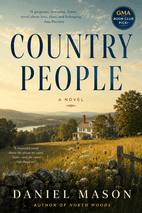
The quotes gathered here come from a novel that moves between sharp observation, warm humor, and sudden tenderness. You will find dialogue between neighbors, long passages of narration, and the private thoughts of characters trying to make sense of new places and old fears. Some lines are funny in a quiet way, others carry real weight.
What makes the book quotable is how freely it shifts between those registers. A sentence can start as a joke and end as a reflection on family, time, or the strange kindness of strangers. The writing feels alert to ordinary moments and willing to find meaning in them, whether through a shared snack, a snowfall, or a memory of home.
Top Quotes from Country People
“He did it, he was brave, he was their father.”
Miles reverses the car over a narrow bridge above a ravine while his family yells from inside.
It elevates a mundane parental act into quiet heroism, showing love through competence and courage.
“Here he was, in a new place, a new start, and his kids off at school, and he alone, as topless as Adam, a little softer, but better read.”
Miles hikes alone in Vermont after dropping his kids at school, with his shirt tied over his head.
The line is wryly self-aware and celebrates the comic, undramatic possibility of a midlife new beginning.
“Truth and falsehood glowered at each other across the goldenrod.”
Wesley quietly contradicts Hugh's claim about Joe Pye, and the two are locked in a tense standoff.
The image personifies an intellectual clash in a meadow, giving a small disagreement mythic weight.
“You can send a hundred photos, but it’s not going to make it any older.”
— Hank Bush
A caller insists his bargain dresser is a rare Revolutionary-era antique, and appraiser Hank Bush cuts off the photo offer.
It is a crisp, funny dismissal of wishful thinking and of the idea that evidence can override reality.
“The family offered the teacher a fig bar, the teacher offered the family rabbit jerky, and, in a model for the divided nation, all parties accepted the respective offerings and sat down for a snack.”
After Miles's family discovers Olive's teacher is the hunter in camouflage, they share snacks on the trail.
The everyday exchange becomes a witty allegory for political division and the possibility of coexistence.
“Just water in a slightly different package.”
— Miles
Miles tells the dog Giuseppe what snow is, as Giuseppe keeps barking at it and looking back at him.
The line turns a simple observation into a gently magical explanation, capturing the warmth and humor of the moment.
“There should be a word, he thought, to place among the taxonomy of parental fears, a missing-child terror. Subspecies, nighttime forest; sub-subspecies, winter, snow.”
— Miles
Miles loses sight of Olive in the darkening woods and feels the onset of pure parental panic.
It turns an overwhelming emotion into a precise, almost scientific classification, giving a name to a fear every parent recognizes.
Themes Behind the Quotes
One theme is the pull of place and the search for belonging. The characters are newcomers, guests, or people returning to land that feels both welcoming and strange. The natural world surrounds them, from coastal forests to winter snow, and it offers comfort, danger, and a sense of scale beyond human worries.
Another theme is the fragile bond between generations, especially what parents try to protect and what children carry forward. Underneath the humor is an awareness of time passing, of small moments becoming memories, and of the ways people need each other across distances. The novel also keeps circling back to the absurdity and hope of divided communities, where strangers share awkward snacks and still find common ground.
Quotes by Chapter
Chapter One
“It might have been pathetic had he not loved the books, the stories, the paths they took him down, the laughter, outsized and impossible.”
The husband reflects on his fourteen-year dissertation drift through one obscure topic after another.
It turns a would-be tragedy into a love letter to intellectual curiosity, making readers root for him.
“Green, for them, was a dark live oak, the furred skyline of the redwood coastal forests, the sword ferns rising from rust-colored duff.”
The narrator describes how the California couple understands the color green before they enter the lush Northeast.
The precise, lyrical imagery evokes a specific home landscape and deepens the sense of displacement.
“The world was all before them, where to choose Their place of rest, and Providence their guide; They, hand in hand, with wandering steps and slow, Through Eden took their solitary way.”
The family’s daydreams about their new country life end as they set out toward Vermont.
The Paradise Lost echo lends the ordinary road trip a mythic, elegiac grandeur.
“His father answered with an expression that answered, We got this, little buddy.”
At the Fort Inn front desk, the son gives his father a worried look and the father silently reassures him.
It is a tender, comic moment of parental confidence in the face of an absurd situation.
Chapter Two
“Well, no one would be going back to bed after that. Not with the birdsong, not with the day ahead of them.”
The family watches a deer bound away from their window at dawn on their first morning in the country.
It captures the delighted restlessness of a new beginning, where wonder makes sleep impossible.
“Something powerful—the winds, the rains, the movement of the earth—was on their side, and they didn’t even know it.”
The family unknowingly turns back before reaching a dangerous person at a sheep farm.
The line delivers dramatic irony and a sense of guarded luck, as if the landscape itself protects them.
“No, it was impossible not to feel the entire country was benign; even the lingering political signs were benign, the flags painted lovingly on wooden pallets, the colossal replica of a former candidate, tall as a barn, black suit, red tie, pink face, red hat, pink finger extended toward the passersby.”
At the end of their first week, Miles sees only benevolence in the Vermont landscape and its political displays.
The irony of calling a looming candidate's effigy benign captures how rural America can feel both welcoming and unsettling to newcomers.
Chapter Three
“God bless people who make words out of worms and flowers, thought both Kate and Miles, simultaneously.”
— Kate and Miles
On Olive's first morning of school, her teacher holds a 3rd-grade sign decorated with worms and flowers.
It is a tiny shared moment of faith in human kindness, placed right before Olive's first-day hesitation.
“What malicious god had invented such a disease? These limbs benumbed; uncouth, augmented pain; and sight tormenting.”
— Miles
Miles reflects on Kate's multiple sclerosis after she first discloses her medical history to him.
The Miltonic phrasing turns rage against illness into a bitter, almost prayerful lament.
“It had a strangely illicit feel, like she was shooting up, or fortifying with a banned elixir. Or more: That he had been granted a privilege, a proximity that was forbidden other people. That the woman of such seeming invulnerability would let him handle her lifesaving drug.”
Miles remembers being allowed to watch and later help with Kate's daily MS injections.
It captures the awe and tenderness of being trusted with someone's most private vulnerability.
Chapter Five
“Her students had been extraordinary, curious and lively, each one so eager to speak, to share a thought, to ask a question. Where did they come from?”
Kate returns home after her first Milton class, astonished by the enthusiasm of her students.
It captures a teacher's rediscovered hope and overturns weary stereotypes about young people.
“And, honestly, Reader, which group would you choose?”
The hike splits between those listening to nature facts and those drawn to celebrity gossip.
The playful direct address pulls readers into the same guilty desire for gossip.
“Not really. But someone should warn Beyoncé.”
— Kate
After Miles asks if she is worried about the rattlesnakes Wesley mentioned, Kate jokes about the celebrity whose blisters Hugh discussed.
It is a deadpan one-liner that connects the nature walk's absurd celebrity gossip to the real world.
Chapter Six
“You could nuke the shit out of it and they'd be scurrying over all our corpses, over the scarred and melted earth.”
— Garfield
Kate asks whether their mouse problem might be the curable kind of cancer.
The absurd escalation makes the futility vivid and darkly comic.
“And Miles recalled, at other dawns, on other evenings, seeing people with similar buckets, crouched suspiciously by the roadside, so he joined the good, kind country people who redistributed each other's mice.”
Miles learns that trapped mice must be released two miles away and recognizes the roadside ritual of his neighbors.
It captures the book's title and the gentle absurdity of rural neighborliness.
“He wasn't certain when it had begun to happen, but, looking back, he sensed a moment, sometime in his late twenties, when he had begun to find old friends, good friends, slowly receding, while new acquaintances already had rich, full lives.”
Miles reflects on adult friendship after Kate pushes him to find friends of his own.
It names the quiet, universal grief of friendships fading with age.
“The troubles of the world seemed distant; he was a guest of the land, of these kind and welcoming people who had left their far-off homes and settled in the same benignant valley where he had come to stay, if briefly.”
Miles waits in Andrei's orchard before meeting him.
This line beautifully expresses provisional belonging and the appeal of country life.
Chapter Seven
“The grass lay down, the leaves left blushes across the meadows, the meadows yellowed and turned brown.”
The opening narration follows the town and school grounds as autumn advances.
The lyric, almost incantatory rhythm makes seasonal decay feel beautiful and inevitable.
“Then he met a man in camouflage in a tree who told him that if he didn’t get some blaze orange on him and his dog, their heads were going to end up on someone's wall.”
Miles, still learning the local culture, is warned by a hunter while walking with his dog.
The offhand threat is deadpan and startling, distilling the unfamiliar rules of this rural world in one sentence.
Chapter Eight
“As if this were a miracle of his master's making.”
Giuseppe barks at the unfamiliar snow and repeatedly looks to Miles for confirmation.
It beautifully expresses the dog's trusting belief that Miles has produced this marvel.
“Not enough to make a snowman, even a snowball, but enough.”
The family and Giuseppe step outside into the first real snowfall, catching flakes on lashes and tongues.
The understated final line makes a meager snowfall feel like a precious gift after a winter that seemed absent.
“Anyone who didn't believe in global warming needed to watch A Charlie Brown Christmas, thought Miles, because if numbers weren't your thing, if science didn’t do it for you, then here was proof, from 1965.”
— Miles
Miles watches A Charlie Brown Christmas on a flight to California and thinks about how winters have changed.
It uses childhood nostalgia to make climate loss tangible and deeply personal.
Chapter Nine
“Don't do it, he pleaded, telepathically. Don’t fuck with a twelve-year-old about Norse myths, he begged. Not in front of everybody.”
— Miles
During the first ski-league practice, Wesley has just corrected Bjorn's Norse mythology in front of everyone.
It captures the comic parental dread of watching a child challenge adult authority with pedantic accuracy, and the telepathic plea makes the panic hilarious.