Contend Quotes
by Philip Anthony Mitchell
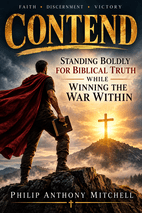
This page gathers lines from Contend that hit with unusual clarity. You will find short, direct statements about faithfulness, private devotion, courage, and the slow compromises that can wear down a believer. Some lines are confrontational, some are pastoral, and many are built to be remembered and shared.
The book is quotable because it turns complex spiritual warnings into compact, vivid language. It does not rely on vague inspiration. It names real tensions, presses toward self examination, and keeps pointing back to obedience, surrender, and the condition of the heart.
Top Quotes from Contend
“The greatest threat to the American Church is the American pulpit. The pulpit is killing the American Church. The pulpit is killing the Church in the UK. The pulpit is killing the Church in cities and countries all around the world.”
The author identifies the central internal threat facing the church.
It is blunt and memorable, reframing the enemy as the pulpit rather than external forces. The repetition drives home the global scope of the warning.
“What feels harmless becomes a habit. A habit becomes a pattern. And a pattern becomes ruin.”
The author describes how small compromises in the pulpit lead to decline.
Its short, rhythmic progression makes the warning easy to remember. It shows that ruin often begins with unnoticed concessions.
“Consequently, many unsuspecting scrollers have strong thumbs and weak souls.”
Chandler laments that believers amplify false teaching online.
The image is memorable because it names how digital fluency can mask spiritual weakness.
“We can’t amuse people into holiness or charm them into repentance.”
The author critiques churches that offer inspiration without transformation.
It succinctly rejects entertainment-driven ministry and insists that holiness and repentance require more than charm.
“Lukewarm Faith is active enough to look alive but compromised enough to be useless.”
The author summarizes the spiritual danger of compromised Christianity.
It is a compact, convicting diagnosis of faith that appears healthy while lacking real power.
“You can be surrounded by Truth and never know the Savior. You can quote the Scriptures and never be transformed by them. You can attend gatherings and never be converted. Familiarity is not Faith, and Jude knew that firsthand.”
The author reflects on Jude growing up with Jesus yet initially refusing to believe in Him.
It warns that proximity to Christian things is not the same as saving faith. It is a memorable call to examine whether familiarity with Jesus has become genuine trust.
“Private faithfulness always precedes public obedience.”
After citing Joseph’s integrity, Mitchell draws a principle about hidden faithfulness.
It reminds readers that public courage is built in private obedience. The line is short enough to remember and deep enough to test motives.
Themes Behind the Quotes
The quotes keep circling the gap between public appearance and private reality. They warn that faith can look active while the heart quietly drifts, and they stress that hidden devotion, surrender, and obedience come before any credible public witness. Compromise is shown as gradual, not sudden, which makes self examination and Scripture shaped discernment essential.
Another major thread is courage under pressure. Readers are called to speak and live for Christ without treating grace as something owed or ministry as a performance. The collection also highlights the battle for the heart, the danger of comfort and familiarity, and the need for endurance when faith is costly. Again and again, the point is not image management but a life genuinely yielded to God.
Quotes by Chapter
Chapter One: The Enemy Within
“Satan can't destroy the Church. But what Jesus warned about and the Apostles feared—and what history proves over and over—is that wolves don’t hunt in the open. They hunt in the shadows.”
The author contrasts Satan's limited power with the danger of false teachers.
The wolf metaphor makes the threat feel stealthy and internal. It warns that the most dangerous enemies hide among the flock.
“One sermon points you to Christ. The other points to yourself. One prepares you for persecution. The other promises you a promotion. One trains you to endure. The other tells you to take the easy path. One trains you to be generous and bless others. The other trains you to hoard.”
The author contrasts authentic Gospel preaching with counterfeit gospel pandering.
The parallel structure sharply exposes how false teaching redirects believers from Christ to self. It is both diagnostic and memorable.
Foreword by Matt Chandler
“Read the Scriptures for yourself and spend more time looking up than looking across.”
Chandler encourages readers to pursue intimacy with Christ and discernment.
It turns discernment into a simple, memorable practice: personal Scripture reading and upward focus.
“These allowances seep in subtly, almost unnoticed, like a ship that veers off course, degree by degree, until the shoreline disappears.”
Chandler explains how deception and doctrinal drift begin.
The ship metaphor makes gradual compromise vivid and exposes the danger of small concessions.
“Before you know it, you're falling and can’t remember when you left solid ground.”
After describing sin as a whisper that lures step by step, Chandler pictures the unnoticed fall.
It captures how compromise becomes catastrophic before we realize it and invites honest self-examination.
Introduction: Birth of a Burden
“But what good is a golden temple when the throne of the heart is shared with another? And how long do we think God will bless what we refuse to surrender?”
After reflecting on Solomon's gold-covered temple and his later shrines to idols.
It exposes the absurdity of outward devotion when the heart is divided and presses readers to consider what they withhold from God.
“So if the wisest man in the Scriptures fell by slow surrender, what makes us think we're immune?”
The author applies Solomon's slow compromise to contemporary believers.
It turns Solomon's failure into a warning against spiritual pride and gradual drift.
“We have torched our own credibility and handed matches to the next generation.”
The author says Gen Z can spot inauthenticity and is disengaging from churches.
Its stark image of self-inflicted damage confesses the Church's failure to the next generation.
Chapter Two: A Spiritual Emergency Unfolding
“The Gospel didn’t arrive to coexist with the Ephesian culture or share space with its gods; it came to expose its idols and tear them down.”
The author reflects on Paul’s ministry in Ephesus and the Gospel’s confrontation with idolatry.
It states the Church’s mission with clarity and force, refusing the false peace of cultural compromise.
“Somewhere between guarding the Truth and sustaining the work of ministry, their love for Christ waned. Devotion hardened into duty, so although they kept the form, they lost their fire.”
The author describes how the church in Ephesus abandoned its first love.
It names the subtle drift from heartfelt devotion to hollow religious routine, a warning every believer needs.
“Prosperity dulls spiritual hunger by convincing the soul it is already full.”
The author explains how Laodicea’s wealth numbed the church to its need for God.
It exposes abundance as a spiritual anesthetic that can hide deep emptiness.
Chapter Three: The Warning of Jude
“If being a servant is beneath you, then having a title is above you.”
Jude calls himself a servant of Jesus Christ rather than leveraging his status as Jesus’s brother.
It confronts the church’s craving for titles and self-promotion. The line is short, sharp, and easy to remember.
“When this happens, what can feel like a detour in your life is actually a divine rerouting.”
The author explains that God redirected Jude’s writing plans and may redirect His people’s plans today.
It reframes painful interruptions as purposeful guidance from a sovereign God. Readers who fear wasted time or missed plans will find hope here.
“Stop acting like grace is something you're owed and start acting like it's the most expensive gift ever given to you.”
The author explains that every breath is borrowed mercy and God owes us nothing.
It exposes entitlement and replaces it with gratitude. The contrast makes grace feel costly and worthy of a changed life.
Chapter Four: Contend for the Faith Externally
“External contending is what happens when you start being a witness for Christ in the open—through conversations, in your relationships, and in moments that may cost you something.”
Mitchell defines external contending as visible, everyday witness for Christ.
It makes faithfulness concrete in conversations, relationships, and costly moments. The definition is both practical and challenging.
“The question is not whether the moment will come to speak up and stand up for Christ, but whether you will be ready when it does.”
Mitchell explains that external contending requires being a witness in open settings.
It shifts focus from predicting the moment to preparing for it. The line is a memorable summons to readiness.
“This is not a negotiable command. It does not say contend if the message is working, if people respond well, or if the room is receptive. Contending is unconditional.”
Mitchell says Jude’s command to contend is not conditional on visible results.
It strips away the excuse of waiting for a receptive audience. Contending is framed as unconditional obedience.
Chapter Five: Contend for the Faith Inwardly
“Nobody warns you about the battle that happens after you close the door. The one nobody sees. No one appears strong for you there. Just you, your thoughts, and a darkness that knows your name.”
The author describes the private, unseen struggle that continues after public ministry and public life are over.
It gives language to the hidden inner battle many believers face alone. The line is memorable because it names the darkness without minimizing it.
“God cares more about the altar of the heart than whatever you're doing publicly to look strong in Faith.”
The author contrasts private spiritual reality with public appearances of strength.
It cuts through performance-based faith and redirects attention to the heart. Readers resonate because it exposes the gap between public image and private devotion.
“Seeking help was one of the hardest things I had ever done, but my surrender was Faith in disguise.”
The author reflects on finally agreeing to professional counseling after resisting it for so long.
It reframes surrender and asking for help as acts of faith rather than weakness. This line offers hope to readers ashamed of needing help.
“The strength I thought I needed was never mine to begin with. It was God's, and He made it known when I had nothing left.”
The author reflects on what he learned through counseling, medication, and healing from depression.
It captures the paradox that human weakness can reveal God's strength. Readers are comforted because it removes the pressure to manufacture strength alone.
Chapter Six: How to Fight Back
“But this is biblical Faith. It is trusting God, even when you can’t trace Him. It is stepping into the unknown and believing what He has spoken. It is not allowing reasoning and fear to override Faith and obedience.”
The author defines biblical faith after choosing to move forward with ACCESS despite fear and logistics.
It captures the chapter’s call to trust and obey God rather than letting fear and reasoning control.
“The consistency of his private devotion made him ready for a public moment he couldn't have predicted. The wall got built because the man was already built.”
Reflecting on Nehemiah’s private prayer and fasting before his public rebuilding work.
It shows that public courage grows from private faithfulness and readiness.