Cholesterol Quotes
by M.D. Harper
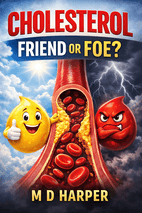
This collection brings together the most thought provoking lines from a book that challenges everything you thought you knew about cholesterol. You will find statements that flip the script on what is considered healthy, surprising facts about how your own body works, and honest reflections on medical dogma.
Top Quotes from Cholesterol
“But what if I told you that this molecule, frequently depicted as a villain, is actually one of the most important substances in your body?”
The author challenges the reader's initial perception of cholesterol as a villain early in the chapter.
This line reframes cholesterol from a feared enemy to an essential substance, provoking curiosity and a shift in perspective. It sets the tone for the entire chapter's argument.
“Your body produces approximately 80% of the cholesterol in your bloodstream. That's correct—the majority of the cholesterol circulating in your veins right now is manufactured by your own cells, primarily your liver, which generates about 1,000 milligrams of cholesterol each day.”
The author reveals the surprising fact that most cholesterol is self-produced by the body.
This fact undermines the common belief that dietary cholesterol is the main culprit, emphasizing the body's intentional production. It prompts readers to reconsider the simplistic 'good vs. bad' narrative.
“Far from being your enemy, it's one of the hardest-working molecules in your body—a true unsung hero of human biochemistry that deserves a better reputation.”
In the concluding paragraph, the author summarizes cholesterol's vital roles.
The metaphor of an 'unsung hero' powerfully personifies cholesterol, making the scientific information memorable and emotionally resonant. It encapsulates the chapter's message of appreciation and balance.
“Your body is smarter than we have given it credit for—it doesn't merely accumulate the cholesterol you eat.”
The author explains why dietary cholesterol has a minimal impact on blood levels for most people.
This line reframes common misconceptions about cholesterol, empowering readers to trust their body's self-regulating nature.
“Many people experience heart attacks despite having "normal" cholesterol levels on standard testing. Conversely, some individuals with apparently concerning lipid profiles never develop cardiovascular disease.”
The author describes the blind spots of the standard lipid panel.
This striking contradiction underscores the limitations of conventional cholesterol tests and reinforces the need for deeper, individualized risk assessment beyond basic numbers.
“Among these 85-year-olds, higher cholesterol was linked to greater longevity rather than increased mortality.”
Results from the Dove Press study on cholesterol and mortality in the elderly.
This starkly contradicts the conventional belief that high cholesterol shortens life, forcing a re-evaluation of age-specific targets.
“Each 1 mmol/L (38.7 mg/dL) increase in total cholesterol was associated with a 15% decrease in mortality.”
From the Leiden 85-Plus Study, which followed 724 individuals aged 85 and older for a decade.
This counterintuitive finding directly contradicts the cholesterol hypothesis and vividly illustrates the 'reverse epidemiology' seen in elderly populations.
Themes Behind the Quotes
A central theme is that cholesterol is not the villain it has been made out to be. The book argues that it is an essential molecule your body produces deliberately and that its role in health is far more complex than simply clogging arteries. Another key idea is the failure of one size fits all medicine. What is dangerous for one person may be protective for another, especially with age. The quotes repeatedly highlight how standard cholesterol testing and the common narrative ignore individual differences in metabolism, particle type, and overall risk factors.
Quotes by Chapter
Prologue
“Total serum cholesterol increased by an average of 37.3%—from normal levels to what many doctors would consider dangerously elevated.”
The author describes the surprising results of a 1999 study where healthy adults fasted for ten days.
This statistic is shocking because it contradicts the common belief that weight loss always improves health markers, immediately raising the central paradox of the chapter.
“In that moment, your triumph turns to confusion and worry. How could something that makes you feel healthier be increasing your risk of disease?”
The author describes a relatable scenario where a patient's weight loss success is met with a doctor's concern over rising cholesterol.
This vividly captures the emotional dissonance many people feel when their personal experience clashes with medical advice, making the reader question conventional wisdom.
“The standard narrative about cholesterol—that it's a dangerous substance that clogs arteries and causes heart attacks, that it should be kept as low as possible, and that rising levels always indicate increased risk—is far too simplistic to explain the complex reality of how this essential molecule functions in the human body.”
The author summarizes the prevailing medical view of cholesterol before challenging it.
This sentence frames the entire book's thesis, inviting readers to reconsider deeply ingrained beliefs about cholesterol and heart disease.
Introduction
“Despite what conventional wisdom would predict, my cholesterol numbers have remained stubbornly high, even with what seems like every advantage: I'm in my fifties, and for the last 15 years I've been free from alcohol and smoking.”
The author shares his personal experience with high cholesterol despite a healthy lifestyle.
This line resonates because many readers experience the same disconnect between healthy habits and lab results, prompting them to question standard medical advice.
“This brief interaction, repeated in medical offices around the world millions of times each day, isn't necessarily poor medicine—doctors are functioning within the constraints of modern healthcare systems— but it is incomplete medicine.”
The author describes the typical short doctor's visit and its limitations.
It highlights the systemic issue of rushed consultations, validating patient frustration while acknowledging the doctor's constraints, which fosters empathy and a call for better care.
“These questions deserve answers. Not quick dismissals, not oversimplifications, and certainly not dogma masquerading as science.”
The author lists unanswered questions patients have about cholesterol.
The phrase 'dogma masquerading as science' is a powerful indictment of uncritical medical narratives, inspiring readers to seek deeper understanding and challenge oversimplified beliefs.
“And perhaps most importantly, we've begun to question whether high cholesterol alone is the villain it's been made out to be, or whether it's one actor in a much more complex play involving inflammation, oxidative stress, endothelial dysfunction, and numerous other factors that contribute to cardiovascular disease.”
The author discusses the evolving scientific understanding of cholesterol and heart disease.
The theatrical metaphor reframes cholesterol from a simple villain to part of a complex system, offering a nuanced perspective that empowers readers to think beyond reductionist health advice.
CHAPTER 2
“The one-size-fits-all approach to cholesterol management ignores this fundamental biological reality: each person has a unique cholesterol metabolism influenced by countless genetic and environmental factors.”
The author discusses individual variation in cholesterol metabolism.
It challenges generic health advice and encourages personalized understanding, resonating with anyone frustrated by blanket dietary rules.
“This fundamental reality—that your body produces most of its own cholesterol—explains why dietary changes sometimes have a lesser impact on blood cholesterol levels than individuals expect.”
The author highlights the body's own cholesterol production as the primary source.
This insight shifts perspective from blaming food to understanding internal regulation, making readers rethink diet-centric approaches.
“Consider cholesterol metabolism as a complex dance—a choreographed performance featuring thousands of molecular participants, precise timing, and exceptional coordination.”
Opening of the chapter, introducing the concept of cholesterol metabolism.
The vivid metaphor makes a scientific process feel elegant and accessible, capturing the reader's imagination.
CHAPTER 3
“Two individuals may have the same total cholesterol levels yet possess very different cardiovascular risk profiles based on the distribution of that cholesterol.”
The author explains why total cholesterol alone is insufficient for assessing cardiovascular risk.
This line powerfully illustrates that identical numbers can hide vastly different health realities, challenging the common assumption that a single cholesterol value tells the whole story.
“Research increasingly suggests that the number of LDL particles may be more significant to cardiovascular risk than the amount of cholesterol they contain.”
The author discusses the distinction between LDL particle count and LDL cholesterol content.
It introduces a critical nuance that standard lipid panels miss, emphasizing that counting the vehicles rather than just the cargo may be more predictive of heart disease risk.
“A slightly elevated LDL-C with high HDL-C and low triglycerides indicates a very different risk profile compared to the same LDL-C with low HDL-C and high triglycerides.”
From the section encouraging readers to look beyond isolated numbers in their lipid profile.
This line powerfully illustrates that the same LDL-C number can mean very different things depending on the full lipid context, challenging oversimplified interpretations.
CHAPTER 4
“What if the molecule labeled as our enemy might sometimes be our ally?”
Opening question of Chapter 4, challenging the simple narrative that high cholesterol is always dangerous.
It invites readers to reconsider long-held assumptions and primes them for the surprising evidence that follows.
“LDL particles bind to bacterial toxins, effectively neutralizing them and preventing their entry into vital organs.”
Explanation of the mechanism behind the Salmonella study in mice.
It highlights a concrete biological role for LDL in immune defense, directly countering the one-dimensional view of 'bad' cholesterol.
“In our oldest old, quality of life may be more important than extending life by small margins.”
Discussion of treatment implications for very elderly individuals.
It shifts the focus from numerical cholesterol targets to holistic patient well-being, a humane and practical alternative to aggressive medication.
CHAPTER 5
“The history of cholesterol science isn't a straightforward path from ignorance to enlightenment. Instead, it resembles a winding journey marked by significant scientific breakthroughs, influential figures, institutional momentum, and, at times, the oversimplification of complex biological relationships.”
Opening paragraph of Chapter 5, setting the stage for the historical narrative.
It frames the entire chapter with a powerful metaphor, reminding readers that scientific progress is rarely linear and often involves trade-offs between nuance and simplification.
“Cholesterol is not a nutrient of concern for overconsumption.”
The 2015 Dietary Guidelines Advisory Committee's statement when removing the long-standing limit on dietary cholesterol.
This concise sentence marks a dramatic reversal in public health policy, illustrating how science can overturn decades of entrenched dietary advice.
“What may seem like established fact today can be refined, revised, or even overturned as new evidence emerges.”
One of the key lessons drawn from the history of cholesterol science.
It encapsulates the provisional nature of scientific consensus, encouraging humility and critical thinking about current medical beliefs.
CHAPTER 6
“It is important to consider that the cholesterol hypothesis may be fundamentally flawed.”
This statement appears in a 2018 systematic review published in Expert Review of Clinical Pharmacology, challenging the dominant cholesterol-cardiovascular disease narrative.
It encapsulates a rare, scientifically grounded challenge to a long-held medical consensus, forcing readers to question foundational assumptions in cardiology.
“What is optimal at 45 may not be optimal at 85.”
The author's conclusion after discussing the elderly paradox in cholesterol studies.
This short, memorable line captures the need for age-specific medical thinking and challenges one-size-fits-all cholesterol guidelines.
“Medicine is not only a science but also an art that necessitates judgment, wisdom, and careful consideration of individual circumstances.”
From the chapter's closing reflection on the limitations of evidence and personalized decision-making.
It reminds readers that medical practice requires balancing data with human context, a timeless and humbling insight.
CHAPTER 7
“The story of statins is, in many ways, a triumph of modern medicine: the development of targeted pharmaceuticals to address a specific biological process linked to disease. Yet it is also a narrative marked by controversy, competing stories, and profound questions about the balance between benefits and harms.”
The author introduces the dual nature of statins as both a medical achievement and a source of debate.
This passage encapsulates the central tension of the chapter, framing statins as neither purely miraculous nor purely harmful, inviting readers to explore the nuanced reality.