Cholesterol — Interactive Mindmaps

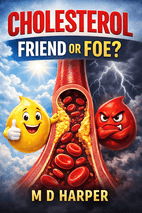
Cholesterol by M.D. Harper Book Cover

by M.D. Harper

M.D. Harper's Cholesterol deconstructs the high cholesterol mythology, arguing the vital molecule is not the primary villain in heart disease. It critiques foundational studies and empowers readers questioning standard advice to understand cardiovascular risk more nuance

On Insta.page you also get an Apply This Book tool that lets you combine insights from up to 3 books to solve your specific situation.

Chapter mindmaps

Free preview: chapters 1–4 are fully interactive. Click any node to expand or collapse. Subscribe to unlock the rest.

Chapter 1: Prologue

Key concepts: Prologue

1. Prologue

The Fasting Paradox

  • A 10-day water fast in healthy individuals caused dramatic cholesterol spikes despite weight loss
  • Total cholesterol rose 37.3% and LDL cholesterol increased 66.1% during fasting
  • Standard medical advice would label this as dangerously increased heart disease risk
  • Creates an evolutionary absurdity: why would fasting increase presumed death risk?

The Patient-Doctor Disconnect

  • Common experience: feeling healthier after lifestyle changes but facing concern over worsened cholesterol
  • Doctors may recommend medication based solely on cholesterol numbers despite other improvements
  • Highlights conflict between subjective health improvements and objective lab results
  • Suggests fundamental misunderstanding of cholesterol's role in health

Reconceptualizing Cholesterol

  • Cholesterol should be viewed as essential and complex rather than simply 'bad'
  • Questions whether rising cholesterol during weight loss is dangerous or a normal metabolic response
  • Explores possibility that cholesterol increases may be part of a healing process
  • Requires moving beyond simplistic 'cholesterol is bad' dogma to nuanced understanding

Book's Mission and Promise

  • To question and unravel oversimplified narratives about cholesterol and heart disease
  • Will explore cholesterol as a critical component of human physiology
  • Promises to provide a more holistic, complex view of cholesterol interpretation
  • Sets stage for scientific deep dive into cholesterol's true role in health

Chapter 2: Introduction

Key concepts: Introduction

2. Introduction

Personal Puzzle and Central Question

  • Author's personal health story contradicts conventional wisdom
  • Healthy lifestyle with consistently high cholesterol
  • Observation of similar patterns in Eastern European community
  • Challenges the standard narrative about cholesterol danger

Critique of Modern Healthcare System

  • Systemic constraints of short doctor visits
  • Simplistic prescription approach without nuance discussion
  • No room for emerging research or personalized strategies
  • Fails to address patient questions about paradoxes and side effects

Cholesterol Scientific Controversy

  • One of medicine's most heated debates
  • Evolving science complicates direct heart disease link
  • Cholesterol's vital roles in hormone production and brain function
  • Complexities include weak dietary-blood cholesterol link and LDL particle types
  • Cardiovascular risk involves inflammation and oxidative stress beyond numbers

Book's Purpose and Methodology

  • Not medical advice or medication recommendation
  • Guided journey through evidence and contradictions
  • Equips readers for critical thinking about science
  • Enables informed conversations with healthcare providers
  • Helps make personal health decisions with greater clarity

Comprehensive Exploration Framework

  • Examines cholesterol from multiple angles
  • Covers biological function and research history
  • Explores controversies in scientific literature
  • Discusses management strategies beyond medication
  • Emphasizes open-minded examination and acceptance of uncertainty

Chapter 3: CHAPTER 1

Key concepts: CHAPTER 1

3. CHAPTER 1

The Misunderstood Molecule: What Is Cholesterol, Really?

  • Cholesterol is a waxy sterol, a lipid present in every cell, not a foreign toxin.
  • Approximately 80% of cholesterol is produced internally by the body, primarily by the liver.
  • Only about 20% of cholesterol comes from dietary sources.
  • The body's significant internal production suggests cholesterol is essential for life.

The Cellular Architect

  • Cholesterol is a fundamental architectural component of cell membranes.
  • It modulates membrane fluidity, ensuring it is neither too rigid nor too fluid.
  • It provides structural stability, helping cells maintain integrity under stress.
  • It organizes specialized membrane regions called 'lipid rafts' for cell signaling.

The Master Precursor for Hormones

  • Cholesterol is the crucial raw material for synthesizing all steroid hormones.
  • It is the precursor for sex hormones: testosterone, estrogen, and progesterone.
  • It is the building block for adrenal hormones like cortisol and aldosterone.
  • Without cholesterol, the body's entire hormonal communication system would fail.

The Sunshine Connection

  • Cholesterol is directly linked to vitamin D synthesis in the skin via sunlight.
  • UV light interacts with a cholesterol derivative (7-dehydrocholesterol) to initiate conversion.
  • Vitamin D is crucial for calcium absorption, bone health, and immune function.
  • This process highlights a non-negotiable, health-promoting role of cholesterol.

The Digestive Assistant

  • Cholesterol is a key ingredient in bile, a digestive fluid produced by the liver.
  • Bile emulsifies dietary fats, enabling absorption of fats and fat-soluble vitamins.
  • Excess cholesterol can be converted into bile acids and excreted, demonstrating a recycling mechanism.
  • Cholesterol is integrated into the body's natural balance for nutrition and waste management.

The Brain's Best Friend

  • The brain houses about 25% of the body's cholesterol, indicating its supreme neurological importance.
  • Cholesterol is a major component of myelin sheaths, enabling rapid nerve signal transmission.
  • It is vital for forming synapses, the connections between neurons for learning and memory.
  • Brain cells produce their own cholesterol locally due to the blood-brain barrier.

The Immune Connection

  • Cholesterol contributes to immune defense via lipid rafts in immune cell membranes.
  • It is involved in producing inflammatory mediators and helps combat bacterial infections.
  • Lipoproteins can bind to and neutralize bacterial toxins.
  • Cholesterol levels may temporarily rise during infection as part of the body's defensive response.

The Vital Balance: Appreciating Complexity

  • Cholesterol's roles are multifaceted: cellular integrity, hormone precursor, vitamin D synthesis, digestion, brain function, and immunity.
  • The oversimplified 'cholesterol is bad' narrative is misleading.
  • Problems arise when cholesterol metabolism or transport becomes dysregulated, not from cholesterol itself.
  • A balanced, nuanced understanding acknowledges cholesterol's essential biological necessity.

Cholesterol's Biological Necessity

  • Cholesterol is primarily produced by the body (about 80%), not just obtained from diet.
  • It is essential for maintaining cell membrane structure and fluidity.
  • Serves as the foundational building block for sex hormones (estrogen, testosterone) and stress hormones (cortisol).

Critical Physiological Functions

  • Enables vitamin D synthesis when skin is exposed to sunlight.
  • Essential for digestion through the production of bile acids.
  • Crucial for optimal brain function, including myelin sheath formation and synapse creation.

Reevaluating Cholesterol Management

  • The 'lower is always better' approach is overly simplistic and potentially harmful.
  • Adequate cholesterol levels are vital for neurological and brain health.
  • Health management should balance cholesterol's essential roles with addressing genuine imbalances.

Cholesterol and Immune Function

  • Plays a supportive role in immune system responses.
  • Its role in cell membrane integrity is crucial for proper immune cell function.

Chapter 4: CHAPTER 2

Key concepts: CHAPTER 2

4. CHAPTER 2

The Body's Cholesterol Production System

  • Nearly every cell can synthesize cholesterol, with the liver producing ~80% (about 1,000 mg daily) of blood cholesterol
  • Production is regulated by a feedback loop centered on the enzyme HMG-CoA reductase, which acts as a cholesterol thermostat
  • This internal production system is the primary source of blood cholesterol, not dietary intake
  • The feedback mechanism is the target of statin medications

Dietary Cholesterol's Limited Impact

  • Dietary cholesterol has minimal effect on blood levels for ~75% of the population
  • The body compensates for higher intake by reducing its own production
  • About 25% are 'hyper-responders' with blood cholesterol sensitive to dietary intake
  • Highlights importance of individual variation over blanket dietary rules

Lipoprotein Transportation Network

  • Cholesterol requires specialized lipoprotein carriers to travel in the bloodstream
  • LDL is the primary carrier to tissues; 'bad cholesterol' label is misleading as LDL is a carrier, not cholesterol itself
  • HDL performs 'reverse cholesterol transport' from tissues back to liver and has anti-inflammatory properties
  • Problems arise with abnormal quantity, quality, or when small, dense LDL particles become oxidized
  • Lp(a) is a genetically determined LDL variant linked to increased cardiovascular risk

Cholesterol Regulation and Elimination

  • Balance is maintained primarily through bile elimination - liver converts cholesterol to bile acids
  • Most bile acids are recycled, but a small fraction is excreted in stool
  • Soluble fiber can enhance this elimination pathway
  • Entire system influenced by genetics, hormones, liver health, insulin resistance, medications, age, and lifestyle

Individual Variation in Cholesterol Metabolism

  • Universal recommendations often fail due to unique metabolic 'fingerprints'
  • Two people on the same diet can have wildly different cholesterol profiles
  • No one-size-fits-all model for cholesterol metabolism or management
  • Personal genetics and physiology dictate responses to diet and medication

Limitations of Standard Cholesterol Testing

  • Standard tests (Total, LDL, HDL, Triglycerides) measure cholesterol content within lipoproteins
  • They reveal nothing about particle number, size, density, or function
  • Provide only a limited snapshot of cholesterol metabolism
  • Advanced testing needed to better define cardiovascular risk

Continue exploring Cholesterol