Bonfire of the Murdochs Quotes
by Gabriel Sherman
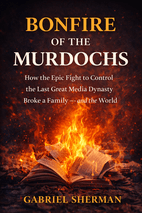
These quotes drop you right into the heart of the Murdoch empire, where every sentence feels like a power play or a confession. You will find sharp put downs, cold business maxims, and raw family fights that show how this dynasty really worked.
What makes the book so quotable is that Sherman captured moments where the mask slips. Rupert Murdoch and his circle say things that are too honest, too cruel, or too revealing to forget. Each line tells a story about ambition, money, and the cost of winning.
Top Quotes from Bonfire of the Murdochs
“Yes, you hurt some feelings along the way,” Rupert later explained, “but you do what you must do.”
Rupert explaining his ruthless takeover of the News of the World from Sir William Carr.
This line captures Rupert's cold pragmatism and willingness to destroy others for success, making it a defining statement of his character.
“Teeth and nails are fine,” Rupert deadpanned, “but it's money that wins this kind of scrap.”
Felker threatens to fight Murdoch 'tooth and nail' over the New York magazine takeover, and Murdoch responds with this cold calculation.
The deadpan delivery and cynical wisdom encapsulate Murdoch’s pragmatic ruthlessness. It shows that in his world, financial power trumps all other forms of resistance.
“If you owe the bank $100, that’s your problem. If you owe the bank $100 million, that’s the bank's problem.”
Rupert Murdoch's observation during News Corp's debt crisis, proving the timeless aphorism.
This memorable maxim flips power dynamics, showing how massive debt can become leverage, and resonates with anyone who understands financial brinkmanship.
“For a man whose identity was conquest itself, talk of retirement felt like a death sentence.”
The author describes Rupert's reaction to Anna's demands that he retire.
This line encapsulates Murdoch's core identity and his fear of irrelevance. It reveals why he rejected retirement and pursued ever-bigger ventures.
“Fuck the lot of you and fuck my dad, I’m doing it my way.”
James Murdoch to Sky and News Corp executives after they tried to get his father to tone down his speech.
It perfectly captures James's defiance and determination to assert his independence, directly echoing the chapter's title and his rebellious character.
“IF YOU DO THIS DEAL, I'M NEVER SPEAKING TO EITHER OF YOU AGAIN!”
Lachlan said this to Rupert and James during a dinner over the Disney acquisition.
It captures the ultimate family betrayal and the emotional stakes of a business decision that tore the Murdochs apart.
“Over seventy years, Rupert said he was building a family business. But what he built was a business that destroyed his family.”
The narrator's concluding reflection on Rupert Murdoch's legacy.
This succinct, devastating line serves as the chapter's moral center, summing up the tragic irony of Murdoch's life in a single, unforgettable sentence.
Themes Behind the Quotes
A central theme is the relentless pursuit of power and how it corrodes everything it touches. Murdoch treats business as war, where money is the only weapon that matters and sentiment is weakness. The quotes show a man who measures success by conquest, not happiness, and who will sacrifice anyone to keep control.
Another major theme is the destruction of family in the name of legacy. Murdoch built a media machine by pitting his children against each other, then watched it tear them apart. The book reveals how his obsession with dynastic succession left behind heartbreak, rebellion, and a broken empire where loyalty meant nothing and profit was the only god.
Quotes by Chapter
Chapter 1: The Boy Publisher
“I desire that my said son Keith Rupert Murdoch should have the great opportunity of spending a useful altruistic and full life in newspaper and broadcasting activities and of ultimately occupying a position of high responsibility in that field with the support of my trustees if they consider him worthy of that support.”
Sir Keith Murdoch dictated this in his last will and testament, expressing his hopes and conditions for his son's future.
The father's conditional blessing underscores the immense pressure and the perpetual need for validation that drove Rupert Murdoch's entire career.
Chapter 2: Persona Non Grata
“I didn't come all the way from Australia not to interfere. You can accept it or quit!”
Rupert's ultimatum to News of the World editor Stafford Somerfield.
It showcases Rupert's aggressive, no-compromise management style and his determination to reshape the paper his way.
“If it's so objectionable, why are so many more people buying The Sun, tens of thousands of women included?”
Rupert responding to criticism of the Page 3 topless models.
This rhetorical question underscores his populist justification for sensationalism and his belief that the market validates his choices.
Chapter 3: “I can’t lose”
“I can’t back down. After losing the Observer, I'd be a journalistic untouchable around the world. I can’t lose.”
Rupert says this to Felker after Felker pleads with him to abandon his takeover of New York magazine.
This line captures Murdoch's relentless drive and his deep fear of failure, making it the thematic heart of the chapter. It reveals how his identity and empire depend on never retreating.
“The bottom line in this business is to make money,” he said at the time. “If those who attacked me had their way, there would be no newspapers.”
Murdoch defends his sensationalist tabloid tactics in San Antonio against critics who complained about graphic content.
This quote lays bare Murdoch's core business philosophy: profit above all, and a belief that critics are enemies of the free press. It resonates as a blunt expression of his media empire's foundational logic.
Chapter 4: Broken Promises
“The American press might get their pleasure in successfully crucifying Nixon,” he told a friend, “but the last laugh could be had on them. See how they like it when Commies take over the West.”
Rupert Murdoch explained his contrarian view of Watergate to a friend in the late 1970s.
This passage reveals Murdoch's deep ideological suspicion of the mainstream press and foreshadows his drive to build a conservative media counterweight. The cold war imagery and vindictive tone distill his belief that journalism should be a weapon, not a neutral arbiter.
Chapter 5: Citizen Rupert
“What a great adventure! We're betting the company!”
Rupert said this to Diller in a cab on the way to Kluge's apartment to finalize the Metromedia purchase.
It captures Rupert's exhilaration in high-stakes risk-taking, showing he thrives when everything is on the line.
“There is no dog with hearing as sharp as Rupert Murdoch's when opportunity calls. It took him less than a second to say, ‘Ha! Let's go after this!”
Diller recalled Rupert's immediate reaction when Kluge hinted he might sell his Metromedia stations.
This vivid metaphor underscores Rupert's predatory instinct and lightning-fast opportunism.
Chapter 6: Rambo
“You fuckwit! You bastard! Get this fucking newspaper out!”
Rupert screams at a managing editor while overseeing the Wapping printing plant during the printers' strike.
This raw, explosive outburst reveals the volcanic temper and ruthless urgency that drove Murdoch to crush the union at any cost.
Chapter 9: A New Frontier
“Each setback only deepened Rupert's obsession. The more impossible China became, the more it justified his refusal to retire.”
After facing Chinese resistance to his satellite TV ambitions, Rupert's obsession grew.
It shows how failure only intensified his drive, making China a symbol of his refusal to slow down. The parallelism between 'setback' and 'obsession' is striking.
Chapter 10: “It’s easier to be a Murdoch outside of News Corp than inside”
“Then the prince walked away from the throne, leaving his father to contemplate the wreckage of his dynastic dreams.”
The narrator describes Lachlan’s resignation after years of being undermined by Rupert's executives.
This vividly metaphorical closing sentence encapsulates the tragic irony of Rupert's obsessive succession planning—it drove away the very heir he wanted.
“He doesn’t really have the tools to express that he's sorry.”
Liz reflects on Rupert's inability to apologize for not protecting Lachlan from Ailes and Chernin.
It reveals the emotional deficit behind Rupert's legendary business ruthlessness, humanizing him while explaining the family rift.
Chapter 11: “I’m doing it my way”
“The only reliable, durable, and perpetual guarantor of independence is profit.”
James Murdoch's MacTaggart Lecture at the Edinburgh International Television Festival in August 2009.
This line crystallizes the Murdochian free-market ideology and sparked immediate backlash, revealing James's willingness to take an extreme stance despite opposition.
“The mountains are high and the emperor is far away.”
A Chinese proverb James often quoted to describe his strategy of staying distant from Rupert's direct control.
This proverb succinctly explains James's calculated career move to build power far from his father's court, demonstrating his shrewd long-term thinking.
Chapter 12: The Fourth of July
“I am by no means alone within the family or the company in being ashamed and sickened by Roger Ailes’s horrendous and sustained disregard of the journalistic standards that News Corporation, its founder and every other global media business aspires to.”
Matthew Freud gave this quote to the New York Times, revealing the family's internal dissent.
This line exposes the deep ideological fault line within the Murdoch family and publicly shames a powerful figure, making it a stunning breach of family unity.
“He disinvited her from CES literally a week after he told her she was going to be his successor,” a person close to Liz said. “She was heartbroken.”
Rupert promised Elisabeth the succession then immediately withdrew the offer after she signed the Shine deal.
It crystallizes Rupert's manipulative cruelty and the emotional toll on his daughter, highlighting the transactional nature of his favor.
“He was pitting them against each other,” she later said, “but there was always going to be one winner.”
Kathryn, James's wife, reflects on Rupert's manipulation of his children's rivalry.
This line lays bare the engineered sibling competition at the heart of the Murdoch dynasty, offering a devastating summary of the family's dysfunction.
Chapter 13: Split
“Fuck you, Rupert! You're stupid! What are you going to do when I'm gone!?”
An executive recalled Wendi screaming at Rupert in his London office.
This line captures the explosive nature of their marriage and Wendi's contempt, highlighting the personal turmoil behind the public facade.
“It was a humbling defeat that signaled Rupert's empire-building days might be over.”
After Rupert withdrew his $80 billion Time Warner bid.
This closing reflection on a failed takeover encapsulates the theme of decline and the end of an era for the media mogul.
Chapter 14: “If you do this deal, I’m never speaking to either of you again!”
“If you're not going to stand up against Nazis, who are you going to stand up against?”
Kathryn Murdoch challenged her husband James after Charlottesville.
A powerful moral challenge that forces action and highlights the personal cost of complicity.
Chapter 15: Family Harmony
“Murdoch seemed trapped by the people he radicalized, like an aging despot hiding in his palace while the streets filled with insurrectionists.”
The author describes Murdoch's predicament after the 2020 election.
The vivid metaphor captures the irony of a media mogul becoming a prisoner of the forces he unleashed, resonating with readers as a critique of accountability.
“Rupert's ability to blithely rationalize the violence on January 6 was a microcosm of how he evaded any responsibility for the immense damage his media empire did to the public square over the past fifty years.”
The author reflects on Murdoch's reaction to the January 6 attack.
This line succinctly condemns Murdoch's moral evasion and ties his personal behavior to the broader harm of his media empire, making it a powerful indictment.
Chapter 16: Objecting Children
“The play might have worked; but an evidentiary hearing, like a showdown in a game of poker, is where gamesmanship collides with the facts and at its conclusion, all the bluffs are called and the cards lie face up.”
Commissioner Gorman's written decision ruling against Rupert Murdoch.
The poker metaphor perfectly encapsulates the trial's drama and the ultimate triumph of truth over manipulation, making it a memorable and quotable climax.