Bonfire of the Murdochs Key Takeaways
by Gabriel Sherman
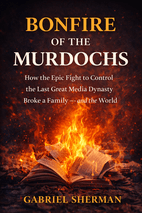
5 Main Takeaways from Bonfire of the Murdochs
A lifelong quest for validation fuels ruthless ambition and expansion.
Rupert Murdoch's entire career was driven by the need to prove himself worthy of his father's legacy, leading to an insatiable drive for scale from Australia to global dominance. Personal slights, like school canings and business attacks, became motivators for conquests framed as moral crusades, as seen in his early tabloid wars and relentless acquisitions.
Loyalty and principles are secondary to business growth and personal gain.
Murdoch consistently betrayed allies, such as Rohan Rivett and the Carr family, when they no longer served his ambitions. This opportunism extended to shedding socialist ideals and making false promises to secure political and commercial advantages, illustrating a pattern of strategic deception that defined his operations.
Sensationalism and populism build audiences but erode journalistic integrity.
From the Sun's Page 3 to Fox News's partisan coverage, Murdoch used emotive, simplified narratives focused on crime, sex, and scandal to win circulation. This strategy courted controversy and moral condemnation, as seen in his anti-establishment persona, but solidified his influence at the cost of ethical standards.
Family succession battles poison relationships and undermine corporate governance.
Murdoch groomed his children as heirs but pitted them against each other, leading to bitter rivalries and fractures, as with James and Lachlan. The phone-hacking scandal exposed these dynamics, culminating in legal battles and estrangement, showing how dynastic ambitions can destroy familial bonds and operational stability.
Political power sought through media manipulation can lead to scandal and downfall.
Murdoch used his properties as weapons for conservative populism, but this led to crises like phone-hacking and the Dominion lawsuit. His influence waned when scandals revealed ethical breaches, damaging his legacy and family unity, as evidenced by the parliamentary hearing and Fox News's election falsehoods.
Executive Analysis
The five key takeaways collectively argue that Rupert Murdoch's life and career embody a tragic paradox: his relentless drive for validation and power, achieved through ruthless business tactics and sensationalist media, ultimately corroded the very family dynasty and political influence he sought to build. His father's shadow fueled an expansionist zeal that disregarded loyalty and ethics, while his populist strategies won audiences but invited scandal. The familial succession battles, manipulated by Murdoch himself, exposed how personal ambitions can undermine corporate governance and lead to public humiliations like the phone-hacking crisis and Dominion lawsuit.
'Bonfire of the Murdochs' matters as a seminal work in media biography, offering a cautionary tale about the dangers of concentrated media power and the personal costs of empire-building. For readers, it provides actionable insights into leadership, family business dynamics, and the ethical compromises required in the pursuit of influence. Situated at the intersection of corporate history and family saga, the book serves as an essential study of how one man's vision can reshape global media while fracturing his own legacy.
Chapter-by-Chapter Key Takeaways
The Boy Publisher (Chapter 1)
The Father’s Shadow: Rupert’s entire career is a drive to prove himself worthy of, and ultimately surpass, his father’s legacy, internalizing Keith’s lessons that newspapers are instruments of power and that rules are barriers to be overcome.
Revenge as Motivation: Personal slights and perceived betrayals—from school canings to the Herald group’s business attack—became core motivators, fueling his competitive ruthlessness and framing his conquests as moral crusades against entrenched power.
The Fungibility of Loyalty: Relationships, principles, and promises were all secondary to business expansion. This is starkly illustrated by his betrayal of Rohan Rivett and the shedding of his socialist ideals when they no longer served his ambitions.
Sensationalism as Strategy: From his father’s Gallipoli letter to his own tabloid wars, Rupert learned that emotive, simplified narratives and a focus on crime, sex, and scandal were potent tools for winning circulation and influence.
The Insatiable Drive for Scale: Local victory in Adelaide was merely a stepping stone. His creed was "expand or perish," pushing him from city to city and foreshadowing his inevitable expansion beyond Australia.
Try this: Analyze how your upbringing and early experiences shape your business philosophy and ethical boundaries.
Persona Non Grata (Chapter 2)
Murdoch's business philosophy is one of ruthless opportunism and strategic betrayal, exemplified by his dismantling of promises to the Carr family.
He consciously adopted the role of an anti-establishment populist, discovering that provoking elite outrage could be a successful commercial strategy with a mass audience.
The launch of The Sun and the creation of "Page 3" institutionalized a formula of sex, sports, and sensation, framed as giving the public what it wanted.
His methods made him a powerful but despised figure in Britain ("The Dirty Digger"), demonstrating that his pursuit of commercial success would deliberately court controversy and moral condemnation.
The personal cost of his notoriety was severe, culminating in a deadly kidnapping plot that accelerated his desire to depart for the United States.
Try this: Assess whether short-term gains from sensationalism and populism outweigh long-term reputational damage.
“I can’t lose” (Chapter 3)
Murdoch’s initial American strategy—directly importing his Australian/British tabloid model—initially faltered due to different market dynamics, but his relentless ambition remained undimmed.
His friendship with Clay Felker was a calculated stepping stone, providing essential social capital and connections that Murdoch leveraged for his own ends, ultimately discarding his ally when a greater opportunity arose.
The acquisition of the New York Post was the pivotal prize, giving him a powerful microphone in the world’s media capital.
Murdoch’s takeover of New York magazine was a ruthless demonstration of his “win at all costs” philosophy, permanently burning his bridges with the American media elite but solidifying his power.
His formula for success combined sensational, ethically flexible journalism to build circulation with the deliberate use of that media influence to secure political power, creating a self-reinforcing cycle of profit and clout.
Try this: Adapt business models to local markets and value alliances, but be prepared to pivot when opportunities arise.
Broken Promises (Chapter 4)
Murdoch's political ideology became fully operational, viewing media not as a neutral Fourth Estate but as a weapon for conservative populist combat.
His business tactics relied on strategic deception: making public promises to gain power with zero intention of honor, and manipulating political systems through back-channel alliances.
Editorial independence was always subordinate to his financial needs and political goals, leading to compromised journalistic standards and outright scandal.
The same willingness to break commitments for personal gain defined his personal relationships, creating profound isolation and resentment in his private life.
Murdoch's driving motivation was revealed as a blend of political power and commercial entertainment, with traditional journalistic ethics seen as an impediment to both.
Try this: Uphold journalistic independence to maintain credibility, even when it conflicts with political or business interests.
Citizen Rupert (Chapter 5)
Murdoch’s strategic evolution was driven by iterative failure: the Skyband collapse taught him the necessity of vertical integration, controlling both content and distribution.
His modus operandi combined instinct, relentless opportunism, and a willingness to use his media properties as leverage in corporate battles, as seen in the war against Warner Bros.
The acquisition of 50% of 20th Century Fox was the critical pivot that transformed News Corp from a print-focused business into a global multimedia empire.
Naturalization was not an ideological choice but a purely tactical maneuver to bypass U.S. media ownership laws and execute his ambitions.
The Metromedia purchase represented the ultimate "bet the company" gamble, financed by high-risk junk bonds, placing Murdoch in a do-or-die position to succeed in American television.
Try this: Learn from failures to innovate, and make strategic bets on vertical integration while managing risks.
Rambo (Chapter 6)
Murdoch executed a premeditated, ruthless campaign to destroy the British printers' unions at Wapping, a decisive business victory that came with significant human and social cost.
His relentless work focus and the immense pressure of the family business created a distant, competitive home environment, sowing early seeds of rivalry among his children.
Flush with success, Murdoch pursued an aggressive, emotionally-driven acquisition strategy fueled by massive debt, driven by both strategic ambition and personal motives like revenge.
By the decade's end, Murdoch's unchecked power and risk-taking led his own team to view him as a lone, unstoppable force—"Rambo"—teetering on the brink of financial overextension.
Try this: Consider the human and social costs of aggressive business tactics to avoid backlash and personal isolation.
“I have to think of my children” (Chapter 7)
Murdoch ruled News Corp through a calculated culture of fear and loyalty, creating a court of sycophants who avoided delivering bad news.
This toxic culture directly contributed to the 1990-91 debt crisis, as executives hid the company's precarious finances until catastrophe was imminent.
The bailout revealed Murdoch's ultimate vulnerability: his dependence on external banks, which forced him to accept painful conditions like the Sky/BSB merger.
Even in moments of profound personal and professional crisis, Murdoch operated with ruthless, long-term strategic cunning, turning the disaster into an opportunity to buy out his sisters and cement his children's inheritance.
The near-collapse left Murdoch visibly chastened and more health-conscious, but it did not soften his fundamental drive to expand and secure his dynasty.
Try this: Create a culture where transparency is rewarded to prevent financial crises and use setbacks for strategic consolidation.
First Among Equals (Chapter 8)
Rupert Murdoch’s deep-seated contempt for inherited privilege stood in direct contradiction to his operation of News Corp as a monarchy and his explicit grooming of Lachlan as a hereditary successor.
Lachlan’s ascent was a managed corporate campaign, but he displayed ambivalence and a desire for a personal identity separate from his prescribed role.
The succession battle poisoned sibling relationships, transforming paternal affection into a corporate prize. Elisabeth and James sought approval through rebellion and achievement, while Prudence’s rejection of the game gave her a unique, honest voice within the family.
Rupert’s public declaration of Lachlan as heir was a catastrophic emotional event for the other children, making private familial competition painfully public and accelerating personal crises.
Try this: Avoid overt succession planning that fuels sibling rivalry and instead foster a merit-based leadership culture.
A New Frontier (Chapter 9)
Rupert’s post–debt crisis restlessness pushes him toward Los Angeles and then beyond, as Hollywood fails to satisfy his need for control and conquest.
China becomes his grand obsession, framed as the “final media frontier,” and he is willing to censor, flatter, and humiliate himself publicly to gain access.
A single triumphalist speech about technology and totalitarianism triggers a nationwide satellite dish ban in China and becomes one of the most expensive missteps of his career.
To court Beijing, Rupert abandons his Cold War hawkishness, promotes propaganda, drops the BBC from Star, and kills Chris Patten’s memoir, damaging News Corp’s credibility.
His fixation on China accelerates the breakdown of his marriage to Anna, who wants stability and recognition after decades of sacrifice.
Wendi Deng emerges as both a sharp internal critic of his China strategy and a figure of relentless personal ambition, whose history reveals a pattern of seizing opportunities and moving on.
The divorce settlement cements a crucial family power structure: four older children with equal votes and any future children excluded from control, a decision that will shape the succession battles to come.
Rupert’s rapid remarriage to Wendi, aboard the same yacht that symbolized his life with Anna and his China ambitions, encapsulates his refusal to look back, even as the personal and ethical costs of his “new frontier” mount.
Try this: Balance ambition with ethical consistency when expanding into new markets, and protect family agreements from personal whims.
“It’s easier to be a Murdoch outside of News Corp than inside” (Chapter 10)
The Illusion of Invincibility: Murdoch's cancer diagnosis forces a confrontation with his own mortality, but his response is to publicly double down on his permanence, even as the event destabilizes his company and family.
The Succession Paradox: Murdoch's desire to have his son succeed him is fundamentally at odds with his inability to relinquish real control or authority, creating a toxic environment for the heir.
Executive Power Over Blood: In critical conflicts between Lachlan and indispensable lieutenants like Roger Ailes and Peter Chernin, Murdoch consistently sides with the executives, undermining his son's authority and revealing where his ultimate priorities lie.
Family Fractures Widen: The chapter highlights multiple schisms: between Murdoch and his older children over secrecy and the trust; among the siblings and Wendi over inheritance; and ultimately, the devastating rupture between father and eldest son.
The Escape Valve: Elisabeth Murdoch's path and her advice to Lachlan present an alternative: that forging an independent identity outside the corrosive atmosphere of News Corp is the only way for a Murdoch to thrive.
Try this: Define clear roles and authority in family businesses to prevent conflicts between family members and key executives.
“I’m doing it my way” (Chapter 11)
James Murdoch’s career was a calculated rebellion, using perceived exile in Asia and Europe to build an independent power base away from his father's court.
His management style mirrored Rupert's ruthlessness but lacked his father’s personal charm, making him enemies.
The pursuit of the Wall Street Journal highlighted how business dealings served as the primary "love language" and tool of manipulation within the Murdoch family.
James's alliance with his sister Elisabeth represented a concerted, but ultimately incomplete, effort to liberalize and legitimize the News Corp brand.
His ultimate undoing began with overreach: defying his father publicly and waging a merciless political campaign that created a formidable enemy in Prime Minister Gordon Brown.
Try this: Build an independent reputation but avoid replicating the ruthless tactics that caused previous problems.
The Fourth of July (Chapter 12)
Succession as a Weapon: Rupert Murdoch consistently manipulated the promise of succession to control his children, pitting them against each other in a destructive competition where he alone could choose the winner.
The Scandal as a Family Mirror: The phone-hacking crisis was more than a corporate disaster; it acted as a catalyst that exposed and amplified the deep-seated rivalries, betrayals, and emotional dysfunction within the Murdoch family.
The End of an Era: The parliamentary hearing and verdict symbolized a profound fall from grace, marking the end of Rupert Murdoch's untouchable political influence in the UK and shattering the family's unified public facade.
Inevitable Fracture: Despite attempts like family therapy and a written constitution, the dynastic structure created by Rupert, combined with the children's own ambitions and resentments, made a familial rupture almost inevitable, fulfilling their mother Anna's deepest fears.
Try this: Use scandals as opportunities for genuine reform rather than manipulation to heal family and corporate divisions.
Split (Chapter 13)
Rupert Murdoch's response to the phone hacking scandal was a strategic corporate split, isolating toxic assets to protect the broader empire.
His marriage to Wendi Deng collapsed under the weight of betrayal, age difference, and her ambitious independent life, culminating in a divorce fueled by allegations of an affair with Tony Blair.
The return of Lachlan Murdoch ignited a bitter succession war with his brother James, revealing deep philosophical divides and Rupert's tendency to pit his children against each other.
A failed bid for Time Warner marked a potential end to Murdoch's era of transformative deals, even as he found late-life love with Jerry Hall.
Despite creating Fox News, Murdoch found his influence over it waning in the face of Donald Trump's rise, while his sons saw an opportunity to oust the network's powerful, problematic head, Roger Ailes.
Try this: Separate toxic elements from the core business but address underlying dysfunctions to prevent recurrence.
“If you do this deal, I’m never speaking to either of you again!” (Chapter 14)
Crisis as Catalyst: The Roger Ailes scandal was a pivotal test that forced the Murdoch brothers into leadership and exposed the fundamental tension between ethical governance and amoral political profit within the empire.
The Politics of Family: The Trump era transformed political disagreement into an unresolvable family schism, pitting the more liberal James and Elisabeth against the hard-right Lachlan, with the pragmatic Rupert siding with power and ratings.
The Succession Endgame: The Disney deal solved Rupert’s succession problem by accident—ejecting James and leaving Lachlan in charge of a smaller, more politically focused company—while granting all children the wealth and freedom to defy him.
Power vs. Mortality: Rupert’s severe health crises starkly contrasted with his continued quest for political influence, highlighting the limits of power and a central hypocrisy: he personally feared the very pandemic his network’s coverage often minimized.
Legacy of Contradiction: The chapter paints Rupert Murdoch as the ultimate pragmatist, able to compartmentalize personal relationships, ethics, and beliefs in service of business and influence, a trait that ultimately fractured his own family.
Try this: Take swift action on ethical breaches, even against powerful figures, to safeguard the organization's future.
Family Harmony (Chapter 15)
The Fox Feedback Loop: Murdoch’s empire, having amplified Trumpism for ratings, found itself trapped by the movement’s anger, leading to the propagation of election lies and the devastating Dominion lawsuit.
The Personal is Political: Murdoch’s romantic life became intertwined with his media bubble, as seen in his engagement to a far-right conspiracy theorist, highlighting his immersion in a radical echo chamber.
Legacy Over Family: The succession battle ceased to be about familial harmony and became an ideological crusade in Rupert’s mind. He was willing to legally disenfranchise some of his children to ensure his conservative empire survived under Lachlan.
The Unraveling Patriarch: The chapter paints a portrait of a once-untouchable mogul showing signs of strain—erratic personal decisions, health scares, and a deepening paranoia that reframed his son as an existential threat to his life’s work.
Try this: Recognize how media narratives can entrap the organization and prioritize integrity over ideological or ratings-driven content.
Objecting Children (Chapter 16)
The trial forced Rupert Murdoch’s secretive, manipulative family governance into the open, revealing a pattern of psychological control and a primary motivation to secure a conservative political legacy.
The legal defeat was a total repudiation of Rupert and Lachlan’s motives, with the judge labeling their plan a deceptive “charade.”
The adversarial process unexpectedly healed the rifts between James, Liz, and Prue, uniting them against their father’s divide-and-rule tactics.
Rupert’s absolute refusal to reconcile after losing in court underscored a central tragedy: he built a business that systematically destroyed his family, prioritizing dynasty over his children.
Try this: Implement transparent family governance to avoid legal disputes and unite heirs around shared values.
Epilogue (Epilogue)
James Murdoch successfully assumed a leadership mantle after Lachlan's departure, demonstrating business acumen but also a ruthless, politically aggressive style that alienated many.
The News of the World phone-hacking scandal, particularly the hacking of Milly Dowler's phone, triggered an unprecedented crisis that destroyed the newspaper, killed the BSkyB takeover, and ignited a major judicial inquiry.
The scandal exposed and intensified bitter sibling rivalries, particularly between James and Elisabeth, over business decisions and the family's tarnished reputation.
The very public parliamentary hearing, including the foam-pie attack, symbolized a dramatic fall from grace for the Murdochs, damaging James's succession prospects and forcing a rare display of public contrition from Rupert.
The phone-hacking scandal was a profound humiliation that damaged Murdoch's political influence and publicly exposed the toxic culture within his newsrooms.
Murdoch's family has been perpetually fractured by succession battles, with the rift between James and Lachlan over the Disney deal becoming an irreparable chasm.
Fox News's decision to broadcast election falsehoods it knew to be untrue, culminating in the Dominion settlement, revealed a stark choice between journalistic integrity and audience retention.
Despite internal chaos and legal defeats, Lachlan Murdoch ultimately emerged as the uncontested operational successor, though his siblings retain significant power through the family trust.
Rupert Murdoch's personal life—through multiple marriages, divorces, and reconciliations with his children—has been inextricably linked to the governance and conflicts of his corporate empire.
Try this: Align business practices with factual accuracy to prevent legal liabilities and protect long-term legacy.
Continue Exploring
- Read the full chapter-by-chapter summary →
- Best quotes from Bonfire of the Murdochs → (coming soon)
- Explore more book summaries →