BEATING GOLIATH WITH AI Quotes
by Gal S. Borenstein
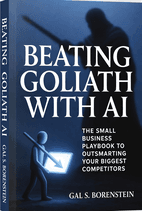
This collection brings together some of the most pointed and practical lines from Beating Goliath with AI. You will find quotes that cut through the hype and get straight to what small business owners actually need: a clear shift in mindset, actionable advice, and permission to start small. The book earns its quotability by turning complex ideas into simple memorable challenges. It speaks directly to the person who feels overwhelmed by tech and reminds them that their existing strengths are exactly the right foundation.
Top Quotes from BEATING GOLIATH WITH AI
“Do that one thing. Fifteen minutes. Progress beats perfection.”
The author advises readers who just want to try something today.
This concise mantra encapsulates the book's core philosophy of taking immediate, small action over waiting for the ideal moment, making it instantly motivating and memorable.
“Al is not your sword. It is your slingshot.”
The author introduces the central metaphor of the book, comparing AI to David's slingshot.
This line reframes AI from an intimidating weapon into a precision tool that levels the playing field. It immediately captures the book's thesis that small businesses can outmaneuver giants with cleverness, not size.
“You can test on Tuesday what they will not approve until next quarter. You can move while they are still scheduling the meeting.”
The author contrasts the speed of small businesses with the sluggishness of large corporations.
This pair of concrete examples makes the abstract advantage of speed tangible and memorable. It embodies the scrappy, adaptive mindset that small business owners can relate to and aspire to.
“Al is not coming for your business. Al is coming for your busywork.”
The author states the core truth about AI for small businesses.
This concise, memorable line cuts through hype and fear, providing immediate relief and a clear, actionable reframe of AI's role.
“David did not try to out-armor Goliath. You do not need to out-spend Best Buy.”
Opening analogy of the chapter comparing small business owners to David and large competitors to Goliath.
Reframes the competitive battle from outspending to outmaneuvering, empowering small business owners to leverage their unique strengths.
“What if the biggest barrier to using Al in your business has nothing to do with tools, pricing, or technical skill? What if the real barrier is permission.”
Opening of the chapter, challenging common assumptions about adopting AI.
It reframes the problem from external obstacles to internal permission, empowering readers to take the first step.
“Your Goliath has budget. You have accuracy.”
The author contrasts the resources of large competitors with the nimbleness of small businesses.
This memorable metaphor reframes the David-and-Goliath struggle as a battle of strengths, not size. It inspires confidence that accuracy can overcome financial disadvantage.
Themes Behind the Quotes
A central theme is the idea of fighting smarter instead of harder. The quotes emphasize that small businesses do not need to match big competitors on budget or scale. They can win by using their unique advantages like speed, direct customer relationships, and the ability to test and adapt quickly. Another theme is permission and mindset. Many of the quotes address the internal barrier of feeling afraid or inadequate when it comes to AI. The book reframes AI not as a threat but as a tool that handles busywork and rough drafts, leaving the human judgment intact.
Quotes by Chapter
INTRODUCTION
“These are not homework assignments. They are proof that Al can work for you, starting now.”
The author describes the Quick Win boxes at the end of each chapter.
This reframes the exercises from chores into empowering evidence, directly addressing reader skepticism and building confidence in AI's practical value.
“Build your foundation first. Everything else will make more sense.”
The author advises readers who don't know where to begin with AI.
This simple, reassuring advice cuts through overwhelm by prioritizing foundational knowledge, giving readers a clear and logical starting point.
INTRODUCTION
“You do not need to worship Al. You do not need to fear it. You need a way to make it serve your business, your brand, and your life.”
The author addresses common emotional reactions to AI among small business owners.
This line cuts through both hype and anxiety, offering a balanced, pragmatic stance. It reassures readers that AI is a tool to be used, not a force to be revered or dreaded.
“The businesses that win will not be the ones who adopted Al first. They will be the ones who adopted it thoughtfully.”
The author reflects on the future of AI adoption and what truly determines success.
This counters the common FOMO-driven rush and validates a careful, intentional approach. It empowers readers who may feel late to adopt by emphasizing quality over speed.
CHAPTER 1: THE PANIC PROBLEM
“I spent three hours tonight trying to figure out ChatGPT,” she said. “I thought it would help me write better emails to my customers, but everything sounded like a robot having a motivational breakdown.”
An anonymous small business owner leaves a late-night voicemail expressing frustration with AI.
This captures the relatable, human moment of panic and self-doubt that many entrepreneurs feel when first encountering AI, making the problem visceral.
“This is what Al panic sounds like for small business owners. It is not about technology. It is about feeling like there is a secret test you did not study for, and everyone is telling you your livelihood depends on passing it.”
The author reflects on the voicemail and generalizes the experience.
It reframes the fear as a psychological trap rather than a technical failure, validating readers' emotions and preparing them for a more helpful perspective.
“Think of Al as an eager intern who types 200 words per minute and never gets tired.”
The author explains how to realistically view AI tools.
The analogy demystifies AI, making it approachable and setting proper expectations for supervision and iteration, which reduces intimidation.
CHAPTER 2: H.U.S.T.L.E. FRAMEWORK
“Your fight is about using what you already have; your speed, your direct customer relationships, your ability to make decisions in hours instead of quarters, and amplifying it with tools that make sense for your size.”
Continued explanation of what the H.U.S.T.L.E. framework is designed to exploit.
Highlights the distinct advantages small businesses possess, replacing feelings of inadequacy with a clear strategy for competing.
“You would not renovate your kitchen by wandering into a hardware store and buying tools at random. You would have a plan. You would know what you are building, which steps come first, and how you will measure success. Al deserves the same discipline.”
Section explaining why most small business AI attempts fail due to lack of structure.
Uses a universally relatable analogy to drive home the necessity of planning and discipline when adopting AI, making the concept accessible.
“Think of Al less as a shortcut and more as a fast coworker who still needs supervision.”
Final 'Reality Check' section that tempers hype around AI.
Provides a practical, human metaphor that sets realistic expectations and emphasizes the owner's continued responsibility and oversight.
CHAPTER 3: MINDSET RESET
“This chapter is about changing the voice in your head from “I cannot do this” to “Let us see what happens if I try.””
Author summarizing the chapter's goal for mindset shift.
It offers a direct, actionable replacement for self-doubt with curiosity, making the change feel achievable.
“Once he saw Al as a rough-draft engine, not a replacement for his judgment, the fear lost its grip.”
Describing Jake the graphic designer's realization after the author's coaching.
It crystallizes a key insight that reduces anxiety and clarifies the proper role of AI as a tool, not a threat.
“The businesses that succeed with Al start almost embarrassingly small.”
Section advising against trying to use AI everywhere at once.
It relieves pressure to be ambitious and gives permission to start small, which is often the most effective path.
CHAPTER 4: SOCIAL MEDIA WITHOUT THE BURNOUT
“If social media feels like a job you never applied for, you are not imagining it.”
The author opens the chapter describing a common small business pain point.
It perfectly captures the exhaustion many entrepreneurs feel about social media, making them feel seen and ready for a solution.
“The goal is not to turn you into a full time content creator. The goal is to make social media sustainable, so it supports your business rather than draining it.”
The author explains the chapter's purpose after noting rushed AI adoption regrets.
It reframes social media strategy from a burden to a sustainable tool, giving overwhelmed business owners a clear, hopeful target.
“What Al cannot do is be you. It cannot know your inside jokes, your specific culture, or what feels “off” for your brand. You remain the final editor.”
The author outlines what AI can and cannot help with in social media.
This reassures readers that authenticity stays in their hands, countering the fear that AI will erase their unique voice.
“Her voice did not change. Her effort did.”
The author summarizes the result after Maria the coffee shop owner implemented a new system.
Two short sentences deliver a powerful, memorable payoff: quality and consistency can improve without sacrificing authenticity.
CHAPTER 5: ADS THAT WORK WHEN YOU CANNOT AFFORD TO WASTE MONEY
“When you cannot match their ad spend, you win with smarter targeting.”
The author advises small business owners facing larger competitors with bigger budgets.
It distills the core strategic advantage of small businesses: precision over spending power. Readers feel empowered to compete without needing deep pockets.
“That is the scrappy way to run ads. Small, fast experiments that keep you adaptive and smart instead of stuck.”
The author describes the Al Hustle approach to advertising.
It sums up a practical, low-risk methodology that feels achievable for anyone. The contrast between 'adaptive' and 'stuck' motivates readers to take action immediately.
“Nothing about his service changed. The story did.”
The author explains how an HVAC company improved ad performance by reframing its message.
This line reveals that differentiation often lies in communication, not product. It reminds readers that powerful results can come from simply telling your truth better.
CHAPTER 6: REVIEWS, REPUTATION, AND THE “OH NO” MOMENTS
“There is a special kind of stomach drop that only small business owners know.”
Opening line of the chapter describing the feeling of seeing a bad review.
It instantly captures the visceral anxiety that small business owners feel when a negative review appears, making the reader feel seen and understood.
“Silence looked like agreement.”
Dr. Flores had not responded to a negative review, making her appear to accept the criticism.
This short, punchy line packs a powerful lesson: failing to respond to criticism can be as damaging as the criticism itself.
“Reputation is not only about defense. It is free strategy research, if you are willing to look in the mirror.”
In the section about learning from patterns, the author explains how reviews offer insights.
It reframes reputation management from a defensive chore into a valuable source of market intelligence, encouraging a proactive mindset.