BEATING GOLIATH WITH AI Key Takeaways
by Gal S. Borenstein
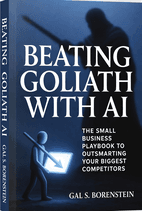
5 Main Takeaways from BEATING GOLIATH WITH AI
AI is a tireless assistant for execution, not a replacement for your judgment.
The book reframes AI as a tool for handling repetitive tasks like drafting social media posts or emails, but you must provide strategic context and final approval. For example, in crisis communication or ad creation, AI generates options, but your human oversight ensures brand alignment and ethical choices.
Start impossibly small with AI to build confidence and prove value quickly.
Begin with a fifteen-minute, low-risk task like creating a response template to overcome overwhelm and demonstrate immediate benefits. This Quick Win Principle, emphasized throughout, combats procrastination and builds momentum for broader integration without requiring technical expertise or big budgets.
Use AI to systemize operations, turning knowledge into scalable workflows.
Convert voice notes into Standard Operating Procedures (SOPs) to document processes and reduce training time. This internal application of AI, as shown in systemizing social media or email triage, creates foundational stability and frees your mental energy for strategic work.
Your brand's authentic voice is amplified, not created, by AI.
AI can maintain consistency in messaging across platforms, but it requires your input on brand promise and personality. In thought leadership or reputation management, AI helps manage content workload while you ensure authenticity, trust, and human connection with your audience.
Build lean, focused AI tool stacks that solve specific problems efficiently.
Organize tools into categories like Core Brain and Specialist Helpers, and conduct one-week auditions to ensure tangible value. Regular audits prevent tool clutter, keeping the focus on practical problem-solving and team-wide workflow efficiency, as outlined in the Lean Stack chapter.
Executive Analysis
The book's five key takeaways collectively argue that AI is not a magical solution but a practical lever for operational efficiency and competitive edge. By repositioning AI as a tireless assistant for execution, it demystifies the technology and emphasizes the entrepreneur's role as the strategist and final authority. The insistence on starting small and systemizing workflows ensures that AI integration is manageable and scalable, turning panic into proactive control.
"Beating Goliath with AI" matters because it translates overwhelming AI hype into a clear, empathetic playbook for time-strapped business owners. It sits uniquely in the business-advice genre by focusing on the mindset and practical steps needed to harness AI for immediate, tangible results—like saving hours on social media or crafting effective ads—rather than theoretical concepts. This book empowers readers to act now, using free tools and iterative experiments to build a more resilient and responsive business.
Chapter-by-Chapter Key Takeaways
INTRODUCTION (Introduction)
Non-Linear Design: The book is intentionally structured to be consumed based on your current business pain point, not from front to back.
Action Over Theory: The primary aim is to deliver immediately applicable strategies, with a strong emphasis on starting small.
The Quick Win Principle: Measurable, fifteen-minute actions at the end of each chapter are designed to build momentum and prove value quickly, combating procrastination and overwhelm.
Empathetic Tone: The writing immediately connects with the reader's real-world stresses (being busy, overwhelmed, unsure), establishing a supportive, partner-like relationship.
Try this: Jump to the chapter addressing your immediate business pain point and complete a fifteen-minute action to build momentum.
THE PANIC PROBLEM (Chapter 1)
The panic is understandable but unnecessary. The intimidating AI narrative is built for enterprises, not entrepreneurs.
AI is a tool for eliminating busywork, not a replacement for strategy or judgment. Think of it as a tireless assistant, not a genius.
Success requires resetting expectations. You will not get perfection on the first prompt. The process involves teaching the tool your style and iterating on its drafts.
Start small, stay in control. Apply AI to repetitive, low-risk tasks first. Always maintain human oversight for quality, accuracy, and brand voice.
You are not the problem. You don't need a technical background or a big budget—you need a simple framework and permission to experiment.
Try this: Apply AI to one low-risk, repetitive task today to prove its value and combat unnecessary panic.
H.U.S.T.L.E. FRAMEWORK (Chapter 2)
AI is a tool, not a strategist. Its core strength is in execution and drafting, not in making high-level decisions for your business.
Context is everything. AI output is only as good as the guidance you provide about your audience and brand voice.
Start impossibly small. Begin with one, well-defined task to build confidence and prove value before expanding.
Adopt an experimental mindset. Test, measure, and learn from every application before making it a permanent workflow.
You are the final authority. Success requires your ongoing judgment to review, edit, and decide what to scale or stop. "Smart" use of AI is about high judgment, not high tech.
Try this: Use the H.U.S.T.L.E. framework to provide AI with clear context for a specific task, ensuring it serves as an execution tool.
MINDSET RESET (Chapter 3)
The biggest barrier to AI is often self-permission, not technical skill.
View AI as a draft-generating tool, not a replacement for your judgment.
Treat disappointing AI outputs as feedback to refine your approach.
You don’t need technical expertise; your business knowledge is sufficient.
Start with small, manageable experiments to build confidence and momentum.
It’s okay to abandon AI for tasks where it doesn’t add value.
Always apply human review to high-stakes content to ensure accuracy and tone.
Embrace a mindset of curiosity and iteration over perfectionism.
Try this: Grant yourself permission to experiment with AI, treating disappointing outputs as feedback to refine your prompts.
SOCIAL MEDIA WITHOUT THE BURNOUT (Chapter 4)
Sustainable social media for small businesses is about systems, not spending more hours.
AI’s highest-value role is in the preliminary, labor-intensive stages: idea generation, first drafts, and repurposing.
You must remain the editor-in-chief; AI cannot know your brand's unique heart and humor.
Define 3-4 content pillars to give your content strategy focus and make AI assistance more effective.
A simple monthly-planning, weekly-creation, and daily-engagement rhythm can create consistency without burnout.
Repurposing one strong piece of content across multiple platforms is a force multiplier for your efforts.
Try this: Define 3-4 content pillars and use AI to generate draft posts, creating a sustainable social media rhythm without burnout.
ADS THAT WORK WHEN YOU CANNOT AFFORD TO WASTE MONEY (Chapter 5)
Competitive Edge is in Messaging, Not Just Budget: You can outmaneuver better-funded competitors by identifying and leading with your authentic, unique differentiator.
AI is a Creative & Testing Accelerator: Its prime value is collapsing the time and cost of the ideation and experimentation cycle, allowing for rapid, low-risk learning.
Ad Success is a Process, Not a One-Off: Replace the "set it and forget it" campaign with a mindset of continuous, small-budget testing and adaptation.
Start with Your Truth: The most effective ads are born from a clear, simple statement of what makes your business genuinely different—often something a larger competitor cannot replicate.
You Remain in Charge: AI generates options, but human judgment sets strategy, refines voice, and makes the final ethical and brand-aligned choices.
Try this: Identify your authentic differentiator and use AI to rapidly test small-budget ad variations for rapid learning.
REVIEWS, REPUTATION, AND THE “OH NO” MOMENTS (Chapter 6)
Your online reputation acts as a silent, powerful salesperson, shaping first impressions before you ever meet a customer.
Proactivity is essential: cultivate a volume of positive reviews to balance inevitable criticism, and never let a negative review go unanswered.
AI is a practical tool for efficiency and emotional control, helping you listen at scale, draft responses, request reviews, and identify trends.
Treat feedback as strategic insight—patterns in reviews are a direct line to understanding what you should improve or promote.
The hustle is about staying scrappy (personally inviting feedback), adaptive (acting on patterns), smart (responding calmly), and relevant (letting current customer voices define you).
Try this: Proactively request positive reviews and use AI to draft calm, professional responses to negative feedback.
THE RESPONSE LIBRARY, STOP TYPING THE SAME EMAIL FOREVER (Chapter 7)
Repetitive communication is a major, hidden source of burnout. A Response Library strategically tackles this drain.
The goal is consistent clarity, not robotic replies. Templates are flexible starting points that you personalize, preserving your brand's humanity.
AI is the ideal co-pilot for analyzing past communications, drafting template language, and maintaining a consistent tone.
Implementation can be simple and swift. Start by identifying your top repetitive questions and use AI to craft your first templates in under an hour.
The system creates operational leverage, freeing up mental energy and time for the complex, high-value work that only you can do.
Try this: Build a response library by using AI to analyze past emails and create templates for your top repetitive questions.
EMAIL TRIAGE (Chapter 8)
Email is a system to be managed, not just messages to be read. Treating it as such prevents it from consuming your mental energy and focus.
The Triage System (Categorize, Template, Batch) provides a structured escape from inbox chaos. AI acts as a force multiplier for each step, but human judgment remains essential.
Batching is non-negotiable for preserving deep work. Scheduled email windows protect your most valuable cognitive resources.
AI's role extends beyond writing from scratch to refining your own voice. It can serve as an effective editor for clarity, tone, and brevity.
Start small with a "Quick Win." Building a library of templates from your own past emails is a practical first step that yields immediate time savings.
Try this: Implement email triage by categorizing inbox items, applying templates, and batching responses to protect deep work time.
SOPs FROM VOICE NOTES (Chapter 9)
Operational Shift: True business scalability and sustainability come from applying AI internally to systemize operations, not just externally for content.
Bridge the Gap: AI is the perfect tool to solve the “time vs. expertise” dilemma, efficiently converting the knowledge in your head into documented procedures.
Start Small and Iterate: Begin with one frustrating, recurring process. The voice-to-SOP method is fast and demonstrates that documentation is achievable.
Live Documents: SOPs are not static. They must be housed accessibly, reviewed regularly, and updated easily—a task where AI continues to add value.
Foundational Stability: Well-documented processes reduce errors, training time, and your personal stress, making your business more valuable and resilient.
Try this: Record a voice note explaining a frustrating recurring process and use AI to transcribe and structure it into a starting SOP.
CRISIS MODE (Chapter 10)
Prepare During the Calm: Assume a crisis will happen and use quiet periods to build your communication safety net.
Templates Trump Panic: Having pre-drafted, authentic templates for the four main crisis types allows you to respond with speed and clarity when stress is high.
AI is Your Drafting Partner: Use AI to generate initial drafts and adapt messages for different audiences, but you must always apply your judgment, voice, and values to the final output.
Communicate Internally First: Your team is a primary audience in any crisis; keeping them informed prevents confusion and aligns your front line.
Action + Communication = Trust: Effective crisis response combines immediate corrective action with transparent, humane communication, turning a threat to trust into an opportunity to reinforce it.
Try this: Draft crisis communication templates for four common scenarios now to ensure swift, authentic responses under pressure.
BECOMING THE VOICE YOUR CUSTOMERS TRUST (Chapter 11)
Brand is a human promise, defined by actions and perceptions, which AI can only amplify—it can make a strong, honest brand more consistent or a weak, sloppy one more prolific.
Use AI to build a "brand kit" across three layers: a crystal-clear Promise, a teachable Personality, and honest Proof in the form of client stories.
Thought leadership is a scalable form of branding that establishes authority. It begins with the questions your customers already ask you.
A sustainable system beats sporadic perfection. Commit to a simple, monthly rhythm of one core theme, one anchor piece, and multiple content fragments, using AI to manage the workload without losing your authentic voice.
The ultimate goal is to become a trusted voice, ensuring long-term relevance in a noisy digital landscape by being more human, honest, and helpful than the competition.
Try this: Articulate your brand promise and personality into a 'brand kit' for AI to consistently amplify across all content.
THE LEAN STACK (Chapter 12)
Prioritize problem-solving over tool accumulation to build a lean, effective AI stack.
Organize tools into three categories: Core Brain, Embedded AI, and Specialist Helpers.
Evaluate tools through one-week auditions focused on specific jobs to ensure tangible value.
Regularly audit your stack to cancel unused subscriptions and maintain focus.
Foster team-wide understanding and usage of a small toolset to enhance workflow efficiency.
Try this: Audit your current tool subscriptions and trial one new AI application for a week to solve a specific problem.
MAKING IT STICK (Chapter 13)
Tools are not solutions; workflows are. Lasting change and efficiency come from integrating AI into repeatable processes, not from using it sporadically.
Start with one painful, recurring task. Build your first workflow around a single high-friction activity to demonstrate quick value and learn the process.
Good workflows are visible, simple, and owned. They must be documented, easy to follow, and have clear accountability to work, especially within a team.
Commit to quarterly reviews. Workflows require maintenance. Regularly ask where you're slowing down or where AI could be better leveraged.
The ultimate goal is freedom. Effective, AI-supported workflows automate the repetitive to free up your most valuable resources: time and focus for strategic and creative work.
Execution begins now. The transition from learning to doing is critical. The following 90-day plan is designed for immediate, imperfect action.
Try this: Document one AI-supported workflow for a painful task and schedule a quarterly review to optimize and scale it.
YOUR 90-DAY PLAN (Chapter 14)
Efficiency at Scale: The provided prompt library acts as a force multiplier, creating templates for nearly every business communication need, from marketing to crisis management, saving immense time and mental energy.
Quality and Consistency: Using these structured prompts ensures your communications are consistently professional, on-brand, and strategically aimed at achieving a clear objective, whether it’s qualifying a lead or recovering from a mistake.
Proactive Mindset: The prompts, especially for crisis communication and reputation management, encourage a forward-thinking approach—building social proof before you need it and addressing problems before they escalate.
Responsible Implementation: The appendices ground the technology in practical reality: start with free tools, spend only when you see clear value, and vigilantly protect sensitive client and business data.
The Human Edge: The framework emphasizes that AI generates the first draft, but your judgment, customization, and final review are what make the communication authentic and effective. The tool empowers the craftsman; it does not replace them.
Try this: Use the book's prompt library to immediately generate a professional communication, then customize it with your judgment and voice.
Continue Exploring
- Read the full chapter-by-chapter summary →
- Best quotes from BEATING GOLIATH WITH AI → (coming soon)
- Explore more book summaries →