Awaken the Giant Within, Updated Quotes
by Tony Robbins
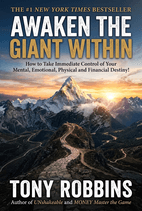
Tony Robbins has a way of distilling big ideas into sentences that stick. This collection pulls the most striking lines from Awaken the Giant Within, Updated, the edition that refines his core message on personal change. These quotes speak to the moments that define us, the beliefs that drive us, and the habits that shape our days.
What makes this book so quotable is its focus on action. Robbins does not ask you to dream harder. He asks you to decide, to commit, and to take responsibility for the meaning you create. The lines here are direct, punchy, and built for sharing when you need a nudge in the right direction.
Top Quotes from Awaken the Giant Within, Updated
“The two most important days in your life are the day you are born and the day you find out why.”
Mark Twain epigraph at the start of the chapter.
It reframes existence around purpose, making readers wonder whether they have discovered their own why.
“Change is inevitable. Growth is optional.”
Opening epigraph attributed to John Maxwell.
It captures the book’s core premise in a memorable contrast: time will pass no matter what, but choosing to grow is up to us.
“It is in your moments of decision that your destiny is shaped.”
Robbins repeats this as his core message in the chapter.
It distills the chapter’s thesis into a single powerful line, reminding readers that choices, not conditions, create their future.
“Making a true decision means committing to achieving a result, and then cutting yourself off from any other possibility.”
Robbins explores the word ‘decision’ from its Latin root meaning “to cut.”
It makes decision concrete and irreversible, shifting readers from wishful thinking to real commitment.
“The secret of success is learning how to use pain and pleasure instead of having pain and pleasure use you. If you do that, you're in control of your life. If you don’t, life controls you.”
Robbins sums up the difference between mastering pain and pleasure and being mastered by them.
It is an empowering call to take conscious control of the forces that otherwise run our lives.
“To paraphrase the philosopher Nietzsche, he who has a strong enough why can bear almost any how.”
Robbins paraphrases Nietzsche to explain the power of leverage.
It reframes hardship as manageable when purpose is strong, and it reinforces the chapter's emphasis on finding a compelling reason to change.
“Quality questions create a quality life.”
Tony Robbins summarizing the core lesson of the chapter.
This is the book's central takeaway, condensed into a memorable mantra. It is easy to remember and immediately actionable.
Themes Behind the Quotes
The strongest theme is the power of decision. These quotes insist that destiny is not handed to you. It is shaped in the moments when you commit without leaving a back door open. Robbins ties this to a practical psychology of pain and pleasure. Your behavior is driven by what you link to pain and what you link to pleasure. Lasting change happens when you make your old habits hurt and your new habits feel rewarding.
Another theme is the importance of internal meaning. Events do not control your life. Your interpretation of those events does. Beliefs can empower or destroy, so choosing useful beliefs is essential. Robbins also stresses momentum. Small repeated actions become powerful forces over time, and the questions you ask yourself determine what you notice and experience. The overall message is that you can consciously shape your inner world, and that inner world will reshape your outer results.
Quotes by Chapter
Chapter 1: Dreams of Destiny
“I decided I would never again settle for less than I could be, even if that meant changing every aspect of my life.”
Robbins recalls the turning-point declaration that changed his life.
It captures the personal commitment behind lasting change and shows that one decision can redirect a life.
“I truly believe we all have a sleeping giant within us.”
Robbins shares his core belief about human potential.
It directly echoes the book's central metaphor and inspires readers to awaken their latent power.
“Most people dabble their way through life, never deciding to master anything in particular. They major in minor things.”
He explains why so few people achieve what they truly want.
The phrase 'major in minor things' is a memorable warning against scattered effort and mediocrity.
Chapter 2: Decisions: The Pathway to Power
“It's not what we do once in a while that shapes our lives, but what we do consistently.”
Robbins explains what actually shapes long-term results.
It reframes discipline around consistency rather than occasional effort, motivating readers to examine their daily habits.
Chapter 3: The Force That Shapes Your Life
“Everything you and I do, we do either out of our need to avoid pain or our desire to gain pleasure.”
Tony Robbins states the core thesis of the chapter.
It distills the book’s entire argument into one memorable sentence and invites readers to examine their own motives.
“We are the only beings on the planet who lead such rich internal lives that it's not the events that matter most to us, but rather, it's how we interpret those events that will determine how we think about ourselves and how we will act in the future.”
Robbins explains the unique power humans have to interpret events.
It reframes personal responsibility by showing that meaning, not circumstance, drives our inner lives.
“Ultimately, in order for a change to last, we must link pain to our old behavior and pleasure to our new behavior, and condition it until it's consistent.”
Robbins describes the condition for lasting change.
It gives readers a practical formula for replacing old behaviors with new ones.
Chapter 4: Belief Systems: The Power to Create and the Power to Destroy
“Beliefs have the power to create and the power to destroy.”
Tony Robbins states the central argument of the chapter about belief systems.
It crystallizes the entire chapter into a simple, memorable antithesis.
“It's never the environment. It's never the events of our lives. It's the meaning we attach to the events—how we interpret them—that shapes who we are today and who we'll become tomorrow.”
Robbins draws this lesson after contrasting people who faced similar hardships but formed opposing beliefs.
This is the book's core insight: meaning, not circumstance, determines the direction of our lives.
“Beliefs are what make the difference between a lifetime of joyous contribution and one of misery and devastation. Beliefs are what separate a Mozart from a Manson.”
Robbins compares the power of beliefs to elevate or destroy a life.
The pairing of Mozart and Manson makes the stakes unforgettable.
“Human beings have the awesome ability to take any experience of their lives and create a meaning that disempowers them or one that can literally save their lives.”
Robbins explains how people can transform even painful experiences into empowering purpose.
It reminds readers that personal meaning is a choice, and that choice can be life-saving.
Chapter 5: Can Change Happen in an Instant?
“After all, if you can create a problem in a moment, you should be able to create a solution, too!”
Robbins urges readers to adopt the belief that change can happen in an instant.
It turns the common experience of creating problems overnight into proof that solutions can be equally immediate. This empowers readers to stop waiting and start shifting.
“It's only when something becomes a must that we begin the process of truly doing what's necessary to shift the quality of our lives.”
From the list of beliefs required for lasting change.
It captures the difference between wishing and commitment, showing that real transformation is triggered by an internal sense of necessity.
“But you know, we can “should” all over ourselves, and our life still won’t change!”
Robbins pokes fun at how people use 'should' instead of taking action.
The wordplay makes a serious insight stick: we can talk about change endlessly without ever becoming truly committed.
“We must be the source of our change if our change is going to last.”
From the same discussion of the three beliefs about responsibility.
It puts the power and responsibility for change squarely on the individual, which is the book’s core message.
Chapter 6: How to Change Anything in Your Life: The Science of Neuro-Associative Conditioning
“The beginning of a habit is like an invisible thread, but every time we repeat the act we strengthen the strand, add to it another filament, until it becomes a great cable and binds us irrevocably, thought and act.”
Opening epigraph by Orison Swett Marden.
It vividly describes how small repeated actions compound into unbreakable habits, making the stakes of daily choice feel tangible.
“If you and I want to change our behavior, there is only one effective way to do it: we must link unbearable and immediate sensations of pain to our old behavior, and incredible and immediate sensations of pleasure to a new one.”
Tony Robbins states the core principle behind Neuro-Associative Conditioning.
This distills behavioral change into a clear pain-and-pleasure equation and gives readers a memorable framework for action.
“I've found that 20 percent of any change is knowing how; 80 percent is knowing why.”
Robbins offers a practical insight about what makes change stick.
It is a concise, quotable reminder that motivation and purpose matter far more than technique.
Chapter 7: How to Get What You Really Want
“In short, then, isn’t it true that what you really want is simply to change the way you feel?”
Tony Robbins asks readers to look past their stated goals.
It cuts through surface desires and reveals emotional change as the ultimate prize.
“The state that you're in at any given moment determines your perceptions of reality and thus your decisions and behavior. In other words, your behavior is not the result of your ability, but of the state that you're in at this moment. To change your ability, change your state.”
Tony Robbins explains why emotional state matters so much.
It reframes performance as state-dependent, which means anyone can access excellence by shifting their state.
“One of the most powerful distinctions that I've made in the last ten years of my life is simply this: emotion is created by motion.”
Tony Robbins introduces the power of physiology.
It gives a simple, immediate lever for changing how we feel.
“You don’t have to have a reason to feel good—you're alive; you can feel good for no reason at all!”
Tony Robbins encourages readers to make joy an unconditional choice.
It liberates happiness from circumstances and makes feeling good a daily practice.
Chapter 8: Questions Are the Answer
“He who asks questions cannot avoid the answers.”
Cameroon proverb used as the chapter's epigraph.
It frames the entire chapter's premise in one timeless line. Readers are reminded that every question they ask sets an answer in motion.