AI MARKETING FOR SMALL BUSINESS Key Takeaways
by BOBBE ANN MILES
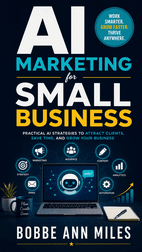
5 Main Takeaways from AI MARKETING FOR SMALL BUSINESS
AI Marketing: Your Affordable, No-Code Sidekick
The book emphasizes that AI tools are now accessible to any small business, regardless of technical skill or budget. You don't need a computer science degree—basic email skills are enough to start using free platforms like ChatGPT, Canva, and ManyChat to automate marketing tasks.
Start Small: Solve One Pain Point at a Time
Rather than trying every AI tool at once, the book advises picking the one that addresses your most urgent need—whether that's answering FAQs with a chatbot or scheduling social posts. Testing and refining one solution builds confidence and avoids overwhelm.
Brand Consistency is the Foundation of Trust
A clear, mission-driven brand statement and consistent visuals are non-negotiable before layering AI on top. Tools like Canva and Looka help professionals out branding fast, but your authentic voice and emotional connection with customers must stay human.
Automate Lead Generation, But Keep It Human
AI chatbots and drip campaigns can capture and nurture leads around the clock, but automation without warmth drives people away. The book stresses personalizing every message, using real names, humor, and transparency to build lasting relationships.
Build a Self-Running Marketing System in 7 Days
The core of the book is a step-by-step 7-day plan that combines content scheduling, lead capture, email sequences, and conversion tracking into one repeatable workflow. After just a week, you have a system that attracts, nurtures, converts, and repeats—mostly on autopilot.
Executive Analysis
The book’s central argument is that small businesses can harness AI to create an affordable, effective marketing system without technical expertise. These five takeaways form a logical progression: first overcome the fear of AI by starting small, then solidify your brand identity as the foundation, automate lead generation while preserving human warmth, and finally integrate everything into a self-sustaining cycle. Each step builds on the last, turning what seems overwhelming into a manageable 7-day plan.
This book matters because it bridges the gap between advanced AI capabilities and the real-world constraints of a small business owner. Unlike theoretical texts, it offers a concrete, no-code playbook using free or low-cost tools that anyone can implement immediately. In the crowded field of marketing advice, it stands out as both practical and empowering—demystifying technology and giving readers confidence to take action, not just learn concepts.
Chapter-by-Chapter Key Takeaways
Introduction (Introduction)
AI tools are now accessible and affordable for small businesses, regardless of technical skill or budget.
The book offers a step-by-step, 7-day plan using only no-code, ready-to-use marketing tools.
You don’t need prior AI experience—basic email skills are enough to get started.
Try this: Begin by accepting that AI marketing is now within your reach—no coding or big budget needed; just a willingness to try a single free tool like ChatGPT or Canva for 30 minutes.
Demystifying AI (Chapter 1)
AI is a practical sidekick for small business, not a complex or scary technology.
It excels at automating routine tasks: chatbots handle FAQs, content tools schedule posts, and analytics flag customer behaviors.
Start with one tool that solves your most urgent pain point—don't test everything at once.
Always test AI outputs before going live and fix mistakes with humor and transparency.
Keep your authentic voice; AI augments your marketing, but your personal touch is irreplaceable.
Try this: Identify your most urgent marketing pain point (such as answering FAQs or scheduling posts) and select one AI tool to solve it, testing its output thoroughly before going live while maintaining your authentic voice.
set the stage for success & maximize your ai tools (Chapter 2)
Specific, measurable goals turn vague hopes into achievable targets.
Track the Small Business Profit Trifecta: visitors, leads, and sales. Ignore vanity metrics.
Even a zero is valuable data—it gives you an honest baseline.
ChatGPT and Gemini offer free, powerful AI support when you prompt them clearly.
Ethical marketing builds lasting trust; don’t cut corners for short‑term gains.
Your five‑minute baseline snapshot is the foundation for tracking improvement.
Try this: Set specific, measurable goals for visitors, leads, and sales, then create a five-minute baseline snapshot using free analytics; track only the Small Business Profit Trifecta and ignore vanity metrics.
branding-- your business foundation (Chapter 3)
Branding is not optional or a future project; it’s the foundation for all marketing and customer loyalty.
Consistency in messaging, visuals, and interactions prevents confusion and builds trust.
AI tools make professional branding accessible and affordable for small businesses.
A clear, mission-driven brand statement acts as your compass for content and strategy.
Resources like Canva, HubSpot, Looka, and Shopify provide practical starting points to implement your brand today.
Try this: Define your brand’s mission statement and visual identity today using free tools like Canva or Looka, ensuring consistency across all messaging—this foundation makes every AI marketing effort more effective.
Day1-your 7-day marketing plan begins! (Chapter 4)
Start small, stay consistent. Thirty minutes a day compounds into real results by week’s end.
Match headlines to platform vibes—short punchy for email, playful for Instagram, clear-for-website.
Always personalize AI-generated content with your brand voice, humor, and local details.
Schedule posts using AI’s best-time suggestions and do a quick quality check before publishing.
Use Canva for professional visuals fast—done is better than perfect.
Leverage evergreen content to keep your feed active with less effort.
Learn from flops by analyzing what didn’t work and tweaking your approach.
Try this: Dedicate just 30 minutes daily to create and schedule platform-specific content using AI, personalizing each post with your brand voice and local details, and always test before publishing.
day2 strategy--capturing leads automatically (Chapter 5)
Lead magnets work best when they’re specific, visual, and instantly delivered—clarity beats perfection.
AI chatbots like ManyChat and Tidio capture leads around the clock; use analytics to refine your script.
Drip campaigns nurture new contacts automatically, with behavior-based triggers that keep emails relevant.
Seamless integrations (WordPress, Shopify) create a consistent experience across all customer touchpoints.
A/B testing turns hunches into data—small tweaks compound into big gains over time.
Automation without warmth drives people away; always keep messages personal and respectful.
Try this: Create a specific, visual lead magnet and set up an AI chatbot (like ManyChat or Tidio) on your website to capture leads automatically, then build a drip campaign that nurtures them with behavior-based triggers—but keep messages warm and personal.
DAY 3 More personal & more effective outreach (Chapter 6)
Segment your list using AI-driven behavior tagging for laser-focused targeting.
Write every email for a real person—read it aloud, fix the stiffness, keep it warm and clear.
A three-email welcome sequence builds trust from the start; use triggers, merge tags, and proper spacing.
Recommendations should be helpful, not pushy—one or two suggestions per message, always with an opt-out.
Let AI handle the busywork, but keep the final say human—your brand’s voice is non-negotiable.
Re-engage cold subscribers with low-pressure win-back campaigns and offer opt-down options.
Track trends in analytics and let AI highlight which tweaks drive real improvement.
Try this: Segment your email list using AI-driven behavior tags, then write every email as if to a single person—read it aloud for warmth—and build a three-email welcome sequence with trigger-based automation, leaving the final human check on tone.
Day4-set it! and forget it! (Chapter 7)
AI content calendars eliminate daily decision fatigue and keep your feed consistent.
Track what actually works (and flops) so you can double down on winning formats.
Automation needs a human signature—use emojis, real names, and local references to keep personality alive.
Mistakes are chances for engagement if you handle them with transparency and humor.
A 30-minute weekly scheduling session can free up hours of daily scrambling.
Try this: Use an AI content calendar to schedule a week’s posts in one 30-minute session, track which formats perform best, and always add a human signature (emojis, real names) to automation—handle mistakes with transparency and humor.
days 5-7 --converting leads into paying customers (Chapter 8)
Timely, personalized follow-up helps warm leads take action before momentum fades. AI-powered reminders make this easy to scale.
Conversion tracking on platforms like Shopify, Mailchimp, and Google Analytics reveals exactly which marketing efforts drive sales—no coding needed.
Use AI to automate upselling with targeted offers, showcase reviews with drag-and-drop widgets, and edit testimonials for maximum impact.
Chatbots can handle complaints gracefully when set up with warm, honest replies and escalation paths for serious issues.
Building repeat business is about making customers feel seen—AI flows nurture loyalty without burning you out.
Try this: Set up AI-powered follow-up reminders and conversion tracking on your platforms, then automate upselling and review displays, while using chatbots to handle complaints with warm, honest replies and escalation paths.
troubleshooting, scaling, & staying ahead (Chapter 9)
AI marketing roadblocks are common and usually easy to fix—always check simple technical issues first before assuming a major problem.
AI content should always be reviewed and personalized before publishing.
Scaling successful campaigns requires adapting messages to different channels.
Personalization keeps your marketing effective even as your audience grows.
Regular tool reviews help prevent overwhelm and keep your systems efficient.
Tracking key metrics like lifetime value and cost per lead keeps your focus on profit.
Try this: When facing roadblocks, check simple technical issues first; review and personalize all AI content before publishing, and periodically audit your tool stack to avoid overwhelm while tracking lifetime value and cost per lead.
chatgpt & gemini made simple (Chapter 10)
Specific prompts with context yield far better results than vague requests.
ChatGPT is ideal for writing, brainstorming, and social media content.
Gemini integrates naturally with Google Workspace, perfect for existing Google users.
Start with one or two prompts and build from there—experimentation is key.
AI tools are creative partners, not replacements; they help small businesses thrive.
Try this: Write specific, context-rich prompts for ChatGPT or Gemini—experiment with one or two prompts for writing or brainstorming, treating these tools as creative partners that amplify your unique voice.
CONCLUSION and recap (Conclusion)
A repeatable marketing system is built by combining all your automated assets into one seamless workflow.
Automate scheduling, follow-ups, and lead capture to let marketing run efficiently in the background.
In just seven days, you’ve assembled a complete cycle: attract, nurture, convert, repeat.
The system you now have is designed to be sustainable—run it once, then let it run itself.
Bonus chapters offer extra depth on branding and a step-by-step profit outline, so keep reading to reinforce your foundation.
Try this: Combine all your automated assets—scheduling, follow-ups, lead capture—into one seamless workflow that runs in the background; you now have a complete attract-nurture-convert-repeat system that sustains itself.
BONUS CHAPTER1: MORE ON BRANDING! (Chapter 11)
Branding isn’t skin-deep—it’s about the functional and emotional experience you deliver.
A strong brand does three things: attracts the right people, connects with their emotions, and converts them into loyal customers.
AI tools can dramatically speed up the branding process, but only if you start with a clear promise that answers “why choose you?”
Always tie your brand to an emotional trigger—logical reasons come second.
Try this: Anchor your brand in a clear emotional promise that answers 'why choose you?' and use AI tools to speed up the branding process, but only after you've defined that functional and emotional experience.
bonus chapter2: your 8-step marketing outline to boost profits! (Chapter 12)
Branding is non-negotiable. AI tools amplify your message, but if that message is unclear or inconsistent, automation only speeds up confusion. Lock in your brand identity first.
The eight-step outline is meant to be followed in order. Each step builds on the last, from branding to paid ads to email to support to analytics to scaling.
Specific AI tools are your shortcut. The chapter names concrete platforms (AdCreative, HubSpot, Drift, ClickFunnels, etc.) so you can jump in without endless research.
The resource section is a living document. Treat it like a tool shed—add to it, customize it, and keep it close as your business evolves.
Try this: Follow the eight-step marketing outline in order—starting with branding before automation—and treat the resource list as a living toolbox to add and customize for your evolving business.
bonus chapter3: build your own chatbot! (Chapter 13)
No code needed – You can build a fully functional chatbot using only flowcharts and a drag-and-drop interface.
Listening beats talking – The bot’s real value is in understanding user intents and responding helpfully, not in sounding clever.
Personality drives engagement – A name, greeting, and simple buttons make the bot feel like a team member, not a script.
Testing is continuous – The simulator and iterative tweaks ensure your bot learns and improves over time.
Deploy anywhere – From your website to social messaging apps, the same chatbot can serve customers across platforms.
Try this: Build a no-code chatbot using a drag-and-drop interface and flowcharts; give it a name and personality, test continuously with the simulator, and deploy it across your website and social messaging apps.
bonus chapter4: sixteen sweet ways to make money with ai! (Chapter 14)
Each method pairs a specific AI tool with a clear monetization model—no vague advice.
You can start immediately with free or low-cost trials of most tools.
The same core skills (prompting, editing, distribution) apply across multiple income streams.
Consider combining two or three approaches for diversified earnings (e.g., tutoring + YouTube + AI templates).
Try this: Pick one or two of the sixteen monetization methods and start immediately with free trials of the paired AI tools, using your core skills of prompting, editing, and distribution across multiple streams.
Dear Reader, (Chapter 15)
The book grounds its advice in real small-business case studies, not theoretical fluff.
Common AI marketing misconceptions are exposed and reframed as opportunities.
Privacy and ethics aren’t afterthoughts; they’re woven into every recommendation.
Practical, affordable tools (Canva, Buffer, ContentStudio, etc.) are highlighted so you can start immediately.
The long-term value of creating evergreen content is reinforced—AI helps you keep it fresh and visible.
Try this: Ground your AI marketing in real case studies and ethical practices; prioritize privacy and use affordable tools like Canva and Buffer, focusing on evergreen content that AI helps keep fresh.
Continue Exploring
- Read the full chapter-by-chapter summary →
- Best quotes from AI MARKETING FOR SMALL BUSINESS → (coming soon)
- Explore more book summaries →