A Statin-Free Life Quotes
by Aseem Malhotra
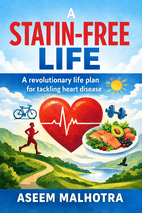
This collection gathers the most striking statements from Aseem Malhotra's provocative book. You will find direct challenges to conventional wisdom about cholesterol and statins, backed by research and clinical experience. The author's willingness to question long held medical beliefs makes these quotes particularly powerful. Many are short and punchy, perfect for sharing or remembering. Others are startling in their clarity, inviting readers to think again about heart health and medication.
What makes this book so quotable is its blend of bold claims and personal stories. Malhotra writes with the confidence of a cardiologist who has seen the limits of standard practice. His words often cut through medical jargon, offering simple truths that stick with you long after reading.
Top Quotes from A Statin-Free Life
“Your genes load the gun, but your environment pulls the trigger.”
Dr. Ross Walker opens the foreword with this metaphor.
It succinctly captures the interplay between genetic predisposition and lifestyle choices, empowering readers to take action.
“It is much easier for a person to swallow a pill than to put effort into changing their lifestyle.”
Dr. Walker explains why doctors and patients often default to medication.
This line resonates because it honestly reflects human nature and the healthcare system's convenience trap.
“Many, if not most, people prescribed statins would most likely choose not to take them if fully informed about their true benefit in preventing a heart attack or prolonging life.”
Author explains how the exaggerated benefit of statins undermines informed consent.
This line empowers readers by suggesting that full transparency would drastically change personal decisions, highlighting the gap between marketing and reality.
“Any reasonable scientist knows that correlation doesn’t necessarily mean causation.”
The author critiques Ancel Keys' Seven Countries Study and the assumption that dietary fat causes heart disease.
This pithy reminder of a core scientific principle is universally relatable and challenges the reader to question widely accepted correlations.
“Just because LDL cholesterol was at the scene of the crime, it doesn’t mean it’s the perpetrator.”
GP and author Malcolm Kendrick's analogy, quoted by the author, regarding LDL cholesterol's presence in arterial plaques.
The crime-scene metaphor makes a complex medical concept instantly understandable and memorable, undermining the simplistic 'bad cholesterol' label.
“In those who were high-risk or had suffered a heart attack and who had taken statins religiously for 5 years, there was an increase in life expectancy of a meagre 4.2 days over that 5-year period.”
The author cites a 2015 BMJ Open paper analyzing life expectancy gains from statins.
The meager 4.2-day gain starkly contrasts with the perceived life-saving power of statins, making readers question whether the trade-off with side effects is worth it.
“The conventional dietary advice on lowering cholesterol by reducing saturated fat intake is not just wrong, but has also likely worsened the risk of heart disease by fuelling the single most important root cause of coronary artery disease and heart attacks: insulin resistance.”
The author explains why heart disease remains the top killer despite decades of advice.
This is a bold, comprehensive indictment of mainstream nutritional guidance and points to the real culprit.
Themes Behind the Quotes
One central theme is the rejection of the cholesterol hypothesis as the main driver of heart disease. The book argues that inflammation, insulin resistance, and lifestyle factors like diet and stress matter far more than LDL levels. Another key idea is that statins have been oversold: their benefits are tiny in absolute terms, and many patients never experience any real gain. The author emphasizes that patients deserve full transparency about these numbers, not just relative risk reductions that exaggerate the effect.
A second major theme is the power of lifestyle change over pills. Malhotra repeatedly shows that simple habits can dramatically lower heart risk, often more than any medication. He also warns against trusting risk calculators that ignore advanced testing like coronary calcium scans. Throughout, the message is clear: take control of your own health by understanding the evidence and questioning what you are told.
Quotes by Chapter
Foreword
“Your health is your greatest asset and you are the greatest advocate for your health.”
Dr. Walker concludes the foreword with this advice.
It empowers readers to take personal responsibility and actively question medical recommendations.
“The often-ignored MORGEN trial from Holland demonstrated an 83% reduction in cardiovascular disease in people who follow these principles compared with those who scored poorly in each of these areas.”
Dr. Walker cites a study supporting the five lifestyle principles.
This statistic provides powerful, concrete evidence that lifestyle changes dramatically reduce disease risk.
Introduction
“The four-decade global campaign to curb heart disease by lowering cholesterol through diet and drugs has sadly failed.”
Opening statement of the chapter that sets the provocative thesis.
It immediately challenges the dominant medical narrative and grabs the reader's attention with a bold, unequivocal claim.
“Contrary to popular belief, the pharmaceutical industry has a fiduciary obligation to produce profit for its shareholders, with no legal requirement to provide us with the best treatment.”
Author discusses the commercial influences that bias medical evidence.
It exposes a systemic conflict of interest that many patients are unaware of, making it a powerful call for critical thinking about medical advice.
1 The great cholesterol con
“Contrary to popular belief, however, there is no convincing evidence that statins have resulted in a reduction in death rates from heart disease in populations.”
The author states this after summarizing clinical trials on statins.
This line directly challenges the widespread assumption that statins have saved lives at the population level, prompting readers to question the evidence behind standard medical advice.
“Has our obsession with lowering cholesterol - and more specifically LDL-C - done more harm than good and distracted us from a better way of combatting heart disease?”
The author poses this rhetorical question early in the chapter.
It encapsulates the central theme of the book and forces readers to reconsider whether the focus on cholesterol has been misguided.
“The standard mantra was: ‘Take these pills on a daily basis; they're life- saving.’ At least, that’s what we were led to believe from national and international medical guideline bodies.”
The author reflects on the prevailing medical advice given to patients after a heart diagnosis.
This quote highlights the blind faith placed in statins and the disconnect between official guidelines and the author's clinical observations.
“Doctor, within a few days of stopping the statin my chest pain and fatigue have completely disappeared. For the first time in months I feel like myself again.”
Mr. Patel, a patient, says this to the author after stopping his statin on a trial basis.
This personal anecdote powerfully illustrates the potential side effects of statins and the dramatic improvement patients can experience when the drug is withdrawn.
2 What is cholesterol and how is it related to heart disease?
“In summary, without cholesterol we wouldn't be able to survive.”
The author summarizes the essential functions of cholesterol in the body.
It starkly contradicts the common fear of cholesterol by stating a basic biological truth, making readers reconsider its vilification.
3 What is the evidence for lowering cholesterol?
“How could I develop more heart disease in such a short space of time with very low levels of cholesterol? I thought that was impossible!”
Mr Smith, a patient who lowered his cholesterol dramatically via diet but then experienced worsening heart disease, asks this desperate question.
It exposes the profound contradiction between the cholesterol hypothesis and real-world outcomes, forcing readers to question the assumption that low cholesterol automatically prevents heart disease.
“You could be an obese, diabetic, smoking couch potato and still not develop coronary artery disease (furring in the arteries) ... as long as the cholesterol level in your blood is low enough.”
This is a quote from Dr Michael Greger's book 'How Not to Die', cited by the author as an example of the extreme cholesterol-centric view.
It starkly dramatizes the conventional belief that cholesterol is the sole risk factor, setting up the author's subsequent refutation and making readers reassess what truly drives heart disease.
“Firstly in 75% of the trials, there was no statistically significant reduction in mortality, ie. no prolongation of life for any of the participants.”
The author describes the findings of a 2020 BMJ research paper he co-authored analyzing 35 randomized controlled drug trials for LDL lowering.
This startling statistic directly challenges the primary justification for aggressive cholesterol lowering, suggesting that such interventions often fail to extend life.
“Congratulations,’ I replied, ‘You're probably going to live longer.”
The author responds to a terrified patient whose GP told her she had high cholesterol.
This counterintuitive and reassuring line flips the typical fear-based narrative about cholesterol, encapsulating the book's message that higher LDL may be beneficial in many people.
4 Statins and their side effects
“The overwhelming majority of patients taking a statin with heart disease will receive no benefit whatsoever.”
The author explains the concept of Numbers Needed to Treat (NNT) to show the actual benefit of statins.
This blunt statement challenges the widespread belief that statins are highly effective for heart disease patients, forcing readers to reconsider the drug's true impact.
“It is an ethical imperative that all patients and doctors understand the difference between relative and absolute risks to protect patients from unnecessary anxiety and manipulation.”
The author quotes Gerd Gigerenzer from a World Health Organization bulletin on health literacy.
This quote elevates the discussion of risk communication to an ethical duty, appealing to readers' sense of fairness and patient autonomy.
“For those with heart disease, taking a statin every day for 5 years results in a 1-in-39 chance of preventing a non-fatal heart attack and a 1-in-83 chance of delaying death.”
The author presents the NNT for statins in patients with established heart disease.
These concrete numbers make the limited benefit tangible and memorable, empowering readers to make informed decisions rather than relying on exaggerated relative risk reductions.
5 What actually causes heart disease?
“It's now overwhelmingly clear that dietary fat does not cause coronary plaques to develop.”
The author debunks the clogged pipe hypothesis of heart disease.
This directly challenges decades of dietary dogma and offers a liberating perspective on heart disease causation.
“It's estimated that 86% of heart attacks occur at sites where there is actually no reduction in blood flow to the heart muscle, even with exercise.”
The author explains where heart attacks typically occur.
This statistic is counterintuitive and underscores that blockage severity is not the main culprit.
“It’s not the degree of narrowing itself that kills people: it’s the sudden formation of a clot over the narrowing — whatever size that may be - that does.”
The author summarizes the true mechanism of heart attacks.
It provides a clear, memorable explanation that shifts focus from plaque size to clot formation.
6 The coronary calcium score
“Without the calcium score, his risk would have been given a falsely high reading of 12.4%, placing him in the moderate risk category. Potentially, he would be told by his primary care physician that he should go ona statin.”
A case example illustrating how a calcium score can correct a falsely high risk estimate from conventional risk calculators.
This passage exposes the potential for unnecessary statin prescriptions due to flawed risk assessment, highlighting the power of the calcium score to prevent overtreatment.
“Remember that for individuals with a greater than 10% cardiovascular risk there’s no mortality benefit in taking statins, unless you've already had a heart attack, and an approximately 1-in-100 chance of preventing a non-fatal heart attack or stroke over the next 5 years from religiously taking the medications in primary prevention.”
The author explains the limited benefit of statins for primary prevention in those with greater than 10% risk.
It challenges the widespread assumption that statins are beneficial for all high-risk patients, emphasizing the lack of mortality benefit and the very small absolute risk reduction.
“So, risk calculators without a calcium score can either falsely reassure patients or falsely give them an increased risk assessment, and subject them to a lifetime of statins without informed consent.”
A conclusion about the consequences of using risk calculators without a calcium score.
This line encapsulates the ethical issue of misinformed medical decisions, arguing that patients are often subjected to lifelong medication without proper understanding.
“What several studies of the calcium score test have also exposed is that there is no relationship between LDL and either extent of heart disease or risk of heart attack.”
The author summarizes findings from calcium score studies regarding LDL cholesterol.
This quote directly contradicts the long-held belief that LDL cholesterol is the primary cause of heart disease, supporting the book's central thesis.