A Brief History of Time Quotes
by Stephen Hawking
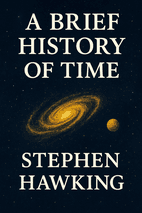
Inside you will find a collection of memorable lines from Stephen Hawking's masterpiece. These quotes capture his ability to explain deep cosmic ideas with clarity and wit. From profound insights about time and space to playful remarks about turtles and antimatter, each quote reflects his unique voice. The book is quotable because Hawking makes complex physics feel personal and even humorous. His words invite you to think about the universe in new ways.
What makes these quotes stand out is their blend of scientific rigor and human curiosity. Hawking never talks down to his readers; instead he shares his wonder and occasional skepticism. Whether he is describing black holes or the nature of time, his language remains accessible and vivid. Readers will find lines that challenge their assumptions and spark conversations. This collection is perfect for anyone who wants a taste of Hawking's genius.
Top Quotes from A Brief History of Time
“You're very clever, young man, very clever,” said the old lady. “But it's turtles all the way down!”
An old lady responds to a scientist who dismissed her flat-earth theory by asking what the tortoise stands on.
This humorous exchange illustrates the infinite regress problem and underscores how deeply held assumptions can defy logic, making it a memorable entry point into questioning our own picture of the universe.
“As we shall see, the concept of time has no meaning before the beginning of the universe.”
Hawking introduces St. Augustine's insight that time is a property of the created universe.
This statement challenges our intuitive understanding of time and sets the stage for the revolutionary idea that time itself began with the big bang.
“In other words, the theory of relativity put an end to the idea of absolute time!”
After explaining how observers disagree on time intervals in relativity.
This dramatic declaration highlights a major shift from Newtonian to relativistic thinking. It challenges the intuitive notion of a universal clock.
“Nevertheless, Einstein never accepted that the universe was governed by chance; his feelings were summed up in his famous statement “God does not play dice.””
Einstein's objection to the randomness introduced by quantum mechanics.
This quote captures Einstein's famous skepticism and the philosophical tension between determinism and probability that defines quantum theory.
“However, if you meet your antiself, don’t shake hands! You would both vanish in a great flash of light.”
Hawking discusses antiparticles and warns about meeting an antiself.
This line is both humorous and vivid, making the abstract concept of annihilation memorable.
“One could well say of the event horizon what the poet Dante said of the entrance to Hell: “All hope abandon, ye who enter here.””
Hawking likens the event horizon of a black hole to the entrance of Hell as described by Dante.
The poetic reference gives a haunting, visceral quality to the scientific concept, emphasizing the irreversible and terrifying nature of a black hole's boundary.
“This result became known by the maxim: “A black hole has no hair.””
Hawking explains the theorem that black holes are characterized solely by mass, rotation, and charge.
The clever metaphor 'no hair' succinctly captures the elegant simplicity of black holes, contrasting with the messy details of their formation.
Themes Behind the Quotes
One major theme is the nature of time itself. Hawking repeatedly questions whether time had a beginning and how it connects to space. He challenges notions of absolute time and shows how relativity reshapes our understanding. Another theme is the limits of human knowledge, embodied by the uncertainty principle and the provisional nature of scientific theories. Hawking emphasizes that we can never prove a theory definitively, only test it.
A further theme is the strange behavior of black holes and singularities. The quotes reveal how black holes challenge our intuitions, with event horizons that trap everything and the possibility of complete disappearance. Finally, Hawking often touches on the human side of science, from historical anecdotes like Galileo to his own playful remarks about antimatter handshakes. These quotes highlight the blend of humility and ambition in scientific inquiry, as well as the ongoing tension between science and religious or philosophical questions.
Quotes by Chapter
Chapter One - Our Picture of the Universe
“Any physical theory is always provisional, in the sense that it is only a hypothesis: you can never prove it.”
Hawking explains the nature of scientific theories and the principle of falsifiability.
It captures the essence of scientific humility and progress—that no theory is ever final, only awaiting a better one—which resonates with anyone curious about how science works.
“One may say that time had a beginning at the big bang, in the sense that earlier times simply would not be defined.”
Hawking summarizes the implication of Hubble's discovery that the universe is expanding.
This redefines the concept of a beginning in a physically meaningful way, transforming a metaphysical question into a scientific one and offering a profound new perspective on existence.
Chapter Two - Space and Time
“When the famous Dr. Johnson was told of Berkeley's opinion, he cried, “I refute it thus!” and stubbed his toe on a large stone.”
Dr. Johnson's response to Bishop Berkeley's idealism, which holds that material objects are illusions.
It is a memorable, witty demonstration of common-sense realism. The anecdote illustrates the clash between philosophical idealism and everyday experience.
“The fundamental postulate of the theory of relativity, as it was called, was that the laws of science should be the same for all freely moving observers, no matter what their speed.”
Einstein's key assumption in developing special relativity.
This concise statement captures the core principle that led to a revolution in physics. It emphasizes the democratic nature of physical laws.
“We must accept that time is not completely separate from and independent of space, but is combined with it to form an object called space-time.”
Conclusion of the section on relativity's implications.
It elegantly summarizes the unification of space and time into a single fabric. This concept is central to modern physics and deeply profound.
Chapter Three - The Expanding Universe
“The discovery that the universe is expanding was one of the great intellectual revolutions of the twentieth century.”
This statement appears after Hubble's observation that galaxies are moving away from us.
It succinctly captures the paradigm shift in cosmology, emphasizing the profound change in our understanding of the universe.
“In fact, in 1922, several years before Edwin Hubble's discovery, Friedmann predicted exactly what Hubble found!”
This refers to Alexander Friedmann's theoretical work based on general relativity.
It highlights the power of theoretical prediction and the underappreciated role of Friedmann in foreseeing cosmic expansion.
“We have no scientific evidence for, or against, this assumption. We believe it only on grounds of modesty: it would be most remarkable if the universe looked the same in every direction around us, but not around other points in the universe!”
This is the author's justification for Friedmann's second assumption that the universe is homogeneous.
It elegantly invokes the Copernican principle and humility, reminding us that our perspective is not special.
“Many people do not like the idea that time has a beginning, probably because it smacks of divine intervention.”
This follows the discussion of the big bang singularity and the beginning of time.
It touches on the tension between scientific cosmology and theological or philosophical beliefs, making the reader reflect on human resistance to certain ideas.
Chapter Four - The Uncertainty Principle
“The more accurately you try to measure the position of the particle, the less accurately you can measure its speed, and vice versa.”
Heisenberg's formulation of the uncertainty principle.
It succinctly and memorably expresses the core trade‑off in quantum measurement, a concept that challenges classical intuition.
“Heisenberg’s uncertainty principle is a fundamental, inescapable property of the world.”
After explaining the principle and its mathematical limit.
This stark declaration underscores that the uncertainty is not a technological limitation but a built‑in feature of reality.
“The uncertainty principle signaled an end to Laplace's dream of a theory of science, a model of the universe that would be completely deterministic: one certainly cannot predict future events exactly if one cannot even measure the present state of the universe precisely!”
The final conclusion about the implications of the uncertainty principle.
It marks a profound shift in scientific worldview, replacing absolute predictability with fundamental limits on knowledge.
Chapter Five - Elementary Particles and the Forces of Nature
“If the world had been created without the exclusion principle, quarks would not form separate, well-defined protons and neutrons. Nor would these, together with electrons, form separate, well-defined atoms. They would all collapse to form a roughly uniform, dense “soup.””
After explaining Pauli's exclusion principle, Hawking describes a world without it.
It powerfully illustrates the crucial role of the exclusion principle in shaping the universe's structure.
“He was the archetypal theoretical physicist: it was said of him that even his presence in the same town would make experiments go wrong!”
Wolfgang Pauli is introduced, with an anecdote about his reputation.
The humorous exaggeration underscores Pauli's legendary status and adds human interest.
“If, for some reason, we could only observe the ball at low energies, we would then think that there were thirty-seven different types of ball!”
Hawking uses a roulette wheel analogy to explain spontaneous symmetry breaking in the Weinberg-Salam theory.
It makes a complex physics concept accessible and memorable through a simple analogy.
Chapter Six - Black Holes
“This remarkable fact led Roger Penrose to propose the cosmic censorship hypothesis, which might be paraphrased as “God abhors a naked singularity.””
Hawking describes Penrose's cosmic censorship hypothesis, which posits that singularities are always hidden behind event horizons.
The phrase 'God abhors a naked singularity' anthropomorphizes a key principle of general relativity, making it memorable and slightly whimsical while underscoring a deep truth.
“It might seem a bit like looking for a black cat in a coal cellar.”
Hawking describes the difficulty of detecting black holes since they emit no light.
The analogy is vivid and humorous, making an abstract concept instantly relatable. It captures the challenge of observing an invisible object in a memorable way.
Chapter Seven - Black Holes Ain’t So Black
“The event horizon, the boundary of the black hole, is like the edge of a shadow—the shadow of impending doom.”
Hawking describes the nature of the event horizon.
This metaphor vividly conveys the ominous and inescapable nature of black holes, making a complex concept deeply resonant and memorable.
“It would be a poor sort of immortality, however, because any personal concept of time for the astronaut would almost certainly come to an end as he was torn apart inside the black hole!”
Hawking discusses the recycling of an astronaut's mass via black hole radiation.
This line poignantly contrasts the idea of cosmic return with the destruction of personal identity, highlighting the ultimate irreversibility of individual experience.
“The most likely outcome seems to be that the black hole will just disappear, at least from our region of the universe, taking with it the astronaut and any singularity there might be inside it, if indeed there is one.”
Hawking describes the eventual fate of a black hole that has evaporated via quantum emission.
This line vividly captures the dramatic, almost poetic image of a black hole vanishing entirely, swallowing both matter and the very concept of a singularity. It encapsulates the profound shift from classical to quantum thinking about the end of spacetime.
“This was the first indication that quantum mechanics might remove the singularities that were predicted by general relativity.”
Hawking reflects on the significance of his 1974 discovery of black hole radiation.
It marks a pivotal moment in theoretical physics, suggesting that the seemingly inevitable singularities of general relativity could be resolved by quantum effects. The simplicity and boldness of the statement make it memorable.
Chapter Eight - The Origin and Fate of the Universe
“He told us that it was all right to study the evolution of the universe after the big bang, but we should not inquire into the big bang itself because that was the moment of Creation and therefore the work of God.”
The Pope addresses the conference attendees, setting a religious boundary on cosmological inquiry.
This line captures the enduring tension between science and religion, and Hawking's subtle defiance in presenting a theory of a universe without a beginning.
“I had no desire to share the fate of Galileo, with whom I feel a strong sense of identity, partly because of the coincidence of having been born exactly 300 years after his death!”
Hawking reflects on his own situation after giving a talk on a no-boundary universe.
It is a witty and personal moment that links Hawking to a historical icon of scientific persecution, highlighting the courage required to challenge dogma.