Young Man in a Hurry Quotes
by Gavin Newsom
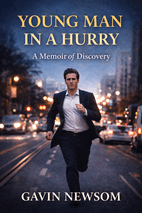
These quotes are drawn from Gavin Newsom's memoir, a book that moves between personal struggle and public life. You will find lines that capture raw emotion, sharp insights, and moments of unexpected beauty.
What makes the book so quotable is its unfiltered honesty. Newsom writes about failure, identity, and the passage of time without sentimentality. The quotes here range from gut wrenching confessions to simple observations that ring true long after you read them.
Top Quotes from Young Man in a Hurry
“I am writing this from a time and place when the seasons have already begun to lose their capacity to tell us what time and place it is.”
The author reflects on writing early in the morning amidst climate change and personal turmoil.
This line powerfully captures the disorienting effect of a changing climate on our fundamental sense of time and place, resonating with anyone feeling the erosion of natural rhythms.
“Storytelling and drinking ran together on the Newsom side of my family. They might as well have been Irish twins the way one prepared the ground for the other, the way one watched out for the other.”
The author describes his family's intertwined traditions of storytelling and drinking.
This vivid metaphor illustrates how family vices and virtues can be inextricably linked, creating a memorable image of mutual reinforcement and heritage.
“To tell a good story, you had to live a good life, and to live a good life, you had to engage with worlds different from your own.”
The author recounts his great-grandmother Belinda Newsom's belief about storytelling and living.
A universal piece of wisdom that connects narrative skill to lived experience and openness, inspiring readers to seek diversity and depth in their own lives.
“A boxer who could barely read, who drank raw eggs from a blender, who pounded his fists into hanging sides of beef, who fashioned a new body with push-ups and sit-ups, who ran up the seventy-two steps of the Philadelphia Museum of Art and lifted his clenched hands above the whole city— it was the Metamorphoses for a kid like me.”
Narrator describes his transformative experience watching the movie Rocky as a struggling dyslexic child.
Vividly illustrates how a fictional character becomes a mythic source of inspiration for a young boy facing his own battles; the rhythmic listing and epigrammatic ending make it unforgettable.
“When language eludes you, identity eludes you, too.”
The narrator reflects on his struggles with dyslexia and reading comprehension.
It succinctly captures the deep connection between language and self-perception, resonating with anyone who has felt lost due to a learning difficulty.
“Your past does not equal your future.”
Tony Robbins' motivational message that the narrator absorbed from audio tapes in the early 1990s.
This concise, empowering aphorism challenges fatalism and inspires personal reinvention, a theme that drives the narrator's journey from setback to opportunity.
“With the benefit of time and reflection, it would become clear to me that what I had done was not just a transgression that tore at friendships and staff. It was the worst betrayal of my life.”
Reflection on the affair's impact.
'Worst betrayal of my life' is a powerful self-indictment that underscores the depth of remorse.
Themes Behind the Quotes
The quotes reveal a deep engagement with identity. Newsom grapples with his learning disability, his family's fractured history, and the question of who he really is. This search for self appears in lines about language, memory, and the ways we tell our stories. It is a thread that ties personal pain to public ambition.
Another strong theme is the tension between time and legacy. Newsom often reflects on how quickly life passes and how little time politicians have to make a difference. There is also a raw honesty about failure and betrayal. These quotes do not shy away from regret, but they also suggest that the past does not have to define the future.
Quotes by Chapter
Chapter One
“My brain does better with nonfiction, but only if the words have room to breathe.”
The author explains his dyslexia and how he processes written text.
A poetic and relatable metaphor for the struggle with a learning disability, it humanizes the experience and emphasizes the need for accessibility in communication.
Chapter Two
“R one hundred thousand dollars,” the voice said, “we'll send you a photo of the boy missing an arm or leg.”
The kidnappers respond to a reduced ransom offer during Paul Getty's captivity.
This chilling, matter-of-fact threat reveals the cold calculation of the kidnappers and the life-or-death stakes of the negotiation.
“I've got one ear on the side of my head and the other one stuck in my brain.”
Young Paul Getty responds after Hilary awkwardly asks about his missing ear.
The line showcases Paul's resilience and sharp wit in the face of a traumatic, disfiguring ordeal, and it breaks the tension with unexpected humor.
“U were devastated to leave Dad,” Hilary told me. “You were holding on to him and crying, and you wouldn't let go. It was just agonizing to watch.”
The author’s sister recalls a wrenching custody exchange at the Nut Tree.
The raw emotion and vivid detail convey the deep pain of a child torn between parents, and the sister's empathy for both the boy and their mother makes this passage profoundly moving.
“He was just seventeen, a boy who'd been carrying a Mickey Mouse comic book under his arm when the kidnappers stole him from his life.”
The narrator describes Paul Getty III at the time of his kidnapping.
This line evokes the tragic loss of innocence with a vivid, heartbreaking image of a teenager clinging to a childhood comic book.
Chapter Three
“I understood even back then that this, too, came from her deep reservoir of love for me. But I don't recall crueler words ever said about me.”
Narrator reflects on his mother telling him it's okay to be average after struggling with dyslexia.
Captures the painful irony of a loving parent's well-intentioned comfort that stings deeply; resonates with anyone who has felt defined by a limitation.
“His own fingers were stained antique yellow from a lifetime of cigarette smoking.”
During the dollar bill game, narrator notices his grandfather's hands.
A single, stark image that evokes mortality, habit, and character; it lingers in the mind as a poignant detail.
“I dropped the phone and left it dangling. There was no one home to stop me from pounding my fists into the floor, but the pounding brought no relief. I was all alone with a sorrow I had never felt in my life.”
Narrator receives news of his grandfather's death over the phone.
Raw, unadorned depiction of childhood grief and isolation; the dangling phone and futile pounding create a powerful, visceral scene.
Chapter Four
“My body began to feel like it belonged to me.”
The narrator describes his late physical maturation after years of awkward growth.
This simple sentence conveys a universal moment of bodily acceptance and confidence, marking a turning point in adolescence.
“Weirdly, my disability had blessed me with the gift of an acute memory.”
The narrator discovers that his dyslexia gave him a strong memory from marking key sentences.
It reframes a perceived weakness as a unique strength, inspiring readers to find silver linings in their challenges.
“He became Gordon's whisperer, his interpreter and translator, a bridge to their friends, a bridge to Gordon's own children.”
Describing the narrator's father's role in connecting Gordon Getty to the outside world.
This line captures the profound and selfless nature of the father's gift, elevating him from a mere friend to an essential lifeline for Gordon.
Chapter Five
“Hitting the ball on the nose and watching it fly over the fence was a sublime feeling, mostly because you couldn't explain how it happened.”
The narrator reflects on his love for baseball and the inexplicable joy of a home run.
It captures the ineffable magic of a perfect athletic moment, resonating with anyone who has experienced a peak physical or creative act that defies rational explanation.
“It took both maximum effort and no effort at all.”
Continuing the description of hitting a home run, contrasting effort and ease.
This paradoxical line eloquently describes the state of flow, where intense focus and surrender coexist, making it memorable for its simple truth about peak performance.
“I had never derived such contentment from a book.”
The narrator discovers an art history textbook that finally clicks with his dyslexic mind during his semester abroad in Rome.
It expresses the profound personal breakthrough of finding a subject that speaks directly to one's learning style, offering hope to anyone who has struggled with conventional education.
Chapter Six
“These were the meter maids who came into public view mostly when they pulled out their ticket books. Who knew—certainly not me—the day-in-and-day-out abuses they were made to endure for simply doing their jobs? They were shouted at and spit on, called the N- word, even shot at with BBs and pellets.”
The author describes the challenges faced by meter maids (parking enforcement officers) as recounted to the Parking and Traffic Commission.
This passage reveals the hidden humanity and systemic abuse endured by low-level public workers, challenging the reader's perspective on a often-maligned job.
“What the public too often did not see were the untold acts of kindness and decency they performed to help drivers out of so many jams. The flat tires they fixed, the ambulances they summoned, the fits of road rage they calmed, the hands they held of women going into labor right there in the back seat.”
The author continues describing the unsung good deeds of parking control officers.
It highlights the compassion and service of these workers, contrasting their public image with their real contributions.
“You don't know how excited I am to be swearing you in tonight.” I let out my breath, only to inhale Willie's fire. “If you want to make it in this business, you have to know how this works. I appointed you. You did not get elected by the people. You did not receive a single vote. Except for mine. You knew my position on this matter. If not, you should have known.”
Mayor Willie Brown admonishes the author after a political misstep regarding the 49ers stadium bonds.
This quote captures the raw, blunt mentorship of a political boss and the harsh lesson about loyalty and political reality.
“My mother believed that my obsessive drive as a businessman and now my resolute leap into politics were a response to my childhood. I was trying to solve the riddle of my identity, the question put there by my learning disability and the vastly different worlds that she and my father had presented to me.”
The author reflects on his mother's interpretation of his ambitions.
This line delves into the psychological motivations behind his drive, revealing vulnerability and the search for identity.
Chapter Seven
“If you're serious about anything,” he bellowed, “you need to be deadly serious about getting to the bottom of police abuse of Black people living in Bayview—Hunters Point.”
Van Jones bursts into Newsom's first meeting with department heads to demand police reform.
It sets a moral imperatives for racial justice, challenging the mayor to act with urgency and sincerity.
“But you ain’t real. You're a ghost. You'll be gone until the next election.”
A young basketball player in Bayview-Hunters Point jabs at Mayor Newsom after a pickup game.
It captures the deep skepticism and distrust that marginalized communities feel toward politicians who only appear at election time.
“This is a short life, Gavin. Your time as a politician to get things done is just a blip.”
Campaign consultant Eric Jaye urges Newsom to act boldly on same-sex marriage despite political risks.
It powerfully reminds leaders that the window for meaningful change is fleeting, justifying courageous action.
“At our age, we do not have the luxury of time.”
Phyllis Lyon laments the nullification of her marriage to Del Martin after more than fifty years together.
It poignantly expresses the pain and injustice felt by elderly same-sex couples who fought for recognition while running out of years.
Chapter Eight
“Everything you've heard and read is true. And I'm deeply sorry about that. I've hurt someone I care deeply about, Alex Tourk, and his friends and family, and that is something I have to live with.”
Gavin Newsom's public apology after the affair was revealed.
The raw honesty and lack of equivocation make this a defining moment of accountability.