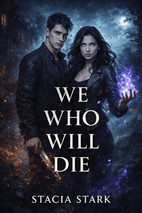
Stacia Stark's We Who Will Die launches a dark fantasy romance series where human tribute Danica must survive a brutal fae gladiatorial tournament, forming a dangerous alliance with a mysterious warrior. This novel is for readers who enjoy high-stakes survival and enemies-to-lovers tension in a conquered kingdom.
On Insta.page you also get an Apply This Book tool that lets you combine insights from up to 3 books to solve your specific situation.
Chapter mindmaps
Free preview: chapters 1–4 are fully interactive. Click any node to expand or collapse. Subscribe to unlock the rest.
Chapter 1: Chapter One
Key concepts: Chapter One
1. Chapter One
The Tavern Vigil: A Guardian in a Den of Magic and Vice
Arvelle endures a tense, late-night shift guarding the cowardly Gaius Panthen in Yorick's tavern.
Her focus is split between the clock, her client, and the single gold coin that stands between her brother and his medicine.
The atmosphere is thick with heat, noise, and casual displays of magic, contrasting with Arvelle's weary, singular focus.
A Past Champion's Shadow: Confrontation with Silver-Crowned Fury
Orson Norcross, a powerful silver-sigilmarked enemy, storms in to confront Gaius over a stolen wife.
Gaius cowardly shoves Arvelle forward as a human shield, forcing her into the conflict.
Orson recognizes Arvelle as 'a champion of the Sands,' a title she visibly recoils from, using her faded reputation to defuse the immediate violence.
Coin and Contempt: The Price of Protection
After the confrontation, the cowardly Gaius tries to withhold Arvelle's payment.
A single, silent, threatening look from Arvelle is enough to secure her gold coin.
This moment underscores her dangerous capability and the transactional, disrespectful nature of her work.
Descent into the Fog-Shrouded Thorn: A District of Shadows and Dread
Arvelle ventures into the dangerous night streets, a world of corrupt Wardens and glister-addled figures.
The sight of the drug 'glister' sickens her with a sense of grim familiarity and foreboding.
The foggy, oppressive atmosphere mirrors her growing anxiety as she heads to the apothecary.
The Vanished Cure: A Panic Solidifies into Horror
The apothecary, Perrin, reveals the crucial lung tonic is completely out of stock.
A frantic district-wide search confirms a terrifying pattern: every last vial has been bought out.
Arvelle's professional composure shatters into raw, desperate panic for her brother Evren.
Dawn's Dark Visitor: A Vampire in the Sanctuary
Returning home at dawn, defeated, Arvelle is met not by solace but by the vampire Bran, leaning casually against her wall.
The sound of Evren's wracking cough underscores the intrusion of this supernatural threat into her family's fragile sanctuary.
Bran reveals the two vials of tonic, demonstrating his control over her most vulnerable point.
The Lethal Bargain: Assassination or a Brother's Death Sentence
Bran, revealing he serves the emperor, offers an impossible deal: survive the Sundering, join the Praesidium Guard, and kill Emperor Vallius Corvus.
The reward is not just the tonic, but a full cure for Evren and freedom for her family.
Arvelle immediately refuses, calling it suicide that would orphan her brothers, showing her primary motivation is familial survival, not ambition.
The Ultimatum: A Choice Between Two Certainties
Bran remains chillingly unmoved, reframing her refusal as the active choice to 'kill him yourself' by denying the cure.
He gives her until midnight to decide, then vanishes with supernatural speed.
Arvelle is left utterly alone, the echo of Evren's cough a ticking clock, trapped between her brother's certain death and her own near-certain demise.
Chapter 2: Chapter Two
Key concepts: Chapter Two
2. Chapter Two
The Waking Nightmare: Evren's Suffering
Arvelle is jolted awake by Evren's severe, painful coughing fit, a recurring crisis.
She administers precious salve, lung tonic, and a healing crystal with a desperate chant.
Evren's guilt-ridden apology about the medicine's cost underscores their perpetual financial ruin.
The Ghost of Betrayal and a Boy's Vengeance
Gerith confronts Arvelle about their uncle stealing her winnings, declaring his intent for revenge.
The conversation shifts to the deeper wound: the loss of their mother and 'him' (Ti).
Gerith reveals his dream to fight in the Sands to cure Evren, filling Arvelle with protective dread.
The Porridge of Poverty
The kitchen reveals stark scarcity: a dying cooling crystal, porridge made with water, Gerith's worn-out boots.
The knock reveals Sarai, a hungry girl who devours Arvelle's offered breakfast in silent communion.
Arvelle's parting words to Evren—'Be good'—carry the heavy ghost of the day their mother died.
Sparring and Shadows: The Murders in the Thorn
At the training arena, Arvelle spars verbally with Fallon, critiquing her form—a moment of strained normalcy.
Carrick arrives, shifting the atmosphere with grim news of ritualistic murders (hearts removed).
He insists on walking with her, draping the district in a new cloak of external, systemic danger.
The Proposal That Feels Like a Knife
Carrick confronts Arvelle's emotional stasis since Ti's abandonment, refusing to let her deflect.
He proposes marriage as a practical escape: a better life for her brothers, away from the Thorn.
Arvelle, paralyzed by the fear of another devastating betrayal, rejects him: 'I can't risk another heartbreak.'
The Ground Gives Way
Reeling from the confrontation, Arvelle hears her name called in raw panic.
Gerith appears, pale, tear-streaked, and breathless from running.
He delivers the two-word catastrophe that shatters the morning's fragile peace: 'It’s Ev.'
Chapter 3: Chapter Three
Key concepts: Chapter Three
3. Chapter Three
The Desperate Sprint Home
Arvelle's frantic run is a blur of panic and denial, a physical manifestation of her terror.
The journey home is stripped of sensory detail, focusing solely on her dread of what she will find.
This opening beat establishes the chapter's breakneck pace and life-or-death stakes from the first sentence.
A Brother Dying on the Doorstep
Arvelle finds Evren suffocating, with the vampire Bran as a calm, observing audience.
Despite the presence of friends Carrick and Gerith, Arvelle feels utterly alone in the crisis.
The domestic threshold becomes a stage for a supernatural assault, inverting safety into vulnerability.
Bran's Cruel Demonstration of Power
Bran offers lung tonics, then shatters one to prove his control and the fragility of Evren's life.
He reveals his fangs not as an attack, but as a silent, chilling threat.
The destruction of the cure is more violent than a physical blow, showcasing psychological warfare.
The Standoff and the Capitulation
Arvelle draws a silver knife, creating a tense stalemate broken only by Evren's decline.
With her brother dying in her arms, her defiance crumbles; she agrees to Bran's terrible bargain.
Key Dialogue: The unspoken agreement—her submission for her brother's breath.
The Horror of the Remedy
The single tonic is insufficient; Bran offers his own blood to heal the physical damage.
Carrick retches, Gerith turns green, but Arvelle ruthlessly forces the vampire blood down Evren's throat.
The act stabilizes Evren but fills Arvelle with self-loathing, marking her first irreversible moral compromise.
The Ultimatum and Fractured Bonds
Bran delivers his terms: departure in two hours, with her brothers' lives as collateral.
Gerith's enraged lunge with Arvelle's dagger is stopped by Carrick, highlighting the group's shattered unity.
After Bran vanishes, Carrick is horrified, Evren stares with miserable tears—Arvelle is now the 'monster' in their eyes.
Emotional Numbness and the Second Sprint
Arvelle shuts down emotionally, begging Carrick to watch her brothers before running again.
Her numbness is a protective shell, allowing her to function but distancing her from her own horror.
The run to Leon's is not from a threat, but toward a slim, desperate hope for survival.
The House of Grief
Leon's cottage is a decaying monument to loss, its charm swallowed by neglect, mirroring its owner.
The atmosphere is thick with visceral pain and unspoken blame over Kassia's death.
Key Dialogue: Leon's cold opener, 'I don't need your visits,' establishes the chasm between them.
A Grief That Curdles Into Fury
When Arvelle reveals she must compete in the Sundering, Leon's sorrow turns to rage.
He accuses her of disrespecting Kassia's memory and lists the brutal statistics of certain death.
His declaration that she is now 'old and slow' with a bad ankle is a brutal, tactical assessment from a master.
The Revelation of Blackmail
Cornered, Arvelle reveals Bran's coercion. Leon is stunned, recognizing it as a death sentence.
Leon coldly compares her situation to the recklessness that got Kassia killed, twisting the knife of shared guilt.
This moment shifts the conflict from refusal to a confrontation with an impossible, damned-if-you-do scenario.
The Final, Cruel Gambit
Seeing he will not help, Arvelle plays her card: she will seek training from Leon's rival, Merrick.
This is a calculated manipulation, weaponizing Leon's love for his daughter and his professional pride.
Key Reaction: Leon's pursuit—the shattering of his apathy by a malice that forces him to engage.
A Tenuous and Tarnished Hope
Malice and fury war in Leon's eyes as he realizes her tactic. With immense reluctance, he says, 'I'll think about it.'
The chapter ends not with a resolution, but a suspended sentence. Her sole hope for survival is ethically tarnished.
The alliance, if it forms, is built on manipulation and leveraged grief, foreshadowing a fraught and painful partnership.
Chapter 4: Chapter Four
Key concepts: Chapter Four
4. Chapter Four
The Devil's Terms on a Quiet Street
Exhausted protagonist returns home to find the ancient vampire Bran waiting with her brothers and Carrick.
Bran lays out his brutal, non-negotiable bargain: compete in the Sundering, win all three challenges, and assassinate Emperor Vallius Corvus in secret.
The sole payment: her brother Evren's lungs will be healed only after she completes the entire mission, making failure impossible.
A Weapon with Clean Hands
Protagonist demands immediate healing for Evren; Bran refuses, revealing his cruel logic.
He chose her specifically because her hands are 'clean'—she never sought violence, making her a perfect, deniable asset.
Her acceptance is fueled by twin fires: Evren's suffering and the Emperor's role in her friend Kassia's death.
A Violent and Humiliating Seal
The bargain is sealed not with a handshake, but with violence and violation.
Bran bites her neck, breaks her wrist when she reacts, then forces her to drink his healing blood.
The act restores her physically but leaves her humiliated, buzzing with unnatural energy, and spitting with defiance.
A Heartbreaking Farewell Under the Statue's Gaze
At the opulent ley line station, the twins marvel at the grandeur and the statue of the god Ghaleros.
The vampire Elva arrives to take Evren and Gerith north, severing the protagonist from her only anchors.
She extracts promises for their safety, shares a final, forced-smile goodbye, and watches her heart be led away.
A Brutal Lesson in Indifference
In the station, they pass a blood addict—a wasted human pleading for a fix.
Bran ignores her utterly, using her as a living object lesson in vampire cruelty and human desperation.
He bypasses all lines, a display of raw power that secures immediate passage on a ley cabin.
Arrival at the Seat of Trauma
The ley travel ends with a visceral, gut-punch view: the arena, looming and thick with memory.
Both the protagonist and Leon are overwhelmed by shared, anguished grief for Kassia.
They arrive in the affluent district surrounding the arena, a world of brutal opulence alien to the Thorn.
The Ludus: A Temple to Vampire Dominion
Bran leads them to the imposing ludus, its entrance carved with scenes glorifying vampire dominance over supplicant humans.
Inside, the architecture is deliberately oppressive: dark, windowless, designed to trap scents and disorient.
Bran dismisses Leon to the guardants' quarters, severing the protagonist's last familiar connection.
Forged Identity and Descent into the Pit
Bran provides a forged background, naming himself as her sponsor, weaving her into his web of lies.
He directs her to the gladians' living quarters below ground, a literal and symbolic descent.
Alone, the smell of food makes her stomach rumble, a stark reminder of her basic humanity and profound isolation.
The Murals' Grim Gospel
The passage brightens, revealing ancient, instructional murals. The first shows a gold-crowned woman praying to the battle god Anoxian.
The next depicts her gruesome death in the arena by a vampire's hand, Anoxian conspicuously absent. The message: gods do not help here.
A final mural shows the god of ruin, Mortuus, looming; a shared fear even for vampires. A stark sign declares: Aut neca aut necare (Either kill or be killed).
First Collision in the Lion's Den
Stepping into the cacophony of the mess hall, she turns and collides forcefully with a figure in formidable black armor.
Her heart jolts with recognition: Vampire. Gauntleted hands steady her, then go still before releasing her as if burned.
He responds to her apology with a damaged, emotionless rasp: 'Watch where you're going.'
A Snap of Defiance and Instant Disarmament
Pushed beyond all endurance, her control shatters. She snaps, 'Fuck you too,' and instantly reaches for a knife.
In a motion too fast to follow, the armored vampire disarms her, plucking the blade and dropping it contemptuously at her feet.
Without a word, he stalks away, leaving her shaken, weaponless, and introduced to the arena's first law: supreme vulnerability.
The Last Promise: A Family Fractured
The protagonist's final moments with her brothers are a desperate negotiation of safety, forcing a brave face while her world collapses.
Her parting advice to Evren—'Keep your head down, your eyes open, and fight for your life'—becomes her own grim mantra.
The forced levity about vampire blood highlights the family's attempt to cling to normalcy in an utterly abnormal situation.
A Lesson in Cruelty: The Ley Line Station
Bran's cold dismissal of the blood addict serves as a brutal object lesson in vampire indifference and the protagonist's potential fate.
Leon's shockingly neutral tone while explaining the wonders of ley lines to the twins underscores his internal conflict and forced compliance.
The opulent statue of Ghaleros stands in stark contrast to the human misery and transactional cruelty occurring at its feet.
The Heartbreak of Departure
The protagonist extracts a promise for her brothers' wellbeing from Elva, a fragile thread of hope in a hopeless deal.
Her forced smile as Gerith and Evren are led away is a mask of agony, marking the moment she becomes truly alone.
The journey through the ley line becomes a sensory prison, amplifying her overwhelming grief for Kassia and fear for her brothers.
Return to the Nightmare: The Arena's Shadow
The sight of the arena triggers a visceral flood of traumatic memory, connecting her present sacrifice to Kassia's past death.
Leon's shared anguish as they view the arena silently confirms their shared history and the source of his fury.
The bustling, betting-obsessed district surrounding the arena creates a grotesque carnival atmosphere around the coming violence.
Architecture of Oppression: The Ludus
The ludus entrance carvings glorify vampire dominance, a constant visual reminder of the power hierarchy.
The deliberately vampire-friendly design—dark, windowless, scent-trapping—makes the environment itself feel predatory.
Bran's dismissal of Leon severs the protagonist's last familiar connection, leaving her isolated in enemy territory.
The Gods Have Left This Place
The murals deliver a brutal ideological indoctrination: supplication leads to betrayal, and divine aid is an arena illusion.
The depiction of Mortuus creates a rare, unsettling point of shared dread between sigilmarked and vampires.
The statue of Anoxian, surrounded by macabre offerings, is a monument to cynical futility rather than divine glory.
The Ominous Creed: Kill or Be Killed
The sign Aut neca aut necare transforms from a motto into a direct, unavoidable command for survival.
The protagonist's physical hunger for food clashes violently with her metaphorical hunger for vengeance and freedom.
Stepping toward the sounds of life marks her point of no return into the gladiatorial world.
Collision Course: First Contact
The literal collision with the armored vampire is a metaphor for her violent entry into this new, hostile society.
The vampire's hiss and recoil, as if burned, suggests an unexpected reaction to the protagonist, hinting at her unique nature.
The impenetrable armor and emotionless, damaged voice render the vampire an unknowable and immediate threat.
A Spark of Defiance and Its Cost
The protagonist's snapped 'Fuck you too' is a cathartic release of pent-up fear, rage, and exhaustion.
The vampire's effortless, contemptuous disarming is a humiliating demonstration of the vast power disparity.
Being left weaponless and shaken on the floor symbolizes her complete vulnerability and the steep learning curve of her new reality.
The New Reality: Alone and Unarmed
The chapter ends not with observation, but with active, dangerous participation in the arena's ecosystem.
Her first interaction sets a tone of cold hostility, defining the social terrain she must now navigate.
The dropped knife between them is a literal and symbolic line crossed, marking the beginning of her fight for survival.
Chapter 5: Chapter Five
Mindmap locked. Subscribe to unlock all chapters of We Who Will Die.