Video Authority Quotes
by Aleric Heck
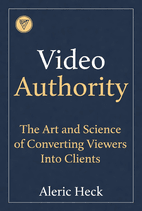
You'll find lines that cut through the noise and land with real impact. Some are short and punchy, others are wise and reflective, but each one carries a lesson you can apply right away. These are the kind of quotes you want to jot down, share with a colleague, or keep on your wall.
The reason this book is so quotable is that Aleric Heck doesn't just talk theory. He speaks from experience, with a directness that makes every sentence feel earned. His words push you to show up as your true self, take risks, and focus on what actually matters. No fluff, just honest guidance.
Top Quotes from Video Authority
“If a picture is worth a thousand words, then a video is worth a million.”
The author is emphasizing the superior impact of video over static images.
This line is a clever and memorable twist on a classic saying, instantly conveying the immense value of video in a single, quotable sentence.
“This book isn’t about my story. It's about yours.”
The author shifts focus from his own success to the reader's potential.
This humbly redirects the narrative, making the reader feel seen and central, which builds trust and engagement from the very start.
“You already are authentic. You just need to allow yourself to be seen for who you are by not trying to be someone else!”
Aleric answers the question of how to become authentic in videos.
It delivers a liberating truth that authenticity is inherent, not acquired, encouraging self-acceptance.
“A mistake you learn from is more valuable than a success you don’t learn from.”
The author argues that learning from failures provides long-term gains.
It challenges conventional thinking by prioritizing growth over immediate positive outcomes, making it a memorable and actionable insight.
“A smooth sea never made a skilled sailor.”
The author quotes Franklin D. Roosevelt to illustrate that challenges build resilience.
A timeless metaphor that reassures readers that difficulties are essential for growth, making struggle feel purposeful.
“You want to get viewers nodding their heads. You want their eyes to light up, as everything clicks into place.”
The author explains the goal of the value and education section of a Video Conversion Training.
It paints a vivid, relatable picture of the ideal audience reaction, making the abstract goal of engagement concrete and aspirational.
Themes Behind the Quotes
A big theme running through these quotes is authenticity and owning who you are. The book keeps coming back to the idea that you already have what it takes, you just need to stop pretending and let your real self be seen. That confidence isn't something you acquire, it's something you uncover by showing up consistently and speaking from the heart.
Another strong thread is the value of mistakes and persistence. Instead of fearing failure, the message is to treat every stumble as a stepping stone. The focus is on delivering real value before asking for anything in return, and building genuine connections rather than chasing quick wins. It's a mindset that puts people first, and that's why these ideas stick.
Quotes by Chapter
Introduction
“In a world where attention is the new currency, video isn't just another marketing tool—it's your secret weapon for breaking through the noise and connecting with your ideal clients.”
The author is setting up the strategic importance of video in today's crowded marketplace.
It captures the modern challenge of capturing attention and positions video as a powerful, almost indispensable asset, resonating with marketers and business owners.
“Video marketing taps into our senses in a way that static marketing simply cannot, combining words, sound, and moving pictures to create genuine human connections.”
The author explains why video is uniquely effective at building relationships.
It succinctly explains the multisensory advantage of video over text or images, clarifying why video fosters deeper connection and trust.
Chapter One
“I didn't want to be a knight in someone else's castle. I wanted to be the king of my own castle.”
Aleric explains why he turned down a lucrative job offer to start his own business.
This line encapsulates the entrepreneurial spirit of independence and ambition, inspiring readers to build their own legacy.
“I didn’t look great on camera in that video, but guess what? It didn’t matter. I showed up as an authentic authority, spoke confidently, and viewers responded.”
Aleric recalls the million-dollar video he almost deleted because he was self-conscious about his weight.
This story powerfully demonstrates that genuine value and confidence outweigh superficial imperfections.
Chapter Two
“You're already confident on video, you just don't know it yet.”
The author reveals a secret to the reader about their existing on-camera confidence.
This line reframes the reader's self-perception, reminding them that they already possess the confidence they seek.
“The best way to show up as an authentic authority is to just talk to the camera.”
The author gives direct advice on how to appear genuine on video.
This concise directive cuts through performance anxiety and emphasizes authenticity over acting.
“Talk to the camera as if it were a good friend of yours.”
The author's technique for building confidence before recording.
The simple metaphor makes the intimidating task of speaking to a camera feel familiar and safe.
“You don’t need to be anybody other than yourself, but you need to be the most passionate version of yourself.”
The author explains the mindset for being authentic on camera.
It balances acceptance of self with the call to amplify passion, a powerful combination for authentic authority.
Chapter Three
“When you adopt the Entrepreneur's Mindset, you throw the word “failure” out of your vocabulary completely.”
The author introduces the core principle of redefining failure.
This line encapsulates a radical mindset shift that empowers readers to see setbacks as learning opportunities instead of defeats.
“The fear of making mistakes has a greater negative impact on you than making mistakes.”
The author paraphrases Bob Proctor's wisdom on decision-making.
This quote frees readers from paralysis by reframing fear as the real enemy, encouraging bold action despite uncertainty.
Chapter Four
“You need to be over-delivering value to clients before you make your sales pitch.”
The author explains the necessity of providing genuine value before asking for a sale.
This line encapsulates the core philosophy of the chapter: earning trust through generosity, which is a timeless principle in marketing.
“Even if someone doesn’t follow the call to action, if they just watch the video and go on about their day, they've still gained some useful information.”
The author describes the nutritionist's ad, showing that value should stand alone even without conversion.
It reframes success beyond immediate sales, emphasizing that true value builds long-term goodwill and credibility.
“This framework has helped my clients generate over $250 million in revenue, and it has scaled my business to over eight figures.”
The author sums up the effectiveness of the Hook > Educate > Call to Action framework.
The concrete, massive financial results make the method incredibly compelling and credible for readers seeking proven strategies.
Chapter Five
“It's like buying the S&P 500, it's a safe bet and it works, but it won't get you outsized returns.”
The author explains why pre-built audiences give only average results.
This analogy makes the concept of 'beta' vs 'alpha' results instantly relatable, reinforcing the need for custom targeting to outperform the market.
“To achieve alpha results, you have to teach the algorithm exactly who you want to reach and the exact strategy you want it to use to reach them.”
The author introduces the core of the Alpha-AI Targeting Strategy.
This line encapsulates the chapter's central thesis—combining human strategy with AI for superior ad performance.
“Google knows what you're buying, and they know where you're browsing (so be good for goodness sakes).”
The author discusses the vast data Google collects from users.
Its humorous tone drives home the unsettling depth of surveillance, making the reader acutely aware of the data available for targeting.
“It's not enough anymore to target people based on the default settings inside of an ad platform when there's an entire universe of data at our fingertips.”
The author argues for moving beyond basic platform defaults.
This statement challenges complacency and urges marketers to leverage the full scope of available data for more precise targeting.
Chapter Six
“It’s a similar journey to the one you took them on with your video ad: Draw them in with a hook, provide genuine value, and then a call to action.”
The author describes the structure of a Video Conversion Training.
This line succinctly captures the core persuasive loop that makes video marketing effective, reminding creators to maintain consistency across their funnel.
“If you try to teach them how in a webinar without tailoring it to individual viewers, then you wind up doing your audience a disservice.”
The author advises focusing on 'what and why' rather than 'how' during the value section.
This insight highlights the common mistake of overgeneralizing and underscores the importance of audience-centric content, resonating with both creators and consumers.
“The purpose is to establish your qualifications and build credibility, but it’s important to be humble about it. Audiences want to know you're an expert, but they still connect strongly with humility.”
The author discusses how to present one's story and credibility in a Video Conversion Training.
It balances two opposing needs—authority and approachability—offering a timeless lesson on authentic persuasion that many find memorable and actionable.