Vasmora Themes
by Keri Lake
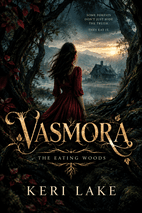
Underneath the plot, the novel is wrestling with how people keep themselves intact when bodies are caged, invaded, or turned into weapons. Survival is endurance and defiance, not clean victory; love shows up as rescue and sacrifice; revenge keeps colliding with mercy. Blood, plague, and prophecy all pressure identity and choice.
On this page you'll find the major themes with concrete moments: cells, cocoons, oubliettes, webs; promises to return and bodily sacrifice; vengeance interrupted by mercy; Pestilios and Morsana blurring self; blood as power, cure, kill, bind, lineage; prophecy versus choice. You'll also see recurring symbols: mimicrow, bloodstones, asphodels, bones.
Major Themes in Vasmora
Survival, captivity, and trauma
The novel repeatedly places characters in cells, cocoons, oubliettes, and webs, and frames survival as endurance and defiance rather than clean victory. Captivity leaves psychological marks that persist after escape, shaping how characters touch, trust, and remember. The past returns through mimicrows, nightmares, and phantom voices even when the captor is gone.
- Maevyth, chained in a dark cell, finds the carved words “I will not obey. I will not beg for mercy” and later repeats them.
- Captain Drefan uses a mimicrow to replay Zevander’s tortured voice, then adds another week of solitary confinement.
- Kazhimyr, trapped in an oubliette, hallucinates his old cellmate and discovers he has eaten the man’s corpse.
- Zevander clutches his blade during intimacy and expects Loyce’s mocking voice, while Maevyth’s flashback to Loyce’s mimicrows interrupts their bath.
Love, loyalty, and protective sacrifice
Love in the book is shown through rescue, promises to return, and bodily sacrifice rather than simple romance. Characters repeatedly put themselves between danger and the people they love, even when the cost is death or infection. Devotion is also complicated by guilt, as survivors wonder whether they failed those they protected.
- Zevander refuses to wait for full healing and arms himself to leave alone to rescue Maevyth because she is his mate.
- Branimir cocoons Rykaia so she will not hear him dying, and Zevander cremates him with sablefyre.
- Gavroche holds Pestilios inside his body until Lothare can seal the amulet, and Zevander later says the villagers live because the child fought to keep breathing.
- Maevyth crawls back through the Aqedormisz melee to rescue injured Rho.
Vengeance, cruelty, and mercy
Vengeance motivates many characters and is often met with graphic cruelty, but the novel also repeatedly interrupts revenge with moments of mercy or refusal. Torture is staged as spectacle by Loyce and Drefan, while mercy appears in death, in sparing the infected, and in refusing a tormentor’s plea. The book does not present vengeance as clean; it leaves survivors altered and haunted.
- Zevander mutilates Loyce, severs her hand, and drops her into the charnelyth pit rather than giving her a quick death.
- Kazhimyr refuses Loyce’s plea to kill her, saying “As so many have begged you,” and leaves her to suffer.
- Maevyth pours the ampoule poison into the pregnant servant’s mouth after Vaelora says the servant says yes, and Vaelora calls her a merciful goddess.
- Cadavros says people are not born wearing the mask of evil and admits he once wanted to be the hero.
Plague, possession, and loss of self
Pestilios and Morsana both invade bodies, blur identity, and make characters act against their own will. Infection is portrayed as a collective voice, a bodily transformation, and a betrayal of the self, while possession similarly makes Maevyth behave unlike herself. The novel links plague and possession through the fear that the person you love may still be present but controlled by something else.
- Kazhimyr’s fingers break and jerk back into place, and a voice commands “Kill him” while his feet move against his will.
- Morsana speaks and acts through Maevyth’s body; Zevander insists, “You are not my mate,” and Rykaia says she wants her Maevyth back.
- Dorjan is found cocooned with black veins and asks Kazhimyr to kill him because he feels them inside him.
- Branimir is infected by his spiders, hears voices telling him to kill his brother, and struggles to control the infected spiders.
Blood as power, cure, and lineage
Blood is the novel’s central magical substance: it cures, kills, binds, seals, and proves lineage. Characters’ blood determines who can wield magic, who can be saved, and who is needed for rituals. The Bonding and the amulet plot both turn blood into a form of intimacy, sacrifice, and political power.
- Maevyth cuts her arm and drips blood into Kazhimyr’s mouth to cure him; earlier her blood causes a giant spider to collapse while her wound heals.
- The amulet requires the blood of a firstborn prince, and Lothare seals it with his blood, which confirms his royal bloodline.
- The Bonding requires Maevyth to stab a valve in Zevander’s heart and exchange blood, after which she becomes immortal.
- Deimos emerges from the flame and reveals he is Maevyth’s father, tying her power and identity to divine bloodline.
Fate, prophecy, and choice
Prophecies, bargains, and visions pressure characters toward fixed outcomes, but the novel repeatedly returns to choice. Maevyth’s decision to become Vasmora, Rykaia’s infertility prophecy, and the alternate-realm twin’s language of “unchoosing” all frame fate as something contested. The book treats prophecy as powerful but not fully trustworthy.
- Maevyth’s alternate-realm twin says, “Choices brought you here. Therefore, you have to unchoose,” and claims every thread of fate has brought Maevyth there before.
- Deimos tells Maevyth she has always had a choice, and she chooses to become Vasmora so she can return to life.
- Rykaia gives up her mother’s heirloom after a Syrenian matriarch says she will never conceive, but Maevyth tells her not to put too much faith in prophecies because they are bollocks.
Symbols and Motifs
The mimicrow
A symbol of psychological torture, surveillance, and deception, especially the way captivity continues through recorded voices and false appearances.
- Captain Drefan uses a mimicrow to replay Zevander’s tortured voice and tells Maevyth the general has a cage full of them.
- Kazhimyr sees through a spider-possessed mimicrow as Loyce lies to Zivant about Maevyth’s whereabouts.
- Drefan crushes a mimicrow outside Maevyth’s cell after taunting her with Zevander’s voice.
Bloodstones
Bloodstones mark magic, bloodline, and the remnants or cost of a life; they can preserve evidence of infection or sacrifice.
- Dolion guards six bloodstones aboard The Halcyon, and Akmyrios later takes them after revealing he used the boy to summon dead Magestroli’s magic.
- Branimir’s bloodstone is mostly red with only a few black swirls, meaning he had not been entirely consumed by the infection.
- Infected wolves killed in the tunnels leave black stones, which Lothare collects.
- Faolan is consumed by black fire and reduced to a bloodstone.
Asphodels
Asphodel fields represent death, the afterlife, and a kind of peace beyond suffering.
- Morsana appears in a meadow of asphodels and shows Maevyth a vision of her twin and Zevander there.
- Branimir dies after Maevyth sings to him and she has a vision of him in a field of white asphodels, where he says he is at peace.
- After Gavroche’s burial, Maevyth sees him running through a field of white asphodels with a kite.
- Aelric’s body crumbles to ash and his spirit fades into a field of asphodels and white mist.
Bones
Bones symbolize death, ancestral memory, and Maevyth’s necromantic power to command the dead.
- Dolion uses residual ichor in a crucible to draw bones together and says Maevyth is meant to assemble an army of the dead.
- Verena explains that bones are sacred to wolves and carry a being’s essence.
- Maevyth touches a bone, sees a vision of Morsana and Hollowyns, then commands the bones to rise into Hollowyn warriors who kneel to her.