University of Berkshire Hathaway Quotes
by Daniel Pecaut
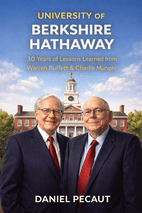
These quotes are drawn from the book University of Berkshire Hathaway, which captures the wit and wisdom of Warren Buffett and Charlie Munger during annual shareholder meetings. You will find lines that cut through market noise and get straight to the point. They are memorable because they are blunt, often funny, and grounded in decades of real world experience.
What makes this book so quotable is how Buffett and Munger use simple language to explain complex ideas. They avoid jargon and rely on vivid metaphors and common sense. Their insights on investing, business, and life have a way of sticking with you long after you read them.
Top Quotes from University of Berkshire Hathaway
“When you build a bridge, you insist it can carry 30,000 pounds, but you only drive 10,000-pound trucks across it.”
Buffett explains the importance of a large margin of safety in value investing.
This metaphor vividly illustrates the principle of building in a safety cushion to absorb errors and bad luck, making the concept accessible and memorable.
“We simply attempt to be fearful when others are greedy and to be greedy only when others are fearful.”
Warren Buffett, in the Berkshire Hathaway annual report, on the market's emotional cycles.
This line perfectly captures the contrarian wisdom of value investing, urging discipline against crowd psychology.
“I would rather be vaguely right than precisely wrong.”
John Maynard Keynes quoted by Charlie Munger, illustrating the danger of false precision.
It champions practical judgment over overconfidence in imperfect data, a core lesson in humility for decision-makers.
“It is far better to buy a wonderful company at a fair price than a fair company at a wonderful price.”
Warren Buffett at the Berkshire Hathaway annual meeting.
This concise statement encapsulates the shift from value investing to buying quality businesses at reasonable prices, a core principle of Buffett's philosophy.
“If you are going to be a lifelong buyer of food, you welcome falling prices and deplore price increases. So should it be with investments.”
Buffett's analogy comparing stock buying to buying hamburgers, urging investors to welcome lower prices.
This simple, vivid analogy overturns the emotional trap of buying high and selling low, teaching a core principle of value investing in an unforgettable way.
“The failure rate of all great civilizations is 100%.”
Charlie Munger, in his characteristically dark humor, comments on the inevitability of inflation and decline.
This stark, witty statement underscores the certainty of eventual setbacks, reminding readers that even the strongest systems are not immune to failure.
“Investing is not that complicated, he explained. Other than learning accounting, which is the language of business, the real key to investment success is to have the right mindset with a temperament compatible with those principles.”
Warren Buffett downplays the complexity of investing and emphasizes temperament.
It distills the core of Buffett’s philosophy: success comes from mastering a few fundamentals and maintaining emotional discipline, not from intricate formulas.
Themes Behind the Quotes
A central theme is the importance of focusing on intrinsic business value rather than market fluctuations. The quotes emphasize that true investing is about evaluating what a company is worth, not predicting short term price movements. Another theme is the value of patience and a long term mindset. Many quotes highlight the folly of trying to time the market or follow crowd behavior.
Another recurring idea is the need for a margin of safety and resisting leverage. The quotes also stress the dangers of complex financial systems and overreliance on historical data. Finally, there is a strong undercurrent of humility and self awareness. The best investors understand their own limitations and focus on what they can control, such as their own behavior and the quality of businesses they own.
Quotes by Chapter
1986
“Buffett defines it as “what a company would bring if sold to a knowledgeable buyer.””
Buffett defines intrinsic business value at the annual meeting.
This concise definition captures the essence of Buffett's approach, moving beyond pure numbers to include intangible assets like management and franchise value.
“He pays no attention to economic outlooks. His decisions are based simply on intrinsic business values.”
Buffett discusses his disregard for economic forecasting during the Q&A.
It reinforces the core Grahamite discipline of focusing on fundamentals rather than macro predictions, a timeless lesson for investors.
“When the lemmings are running, Buffett notes that more money can be made in the market than in buying whole companies.”
Buffett comments on the stock market and the behavior of investors.
The lemming metaphor powerfully conveys the idea of herd mentality and the rare opportunities that arise when others are irrational.
1987
“Anything that can't go on forever will end.”
Warren Buffett quoting Herb Stein, commenting on the Japanese stock market's extreme rise.
A succinct reminder that unsustainable trends inevitably reverse, making it a timeless caution for investors.
“Something that costs a penny, sells for a dollar and is habit forming.”
Warren Buffett describing his ideal business.
A brilliantly simple and memorable definition of a high-margin, recurring-revenue business model.
1988
“Printing money is too easy. I'd do it myself if I could.”
Buffett explains why inflation is inevitable.
This line captures the dangerous simplicity of printing money and highlights Buffett's blunt humor about human nature.
“You can leverage up to your eyeballs, but you may not make it across the river.”
Buffett warns about the risks of using leverage as an inflation hedge.
The vivid metaphor of drowning in debt while trying to cross a river makes the perils of leverage unforgettable.
“The fact that you are being obsoleted does not mean you should go into the successor business.”
Buffett discusses how to respond when your industry is becoming obsolete.
This counterintuitive insight warns against the common mistake of chasing a new, often worse, industry instead of exiting entirely.
“We are trading away the farm. We are sending IOUs out that are slowly being redeemed for pieces of the farm.”
Buffett illustrates the long-term cost of the U.S. trade deficit.
The simple, homespun analogy makes a complex economic problem instantly relatable and powerfully memorable.
1989
“A lot more people turn out to talk about their money than to look at old paintings.”
Buffett remarks on the delayed annual meeting at the Joslyn Art Museum.
It humorously captures human nature's preoccupation with wealth over culture, and sets a self-deprecating tone for the meeting.
“Peter Minuit traded trinkets for Manhattan. Now we are trading Manhattan for trinkets.”
Buffett uses this metaphor to explain the trade deficit's long-term danger.
The vivid reversal of a famous historical trade makes the abstract concept of national debt tangible and memorable.
“I am unfamiliar with this ridiculous extravagance.”
Munger responds when asked about Berkshire's corporate jet.
The dry wit and stark contrast with Buffett's ownership of the jet underscores Munger's legendary frugality and principled simplicity.
“If investors only had to study the past, the richest people would be librarians.”
Buffett critiques the tendency to rely on historical data to justify risky investments like junk bonds.
The aphorism cuts through intellectual laziness, reminding readers that investing requires forward-looking judgment, not just backward-looking statistics.
1990
“First liens against the passage of time.”
Charles Munger at the Wesco Financial annual meeting, describing Coca-Cola and the Washington Post.
This vivid metaphor suggests that great businesses generate value simply by existing over time, making them reliable investments.
1991
“What's the sense of getting rich if you discard associations you enjoy?”
Warren Buffett explaining that economics are not the only factor in choosing permanent holdings.
It encapsulates Buffett's philosophy that wealth is meaningless without meaningful relationships and enjoyment, a timeless reminder to prioritize purpose over profit.
“Do what you enjoy the most. Work for people you admire. You can’t miss if you do that.”
Buffett's advice to MBA graduates during the meeting.
This concise, actionable life advice distills Buffett's own career success into three easily followed rules, inspiring readers to align passion with admiration.
“A well-educated orangutan could see the success of our approach, and yet no one is doing it.”
Charlie Munger criticizing the efficient market theory and academia's refusal to adopt their value investing approach.
Munger's biting wit and absurd imagery powerfully highlight the disconnect between academic theory and proven real-world results, making a memorable jab at intellectual rigidity.
1992
“It is far more fruitful to decide whether a product can sustain itself than make economic predictions.”
Buffett explaining why he ignores macroeconomic factors, using Coca-Cola's long-term success as an example.
This line encapsulates Buffett's core investing principle: focus on business quality rather than market forecasts.
“If you're in the sailing business, you want to set up flat-earth scholarships.”
Buffett's sarcastic comment on modern portfolio theory, suggesting academics benefit from ignoring reality.
A witty metaphor that critiques academic finance and highlights Buffett's contrarian insight.
“The difference between 12% and 13% is the corruption in U.S. accounting . . . the moral and intellectual failing of the U.S. accounting system.”
Munger responding to Buffett's analysis of corporate return on equity and accounting biases.
Blunt condemnation of accounting manipulation; shows Munger's no-nonsense view on corporate integrity.
“There's no way investment returns can match what has been achieved.”
Buffett's emphatic statement about future market returns after a period of high returns.
A sobering reminder that past performance cannot be extrapolated, a key lesson for investors.
1993
“True investing is really more like betting against a parimutuel system, trying to find a 2-to-1 shot that pays 3 to 1.”
Charlie Munger explains his analogy for value investing.
It vividly captures the essence of value investing as finding mispriced odds, making a complex concept intuitive and memorable.
“The danger of relying on historical statistics or formulas is that you end up betting on a 14-year-old horse with a great record but is now ready for the glue factory.”
Warren Buffett warns against overreliance on past data in investing.
The colorful metaphor of an aged horse powerfully illustrates the risk of ignoring changing fundamentals, a timeless caution for investors.