Trad Wife Themes
by Sarah Langan
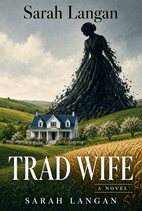
Underneath its plot, the novel wrestles with how trad wife fantasy gets staged and sold, and what that costs women. It asks whether home can be refuge or a trap, whether identity can be stolen through hair, clothes, journals, and public voice, and who really owns women's bodies, labor, and pain.
On this page you'll find theme breakdowns with concrete moments: Jenny clocking Mia's cues and staged accidents, Mia and Mr. Yellow taking over Jenny's name and voice, Black Swan's patriarchal hustle, Jenny's viral backlash from the Brotherhood and DirtyGarry, Mia running pregnant on a treadmill, and homes like Black Swan Farm and the locked chapel. There are also symbol analyses of Mr. Yellow, houses, hair and wigs, and the claddagh ring.
Major Themes in Trad Wife
Performance and Manufactured Authenticity
The novel repeatedly presents Trad Wife content as staged, curated, and monetized rather than natural. Jenny detects Mia's cues, watches accidents at half speed, and sees how the farm's image is built for followers. Even the camera makes Mia look ethereal while real life shows exhaustion, and Leo frames everything as scripted content.
- Jenny rewatches 'Taco Tuesday Disaster!' at half speed, hears Mia's tongue click before the dog charges, and concludes the dog was trained and the accident was a trick.
- Mia films a video in which she hooks Josie's legs and knocks her down, then tells Jenny that the internet loves blood and humiliation and that accidents get views.
- Mia claims in her videos not to allow iPad, but Josie is scrolling TikTok; Jenny also finds Broadway casting calls and decides Mia's Broadway story is likely a wishful lie.
- Leo tells Jenny she must say all the words and viewer names, saying, 'It's the show. It makes sense inside the show.'
Identity Theft, Possession, and the Erasure of Self
Mia and Mr. Yellow progressively take over Jenny's body, name, and public voice. The swap is literalized through stolen hair, clothing, journals, and an engagement ring, while Mr. Yellow controls Jenny's movements and thoughts. By the end, Jenny Kaplan is declared dead and replaced by the new Mia Wright.
- Mia appears dressed like Jenny, wearing Jenny's hair sewn into a net and Jenny's engagement claddagh, while a fake article has been posted under Jenny's name.
- Mia tells Jenny she will leave as Jenny Kaplan while Jenny stays as Mia Wright; she says they are true sisters with Mr. Yellow.
- Mr. Yellow occupies Jenny's body, animating her movements, cooking, cleaning, repairing the farmhouse, and controlling the children and others when Mia claps.
- At the end, 'Jenny Kaplan was dead. She was the new Mia Wright, and her work had just begun.'
Patriarchal Ownership and the Exploitation of Women
Black Swan's business and ideology place men at the top while women perform, recruit, and sacrifice. The notes repeatedly show women's labor and bodies enriching husbands or uplines, with women owning little. Corrie's curse frames this as a world where a woman can never own herself and a man can only build ashes.
- The lawyer reveals Black Swan, Inc. belongs to Steadman and his brothers, not Mia, and a lawyer confirms Mia owns nothing and may have a prenup.
- Blair buys about three thousand dollars of Black Swan inventory a month to meet quota and has rows of unsold boxes in her garage, while Ashley earns commissions from twelve downline ambassadors.
- Mia describes Trad Wife roles as setting the tone, disciplining kids, and ruling the hearth while her husband is in charge of the rest.
- Jenny's article calls Mia 'Patriarchy’s Trojan Horse' and notes all her sacrifice enriches her husband.
Public Shaming, Online Harassment, and Erasure
From the first chapter, Jenny's viral honesty brings both attention and organized backlash. The Brotherhood and DirtyGarry turn her into a target, costing her job and public standing, while the novel links online harassment to real-world control. The final reveal that Steadman is a DirtyGarry and Jarron the first DirtyGarry ties harassment to the story's central possession.
- DirtyGarry starts the thread 'Jenny Kaplan should kill herself' and threatens to boycott Bread and Circus unless Milton fires Jenny.
- Jenny realizes 'the Brotherhood wanted more than her public shaming. Their threat was existential. They wanted her erasure.'
- After 'Drano' goes viral and Hollywood calls, the studio cancels, invitations are rescinded, and the Stoughton family wants her off the masthead.
- Steadman's laptop is open to 4chan under the handle DirtyGarry, and Mia later reveals Jarron Stills as the first DirtyGarry and founder of the Brotherhood of the American Agenda.
Home, Family, and Belonging as Refuge and Trap
Jenny longs for family and a place where she feels loved, but the novel makes homes both shelters and prisons. Black Swan Farm offers warmth and belonging that curdles into surveillance and possession; Jenny also sees all families as mixtures of happiness and misery. The house motif expands until possession itself is described as a woman being a house for Mr. Yellow.
- Jenny watches Mia Wright's Black Swan Farm video and wishes she had a home, while Melissa admits she is lonely among the other moms and Portia.
- Jenny reflects that Jarron 'was the home I craved' and that she should have called 911, showing how love can make a home feel inescapable.
- Jenny's takeaway at Black Swan is 'I can't tell if this is a happy family or a miserable one. Maybe Tolstoy had it totally wrong, and all families are both things at once.'
- Mr. Yellow thinks, 'A woman is a house for me,' and at the end whispers to Jenny that the world is a house for him.
Women's Bodies Under Strain, Control, and Sacrifice
The novel repeatedly focuses on women's bodies as sites of pain, endurance, medical neglect, and demanded sacrifice. Mia runs pregnant on a treadmill, Victoria's asthma is dismissed, Jenny loses hair and is later possessed and impregnated, and the curse requires a woman to be offered as bride. Even amusement and care are measured through bodily suffering.
- Dr. John Wright dismisses Victoria's asthma as 'not real' and treats her with a cherry-scented essential-oil mister; after Jenny buys an inhaler, Victoria's color returns and Jenny realizes she had been turning blue.
- Jenny wakes on Day Three and discovers a bald, scabbed patch on her scalp and a clump of her hair on the pillow.
- Mia runs hard on the treadmill while pregnant, limping and joyless, and the camera makes her look ethereal while real life shows exhaustion.
- Jenny gives birth to Luke after eighteen hours of labor and later sees her true injured reflection and recalls untreated injuries, pregnancies, and a prolapsed uterus.
Symbols and Motifs
Mr. Yellow
The curse's supernatural agent and a figure of possessive male control; he inhabits women, demands submission, spreads through Black Swan products and people, and treats women as houses for himself. He is linked to Corrie's curse, the town's sacrifice, and the novel's final image of the world as his house.
- Mr. Yellow slithers along the stone wall and bedpost, crawls over Jenny, and appears as a human-faced being with Jenny's features.
- Mia commands Mr. Yellow to accept Jenny as bride and sacrifice, after which Mr. Yellow expands inside Jenny.
- Mr. Yellow makes Jenny's hands write 'SURRENDER YOUR SOUL' and the wallpaper displays 'YOU ARE MINE. SUBMIT TO ME.'
- At the end he whispers to Jenny that the world is a house for him.
The house and home motif
Houses in the novel stand for both the promise of family and the reality of ownership and entrapment. Black Swan Farm, the guest room, the locked chapel, the body itself, and the book A House Is a House for Me all tie domestic space to possession and belonging.
- Luke receives A House Is a House for Me, and in Jenny's dream Melissa asks her to read it, but the words are hieroglyphs.
- Jenny thinks, 'A house is a home, and a person is a home,' remembering she was a home for Melissa, Jarron, and herself.
- Mr. Yellow thinks, 'A woman is a house for me,' and at the end whispers that the world is a house for him.
- The wallpaper converges to 'YOU ARE MINE,' and the locked stone room and chapel hide the farm's secrets.
Hair and the wig
Hair and wigs mark identity as something that can be cut, stolen, worn, or swapped. Jenny's hair falls out under the farm's strain, Mia cuts her own hair into Jenny's pixie cut, and Mia wears Jenny's hair after the swap; the wig also lets Jenny become 'Jenny 2.0' and be mistaken for Mia.
- Jenny discovers bald, scabbed patches and clumps of her hair, hiding the hair in her luggage.
- Mia cuts Jenny's hair short, gives her a wig from her acting days, and gives her a makeover; Jenny calls herself Jenny 2.0.
- Mia has cut her own hair into a jagged version of Jenny's pixie cut, and later Mia appears wearing Jenny's hair sewn into a net.
- Steadman mistakes Jenny for Mia because of the wig, kisses her cheek, and later mistakes her for Mia at night.
The claddagh ring
The claddagh ring represents Jenny's unresolved attachment to Jarron and, later, her stolen identity and possession. She wears it long after the relationship ends, removes it at Mia's urging, and after the swap Mia wears it as part of becoming Jenny.
- Jarron gave her the claddagh ring she wore as an engagement ring; Jenny meets him at Waverly Diner still wearing his ring.
- Mia tells Jenny to take off Jarron's ring, and Jenny does so for the first time since he gave it to her.
- Mia appears after Jenny's recapture looking like Jenny, wearing Jenny's hair and engagement claddagh.
- Dr. Patil attributes Jenny's hair loss to fever, night terrors, and Jenny's claddagh ring.