Time Freedom Quotes
by Jay Abraham
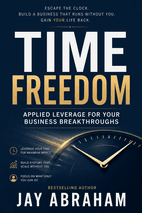
This collection pulls together the most striking lines from Jay Abraham's Time Freedom. You'll find sharp observations about work, business, and the hidden traps of self employment. Each quote challenges the idea that you have to choose between success and sanity.
What makes these quotes so memorable is how they reframe common struggles. Abraham doesn't just offer advice; he points out the exact moments where we get stuck. The language is direct and visual, making it easy to remember and share.
Top Quotes from Time Freedom
“I wasn’t stuck because my business was broken. I was stuck because I was doing the wrong work; maintaining instead of multiplying, managing instead of building.”
Amedeo reflecting on his transformation during a follow-up call after restructuring his time.
This line articulates a profound shift in mindset from mere busyness to strategic leverage, resonating with entrepreneurs who feel trapped by their own successful businesses.
“Everyone says you have to choose; quality or balance, dedication or breathing room, excellence or sanity. But why? Why can’t I have both?”
Phyllis expressing her frustration before discovering the power of compounding work.
It captures the universal tension between professional excellence and personal life, giving voice to a longing that many business owners silently share.
“Work compounds when today's effort makes tomorrow's effort easier, better, or more valuable. When this week's work stacks on last week's. When what we build once keeps giving forever.”
Phyllis defining compounding work after her daughter's theater analogy.
This clear, memorable definition turns an abstract concept into a practical filter, inspiring readers to evaluate every task for long-term leverage.
“That's not a business, Arora. That's a very expensive job you can’t quit.”
Marcus says this to Arora when she admits her business requires her constant presence.
It reframes the common trap of being self-employed versus owning a true business, making readers question whether they have a business or a job.
“Residual income is when you position yourself between a transaction that happens whether you're there or not; and you engineer it so you get paid each time.”
Marcus later clarifies the distinction between passive and residual income after Arora's failed course attempt.
This concise definition provides a clear, actionable framework for readers to rethink how they can capture ongoing value without trading time for money.
“The greatest gift of subscriptions isn’t the revenue; it’s the clarity.”
Kim says this during a follow-up call a year after launching his subscription model.
It captures the profound shift from financial anxiety to strategic clarity, showing that true freedom comes from stability and foresight.
“The better he performed, the faster he worked himself out of every relationship.”
The narrator explains Kim's 'success paradox' in his project-based consulting model.
This ironic statement perfectly encapsulates the self-defeating nature of one-time project work, making the need for recurring revenue painfully clear.
Themes Behind the Quotes
A central theme is the power of compounding effort: when your work today makes future work easier or more valuable, you break the cycle of trading time for money. Another major thread is the distinction between owning a business and simply having an expensive job. Many entrepreneurs find themselves doing the same work over and over, never building assets that pay off repeatedly.
The quotes also emphasize the importance of designing income streams that flow whether you are present or not, such as subscriptions or positioning yourself in recurring transactions. Underlying all of this is a rejection of false trade offs between quality of work and quality of life. The book argues that you can have both, but only if you structure your work to compound.
Quotes by Chapter
Part I: Simplify
“People say you can’t have both; quality work and breathing room, dedication and balance, excellence and sanity. They're wrong. You can have both. But only if your work compounds.”
Phyllis, six months into her transformation, reflects on the change in her work and life.
This line distills the book's central promise—that compounding work allows you to achieve both professional excellence and personal well-being.
Part II: Multiplying
“What if your expertise could work like that? What if you could be at Maya’s science fair while your clients still got what they need, and you still got paid?”
Marcus draws a toll booth on a napkin and asks Arora this question to introduce the concept of residual income.
It vividly connects the abstract idea of residual income to a deeply personal desire for time with family, making the goal tangible and emotionally compelling.
“You're not trying to “make passive income.” You're trying to position yourself in the middle of transactions that happen whether you're there or not; and engineer it so you get paid each time.”
The chapter's 'Universal Principle' section restates the core idea in a memorable, direct way.
It corrects a common misconception about passive income and gives readers a precise mental model to apply to their own businesses.
Part III: Compounding
“Predictability had replaced panic. Partnership had replaced project chasing.”
The narrator describes the transformation Kim experienced after adopting a subscription-based business model.
This succinctly contrasts the old chaotic approach with the new sustainable model, making the core lesson instantly memorable.
“Subscription revenue isn’t just about money. It's about building relationships that compound instead of relationships that expire.”
Kim reflects on the deeper value of his subscription model one year after the transition.
It reframes recurring revenue as a vehicle for long-term partnerships, emphasizing compounding value over transactional exchanges.