Time Freedom Key Takeaways
by Jay Abraham
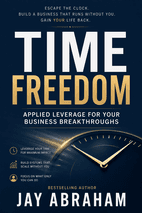
5 Main Takeaways from Time Freedom
Productize Your Expertise for Scalable Freedom
Transform your knowledge and skills into a repeatable product or system that generates value independently. This mental shift from service provider to product company compounds your expertise and allows your business to grow beyond your personal capacity.
Optimize First, Then Multiply for Real Growth
Before scaling any process, maximize what already works by refining and perfecting it. Trying to expand a mediocre system wastes resources; focus on one excellent offering, then replicate it to multiply your impact.
Partnerships Compound Faster Than Hiring Alone
Collaborate with others who bring complementary capabilities instead of building everything internally. Start with small, clear agreements and prioritize cultural fit—but never outsource your core differentiator or lose control of customer relationships and data.
Systematize Delegation Through Documentation and Training
Document every task you perform, create training resources, and ensure authority matches responsibility. This shifts you from being the doer to the orchestrator, freeing your time for high-value strategic work.
Manage Your Energy and Mindset as a Business System
Your personal satisfaction and emotional resilience require the same systematic attention as your business. Track what fuels you, schedule it, and embrace the inevitable zigzags in partnerships with monthly reviews and quarterly recalibrations.
Executive Analysis
These five takeaways converge on a single thesis: true time freedom requires shifting from a hands-on operator to a strategic orchestrator of systems, products, and partnerships. Abraham argues that entrepreneurs must first productize their expertise to create an asset that generates value without their direct involvement, then optimize that asset before scaling. Delegation through documentation and training replaces personal effort, while partnerships accelerate growth without building everything in-house. Finally, managing personal energy and emotional resilience ensures the entrepreneur can sustain this transformation over the long term.
This book matters because it addresses the fundamental bottleneck of entrepreneurship: the owner's own time and attention. Abraham provides a practical, step-by-step system to escape the revenue-for-time trap, drawing on decades of consulting with high-growth companies. It sits within the business development genre alongside classics like "The E-Myth" and "Buy Back Your Time," but distinguishes itself with a relentless focus on leveraging others' capabilities through partnerships and a systematic approach to personal energy management. The reader walks away with a clear blueprint to build a business that truly runs without them.
Chapter-by-Chapter Key Takeaways
Part II: Multiplying (Chapter 2)
Productizing transforms knowledge into a scalable asset that generates value independently.
Real freedom comes when the business grows beyond personal capacity.
The mental shift to a product company compounds expertise.
Maximize what works before scaling; optimize first, then multiply.
Try this: Identify your highest-value service and productize it into a repeatable system; test and optimize that single offering until it works flawlessly before attempting to scale it.
Part III: Compounding (Chapter 3)
Create a scalable product from what you already do well, starting with a simple prototype and refining based on real use.
Delegate by documenting tasks, training with resources, and ensuring authority matches responsibility.
Partnerships compound faster than hiring: access capabilities through collaboration instead of building everything internally.
Never outsource your core differentiator or lose control of customer relationships and data.
Start partnerships small with clear agreements; cultural fit matters more than size or resources.
Your personal energy and satisfaction need the same systematic attention as your business—track, protect, and schedule what fuels you.
Sustainable transformation requires monthly reviews, quarterly recalibrations, and annual vision renewal. Consistency beats intensity.
Stop being a supplicant; become an orchestrator. Shift from “Please give me this opportunity” to “Here’s how we can succeed together.”
Deliver value before the deal closes. Provide insights, introductions, and strategic help during the process.
Embrace the zigzag and systematize it. Meaningful partnerships take 12–18 months and will face delays and doubts.
Build emotional resilience. The best deals will test you. Stay engaged through silence and setbacks.
Try this: Document every repetitive task you do, train someone to execute it with clear authority, and start one small partnership by delivering strategic value upfront—then schedule weekly energy audits and monthly business reviews.