Three Felonies A Day Quotes
by Harvey A. Silverglate
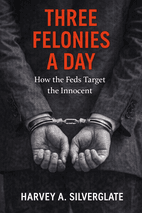
This collection brings together the most striking lines from Harvey Silverglate's landmark book. You will find quotes that expose the blurred lines between lawful conduct and federal overreach. The book is uniquely quotable because Silverglate's examples are both specific and universal. Each quote captures a moment where the law becomes a weapon. They make you think twice about justice.
These quotes invite the reader to question the system. They are crisp, often ironic, and sometimes devastating. Perfect for sharing or reflecting on the state of criminal law.
Top Quotes from Three Felonies A Day
“But was Raul Martinez “corrupt”? Or was he an ordinary local politician, even a pol of above-average skill and charisma, who fell prey to a fishing expedition by federal prosecutors hell-bent on using every legal tool in their arsenal to assert their authority over local political arrangements?”
The author poses a central question about the prosecution of Hialeah mayor Raul Martinez.
This passage encapsulates the book's core critique of prosecutorial overreach, forcing readers to question whether the label 'corrupt' is deserved or a weapon wielded by ambitious federal prosecutors.
“Indeed, the prosecution of Raul Martinez by Dexter Lehtinen’s office demonstrates the ways in which the lack of clarity inherent in the Hobbs Act can be a prescription not so much for keeping interstate commerce free of debilitating corruption, but rather for imposing federal tyranny over local political systems and, not so incidentally, evening political scores and affecting electoral outcomes.”
The author summarizes the broader implications of the Hobbs Act's vagueness as shown by the Martinez prosecution.
It powerfully links a vague federal statute to political manipulation and local autonomy, revealing how law can become a tool for partisan score-settling.
“The pain unjustly suffered by Milken and his family was real and palpable, and it became clear that if they can do this to him, they can—and will—do it to anyone.”
The author reflects on the prosecution of Michael Milken and the danger of the legal tactics used against him.
This line underscores the universal threat posed by prosecutorial overreach, resonating because it warns that no one is immune from similar abuse of power.
“When the law becomes a trap for the unwary, it becomes an engine of oppression rather than a statement of the moral and ethical requirements of a society's citizens.”
The author's closing commentary on the Russell case.
It powerfully encapsulates the danger of vague laws that ensnare innocent actors, transforming justice into oppression.
“To allow the conviction of Cintolo on the facts presented would send a chill down the spine of every ethical and effective criminal lawyer in the country and, in the process, deprive defendants of their constitutionally mandated right to counsel.”
From the amicus brief warning the Court of Appeals about the consequences of upholding Cintolo's conviction.
This line powerfully articulates the systemic danger—that punishing a lawyer for doing their job will deter all defense attorneys from vigorous advocacy, ultimately harming defendants' Sixth Amendment rights.
“Law under our chosen system performs its highest purpose when it limits government power, since history and experience show that governments tend to overuse their perceived authority.”
The author reflects on the founders' view of government power and the rule of law.
This line succinctly captures a core principle of constitutional governance, reminding readers that legal systems exist to restrain, not enable, state overreach.
“But all the procedural rights in the world are for naught if the defendant is unable to understand what it is for which he or she stands indicted.”
The author argues that vague statutes undermine the very purpose of procedural rights.
It highlights the fundamental injustice of prosecuting someone under unclear laws, making a powerful case for statutory clarity above all else.
Themes Behind the Quotes
A central theme is the dangerous vagueness of federal criminal laws. Silverglate shows how statutes written in broad, ambiguous terms give prosecutors enormous discretion. This turns everyday actions into potential felonies, especially for professionals and local officials. The result is a system where the law becomes a trap rather than a guide.
Another theme is the devastating human cost of prosecutorial overreach. Targets and their families suffer regardless of eventual outcome. The book also highlights how the government's enforcement machine chills legitimate conduct. Doctors fear treating pain, lawyers fear defending clients, and businesses fear innovation. Ultimately, the quotes argue for a legal system that limits government power and ensures citizens can actually know what is illegal.
Quotes by Chapter
CHAPTER ONE - Reeling in the Great White, and Other Tales of Fishing for State ...
“The press, all too eager to parade its hard-boiled realism while mounting the pedestal of moral guardianship, rarely bothers to ask such questions about the motives of federal prosecutors and the real offenses of state and local political figures.”
The author comments on the media's failure to scrutinize federal prosecutorial motives during the Martinez case.
It indicts the press for assuming guilt and abandoning journalistic skepticism, a theme that resonates in an era of heightened media complicity in political narratives.
“Even when the federal prosecutorial juggernaut fails to directly dispatch its prey, the wreckage can still destroy the lives of the powerful and the popular.”
The author reflects on the lasting damage to Martinez's political career despite acquittals.
This striking metaphor underscores that failed prosecutions can still ruin reputations, highlighting the immense power imbalance between individuals and the federal legal system.
CHAPTER TWO - Giving Doctors Orders
“The fundamental problem faced by physicians who prescribe controlled pain-killers in their medical practices is that a doctor's therapeutic standards and judgment often differ considerably from a law enforcement agency's definition of “abuse.””
The author explains the core tension between medical practice and federal drug enforcement.
It starkly highlights the conflicting perspectives that put well-meaning doctors at risk, making the reader sympathize with physicians caught in an impossible regulatory gap.
“What would seem to be the good faith practice of medicine to a physician can readily be deemed abusive by a narcotics agent or bureaucrat.”
The author summarizes how subjective enforcement can criminalize standard medical care.
This concise sentence captures the terrifying uncertainty that haunts every pain doctor, showing how easily good intentions can lead to a felony indictment.
“The confusion between addiction and physical dependence is probably the biggest single misunderstanding about opioids.”
A prominent medical pain practitioner quoted in the chapter describes a key clinical distinction.
It pinpoints a fundamental scientific error that drives over-prosecution, making readers understand how ignorance of basic medical facts can destroy lives.
“Winning cases prevailed over facilitating sound medical practice.”
The author explains why the DEA withdrew helpful guidelines after Dr. Hurwitz's lawyers sought to use them at trial.
This blunt indictment of prosecutorial priorities reveals a justice system that values convictions more than patient care, leaving a chilling impression.
CHAPTER THREE - The Unhealthy Pursuit of Medical Device and Drug Companies
“Only a steel will, fortified by Leichter's deeply held (and legally correct) belief that he had committed no crime, enabled him to survive and eventually rebuild his life.”
The author describes Lee Leichter's resilience after years of federal prosecution for medical device violations.
This line captures the immense personal toll of overzealous prosecution and the power of maintaining one's innocence against overwhelming odds.
“In view of the feds’ general tendency to charge targets with highly technical violations of laughably vague regulations, there was a certain irony in what the prosecutors did next.”
The author comments on the prosecutor's sudden shift to dictionary definitions of 'safety' and 'effectiveness' after the defendants had painstakingly followed the regulations.
It highlights the absurdity of a system that prosecutes citizens for failing to obey laws that even the government interprets inconsistently.
“Such is the confusing rhetoric of many federal courts: even in those relatively rare cases when they recognize the impossible burden imposed on ordinary citizens forced to figure out statutes and regulations that puzzle even experienced trial judges like Tauro.”
The author reflects on the appellate court's opinion reversing Leichter's conviction while still calling the evidence 'substantial'.
This sentence powerfully summarizes the central injustice of the book: citizens are held criminally liable for laws that are incomprehensible even to judges.
“Created and organized by Loucks in 1985, the Health Care Fraud Unit of the United States Attorney's office in Boston was emerging as a national model for turning FDA enforcement into a prosecutorial industry and a money machine for filling government coffers.”
The author describes the rise of the Boston Health Care Fraud Unit led by Assistant U.S. Attorney Michael Loucks.
It exposes the financial incentives behind federal prosecutions, challenging the narrative that they are purely about public safety.
CHAPTER FOUR - Following (or Harassing?) the Money
“Milken's biggest problem was that some of his most ingenious but entirely lawful maneuvers were viewed, by those who initially did not understand them, as felonious, precisely because they were novel—and often extremely profitable.”
The author explains why Milken became a target for federal prosecutors despite his lawful innovations.
It captures the tragic irony that success and novelty can be criminalized by ignorance, a theme that resonates with innovators and anyone skeptical of government overreach.
“As is so often the case with federal criminal prosecutions, the fabrication consisted, in part, of dubious testimony given by rewarded witnesses, and felony charges for conduct (admitted to by Milken) that, to informed and objective observers, did not appear to constitute crimes.”
The author describes the tactics used to build a case against Milken.
This line exposes a systemic flaw in federal prosecutions, making readers question the reliability of convictions built on rewarded testimony and manufactured crimes.
“Judge Stanton said from the bench that he understood how odd it was that he was acquitting Rosenthal on a count to which Milken had pleaded guilty.”
After Milken's guilty plea, a different judge ruled the same underlying conduct was lawful.
The judge's acknowledgment of the anomaly highlights the absurdity of a system where one person pleads guilty to a non-crime while another is acquitted for the same act.
CHAPTER FIVE - Accounting for the Perils Facing Business Support Services: The ...
“The executed, if exonerated, corpse of the Arthur Andersen firm—left unceremoniously rotting in the public square—caught the attention of another of the Big Five (now the Big Four) national accounting firms, KPMG.”
The author describes the aftermath of Arthur Andersen's Supreme Court victory, which came too late to save the firm.
This vivid metaphor captures how a firm can be destroyed by prosecution even when ultimately vindicated, serving as a chilling warning to other companies.
““No longer was any type of ‘dishonest[y]'necessary to a finding of guilt,” wrote the high court, “and it was enough for [Andersen] to have simply ‘impede[d]’ the Government's factfinding ability.””
The Supreme Court criticized the trial judge's jury instructions that diluted the mental state required for obstruction of justice.
It starkly illustrates how vague statutes can criminalize ordinary, non-dishonest conduct, threatening due process.
“The underlying problem in the Andersen prosecution is in fact present in a very large (and growing) number of federal prosecutions, but it arose in this case in a form sufficiently stark that it caught the attention of the high court, which noted caustically that both Congress and the DOJ shared the blame for the destruction of a presumptively innocent firm.”
The author sums up the broader systemic issue behind the Andersen case.
It highlights how prosecutorial overreach and poorly written laws can destroy innocent parties, a pattern that extends far beyond this one case.
“The Wall Street Journal editorialized in criticizing the government's pursuit of the KPMG accountants via a criminal proceeding, “the finger-waggers in Congress might acknowledge their role in creating the 6,000-page, 2.8 million-word, tax code Frankenstein that facilitates the tax-avoidance industry.””
The Journal responded to the KPMG tax-shelter prosecution by blaming Congress for the tax code's complexity.
It powerfully indicts lawmakers for creating an impossibly complex system that traps citizens and enables aggressive prosecution of ambiguous conduct.
CHAPTER SEVEN - Doing Their Duty (or Committing Espionage?) and Other Media ...
“The government cannot argue both (1) simple possession of child pornography is itself victimization [of children] ... and yet (2) criminalize the termination of the victimization by destroying the images.”
A lawyer quoted in the chapter criticizing the prosecution's contradictory stance.
It highlights the absurd logic where destroying illegal material to stop victimization is itself criminalized.
“It is as if the primary purpose of the criminal law is to create prosecutions, rather than encourage conforming behavior to the law.”
A lawyer quoted in the chapter criticizing the prosecution's interpretation.
It distills the perverse incentive where law punishes compliance instead of guiding lawful behavior.
CHAPTER EIGHT - National Security: Protecting the Nation from Merchants, ...
“It would be, in short, an absurd and ultimately self-defeating interpretation of the law, with disastrous consequences for those scholars who consult for their governments.”
The author reflects on the dangerous implications of the government's interpretation of the Espionage Act in the Zehe case.
This line succinctly captures the book's central argument that vague laws are twisted to punish innocent behavior, and it warns of far-reaching, self-defeating consequences.
“But this was the 1980s, the beginning of the “Silly Putty®” era of federal criminal law.”
The author describes the prosecutorial mindset during the Zehe prosecution.
The vivid metaphor of 'Silly Putty' perfectly conveys how federal criminal statutes were stretched and manipulated to fit almost any conduct, making the point memorable and accessible.
“Rarely, it seemed, had so much legal fuss been made over so little.”
The author describes the dispute over a non-computerized, off-the-shelf control panel in the Lachman and Subilia case.
This line highlights the absurdity of prosecuting people for violating arcane regulations over trivial equipment, encapsulating the book's critique of overcriminalization.
“The precedent set by the Department of Justice, however, had legs.”
After describing the outcome of the Zehe case, the author notes its long-term influence on later national security prosecutions.
This terse statement underscores how a single unjust prosecution can create a dangerous precedent that endures and expands over time.