The Way of Excellence Key Takeaways

by Brad Stulberg
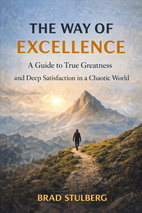
The Way of Excellence by Brad Stulberg Book Cover

5 Main Takeaways from The Way of Excellence

Excellence is a lifelong practice of mastery and meaning, not a destination.

True excellence combines skill development (Mastery) with meaningful contribution (Mattering), offering deep satisfaction through engaged growth. It's a sustained way of being, as highlighted in the Introduction, where the journey itself transforms you, not just the outcome, countering perfectionism and obsession.

Shape your surroundings to automatically guide you toward focused work.

Our environment 'invites' behaviors, so creating tech-free zones and meaningful spaces reduces reliance on willpower. This ecological approach, from Chapter 2, helps combat distraction and fosters deep focus blocks, as in Chapter 7, making excellence more accessible.

Build heroic results through small, consistent actions, not sporadic bursts.

Sustainable systems and compounding effort, as in Chapter 5, lead to massive gains over time. Discipline, from Chapter 8, means showing up regardless of feelings, making action a habit that bridges intention and achievement.

Integrate intentional rest and joy into your work to prevent burnout.

Growth requires stress plus rest, as Chapter 9 notes, and joy from harmonious passion fuels resilience. Deliberate savoring and completion rituals, from Chapters 17 and 18, make the process sustainable and fulfilling.

Cultivate curious communities to amplify growth and navigate failure.

Performance is contagious, and communities of practice provide support during setbacks. Curiosity, from Chapter 14, transforms fear into exploration, while Chapter 16 emphasizes that deep bonds are central to meaning and resilience.

Executive Analysis

The book argues that excellence is not about peak performance or perfection but a sustainable rhythm of engaged growth, blending mastery with mattering. By grounding this in evolutionary biology, psychology, and philosophy, it positions excellence as a biological drive and virtuous practice. The key takeaways form a holistic system where practical habits—like environmental design, consistency, discipline, renewal, and community—support profound meaning, countering the alienation and distraction of modern life.

'The Way of Excellence' stands out in the performance genre by offering a durable framework for long-term fulfillment, beyond quick fixes. For readers, it provides actionable strategies to achieve authentic achievement without burnout, emphasizing joy, curiosity, and social connection as essential fuels. This makes it a critical guide for anyone seeking to reclaim focus, vitality, and purpose in their work and life.

Chapter-by-Chapter Key Takeaways

Redefining Excellence—and Why We Need It More Than Ever (Introduction)

  • True excellence is a deeply satisfying state of engaged growth, accessible to all, characterized by a blend of Mastery (skill development) and Mattering (meaningful contribution).

  • It is crucial to distinguish excellence from its common impostors: perfectionism, obsession, optimization, the mere pursuit of happiness, and flow.

  • In an age of alienation, distraction, and "pseudo-excellence," intentionally cultivating real excellence is a critical act for reclaiming a life of focus, vitality, and authentic achievement.

  • Excellence is a sustained practice and a way of being, not a one-time outcome or a shallow performance for others.

Try this: Redefine your personal excellence as a sustainable practice of engaged growth and meaningful contribution, not as perfection or external validation.

The Biology of Excellence (Chapter 1)

  • Excellence is biological: Our drive for excellence is an evolutionary inheritance called homeostatic upregulation, a life force that uses feelings to guide us toward flourishing.

  • It’s felt, not just thought: Peak performance and “flow” states are primarily visceral, pre-intellectual experiences. We feel our way to excellence more than we think our way to it.

  • Development has a blueprint: The four phases of competence model shows that mastery requires moving from unconscious ignorance, through deliberate effort, and finally to an effortless, felt state of unconscious competence.

  • Skill is a relationship: True skill is the dynamic, felt interaction between a person and their environment, not just a mentally stored set of instructions.

  • Feelings are essential guides: Our emotional sensations are an indispensable compass for engagement and decision-making. Disconnection from them leads to poor outcomes and emptiness, while heeding them situates us in the world and fills us with meaning.

Try this: Tune into your visceral feelings and bodily sensations during practice to guide your learning and move towards unconscious competence.

The Psychology of Excellence (Chapter 2)

    • Dysevolution explains our struggle against modern temptations; our brains are not wired for the engineered abundance of ultra-processed food and digital media.
    • Ecological psychology reveals that our environment actively "invites" behaviors; we can shape our surroundings to invite excellence and remove invitations to distraction.
    • Practical environmental design—like creating tech-free zones and surrounding oneself with meaningful objects—is more effective than relying on willpower alone to combat distraction and "internet brain."
    • The pursuit of excellence is a moral system rooted in our biology; all life moves toward conditions that support its flourishing, and for humans, this translates into the drive for meaningful, high-quality work and experiences.

Try this: Audit your physical and digital spaces to remove invitations to distraction and add cues that prompt focused, meaningful work.

The Philosophy of Excellence (Chapter 3)

  • Multiple philosophical traditions across history converge on the idea that excellence (or arete, wu-wei, Quality) is a core virtue essential for a good and meaningful life.

  • Cultivating intimacy with our valued pursuits—by ruthlessly eliminating distractions—is the antidote to modern alienation and a path to feeling truly "situated" and connected.

  • Engaging in concrete activities with clear, objective standards provides deep autotelic satisfaction and acts as a grounding force, fostering humility and real-world competence.

  • At its most authentic, the pursuit of excellence is a generative, creative act that becomes indistinguishable from love, connecting us to something larger than ourselves.

Try this: Ruthlessly eliminate distractions from your core pursuits to build deep, autotelic satisfaction and connect your work to a larger purpose.

Goals (Chapter 4)

  • We never truly "arrive." Expecting a major accomplishment to provide lasting fulfillment is a trap—a phenomenon known as the arrival fallacy.

  • Growth and meaning are found in the pursuit. The real value of a goal is not the moment of achievement, but who you become and what you learn during the climb.

  • Adopt a process-over-outcomes mindset. Focus on the controllable steps, judge your effort, and let the results take care of themselves.

  • Aim to be the best at getting better. Define "better" holistically to include personal strength, kindness, and wisdom, not just external performance.

  • Life changes through the process, not the outcome. The greatest illusion is believing an accomplishment will change your life; real transformation happens through the person you become while striving for it.

Try this: Focus on becoming the best at getting better through daily controllable steps, and detach from the illusion that achievement alone will bring fulfillment.

Consistency (Chapter 5)

  • Prioritize sustainable systems over dramatic sprints. Heroic intensity is unsustainable; consistent, manageable effort is what builds a heroic body of work over decades.

  • Harness the power of compounding. Small, regular deposits of effort accumulate into massive gains over time. The daily act of showing up is the investment.

  • Raise your floor. Protect your long-term average by avoiding zeros. On bad days, adjust your target and do something—anything—to keep the chain of consistency unbroken.

  • Cultivate a next-play mentality. View setbacks as challenges, not threats. Learn quickly, then forget and focus entirely on the present moment and the next action.

  • Detach from the myth of linear progress. Mastery involves long plateaus. Find motivation in the quality of your daily practice and effort, not in the need for constant, visible improvement.

Try this: Establish a non-negotiable daily minimum effort to maintain momentum, and find motivation in the quality of your practice rather than linear progress.

Trade-Offs (Chapter 6)

  • Balance as traditionally conceived is an illusion; fulfillment often comes from focused, unbalanced effort on what matters most.

  • Use minimum effective doses to maintain connection with other life areas, preventing neglect and ensuring sustainability.

  • Develop internal self-awareness to make conscious trade-offs, aligning priorities with your values and reducing regrets.

  • Avoid chronic obsession; instead, prioritize with boundaries to harness drive without sacrificing health or relationships.

  • Within any pursuit, keep it simple by focusing on fundamentals and avoiding distractions from trends and complexity.

Try this: Consciously prioritize what matters most by applying intense effort there, while using minimal routines to sustain other life areas without neglect.

Focus (Chapter 7)

  • The attention economy drives algorithmic mass distraction, making focus a scarce yet critical resource for excellence.

  • Multitasking is a myth that reduces work quality and well-being; our brains perform best when devoted to single tasks.

  • Focus is like a muscle: it weakens without use but can be rebuilt with consistent practice and patience.

  • Create deep-focus blocks by scheduling distraction-free time, physically removing digital devices, and using tools like physical notebooks.

  • Optimal focus sessions last fifty minutes to two hours, followed by short breaks—such as walks—to restore attention and spark creativity.

  • Prioritizing sustained focus leads to greater effectiveness, creativity, and personal satisfaction in a distracted world.

Try this: Schedule protected, device-free time blocks for deep work, and train your focus muscle by consistently devoting full attention to one task at a time.

Discipline (Chapter 8)

  • Discipline, not motivation, is the reliable foundation for excellence. It bridges the gap between intention and action.

  • You cannot reliably control your feelings, but you can control your behavior. Action is often the catalyst that improves your mood and generates motivation.

  • True freedom (positive freedom) comes from accepting wise constraints (on your time, habits, and energy) that free you from being ruled by every passing whim.

  • Never judge a day’s potential performance by your initial feelings. Discipline means showing up and giving yourself a chance, regardless of how you feel at the start.

  • Sustainable discipline is not about punitive self-criticism. It requires pairing a firm commitment to action with a kind and supportive internal dialogue.

Try this: Commit to showing up and taking the first small action regardless of how you feel, using pre-set rules to bridge intention and behavior.

Renewal (Chapter 9)

  • Rest is a Discipline: In a culture that glorifies grinding, it takes conscious discipline to step away from meaningful work, but this discipline is essential for sustained excellence.

  • Growth Requires Recovery: The formula for growth is "stress plus rest." Without intentional renewal, effort leads only to exhaustion, burnout, and diminished returns.

  • Not All Downtime is Equal: Genuine rest is defined by an absence of self-control, work-related thought, and anxiety. Scrolling social media or obsessing over recovery metrics often does not qualify.

  • Evidence-Based Methods Work: Strategies like light physical activity, social connection, time in nature, quality sleep, and extended breaks are powerfully effective for renewal.

  • Rest is Part of the Work: Renewal is not a distraction from your primary pursuit; it is an integral, non-negotiable part of the process of achieving and maintaining high performance.

Try this: Intentionally schedule periods of complete mental disengagement from work, using evidence-based methods like nature walks and social connection to recover.

Confidence (Chapter 10)

  • Confidence is not the absence of doubt, but the ability to proceed despite it, supported by evidence and "experimental faith" built through repeated experience.

  • Arrogance is noisy insecurity; true confidence is quiet assurance earned by working through challenges and building a track record of competence (self-efficacy).

  • "Owning your seat" means accepting your legitimate place in a endeavor based on your preparation, not on the illusion of having all the answers.

  • Confidence and humility are inseparable; the hard work of building confidence teaches you your limits, keeping you open to growth and new challenges.

Try this: Build confidence through small, repeated experiences of competence, and accept your place based on preparation rather than needing all the answers.

Patience (Chapter 11)

  • There are no overnight breakthroughs; meaningful work requires persisting through barriers and plateaus.

  • We must actively decondition ourselves from society's addiction to speed and instant gratification.

  • Peak achievement often comes with experience, where wisdom meets ability—this requires stick-to-itiveness.

  • A process mindset, focused on daily micro-objectives, generates the dopamine-driven motivation needed for long journeys.

  • Staying in the game increases your "surface area for luck," making you ready for when critical variables align.

  • Consistent quantity of effort is a primary driver of eventual quality.

  • Excellence is a long game; be patient and play all nine innings.

Try this: Embrace a long-term perspective by focusing on daily micro-objectives, trusting that consistent effort will eventually lead to breakthroughs.

Routine (Chapter 12)

  • Routines are for order, not optimization: Their primary value is in providing predictable structure in an uncertain world, automating decisions, and conserving mental energy.

  • Self-knowledge is non-negotiable: There is no "magic routine." You must experiment to discover your chronotype and the practices that genuinely work for your life and goals.

  • Simplicity beats complexity: A short list of core daily, weekly, and monthly practices is more sustainable and transformative than an elaborate, fragile regimen.

  • Design transitions: Actively create rituals to separate work from personal life, preventing time from collapsing into a blur.

  • Embrace rugged flexibility: The best routines are adhered to diligently but released from gracefully when needed, always with the intent to return.

Try this: Create a simple, personalized routine that provides structure without rigidity, and design clear transitions to separate work from personal life.

Gumption (Chapter 13)

  • Gumption is a cultivatable enthusiasm and forward momentum that makes obstacles feel surmountable.

  • Protect your gumption by adhering to a flexible rule (e.g., 48-hour rule) to process outcomes, then consistently returning to the work itself.

  • Break out of slumps by creating small, guaranteed wins to rebuild confidence.

  • Step away strategically when you feel stuck or strained; breakthroughs often happen offstage.

  • Seek inspiration and ideas from outside your primary field to renew energy and spark innovation.

  • Actively manage ego inflation by cultivating relationships with people who will tell you the truth.

  • Avoid rigidity by balancing your innate strengths with their opposites, remaining flexible in your approach.

Try this: Reignite momentum by setting up easy, guaranteed successes, and step away from work when stuck to allow for offstage insights.

Curiosity (Chapter 14)

  • Curiosity is a potent, innate antidote to fear that can be consciously engaged to transform our experience of challenge.

  • Neurologically, activating the brain’s SEEKING and PLAY pathways through curiosity directly inhibits the PANIC and RAGE pathways associated with fear.

  • Viewing your craft as a path for continuous learning and self-discovery is more sustainable and rewarding than a fixation on winning or avoiding failure.

  • Adopt the mindset of a scientist running "safe-to-fail experiments" to foster continuous improvement, especially at advanced levels.

  • Your physical nerves before a challenging event are not inherently bad; by getting curious and reframing anxiety as excitement, you can channel that energy into your performance.

  • Embrace the mantra "brave new world" to shift from a closed state of fear to an open state of exploratory curiosity.

Try this: When facing fear or anxiety, activate curiosity by asking questions and viewing challenges as experiments, channeling nervous energy into exploration.

Failure (Chapter 15)

  • Failure is painful and inevitable. Acknowledging this dual reality is the first step toward a healthier relationship with setbacks.

  • Growth cannot be rushed. Lessons are integrated slowly into our identity; healing and strengthening take time, especially after significant failures.

  • Heartbreak is the price of caring. The depth of your hurt often reflects the depth of your investment and passion.

  • Resilience is built on practical, daily actions. It relies on community, self-compassion, maintained hope, supportive routines, and the disciplined decision to keep going.

Try this: After a setback, allow time for healing while maintaining supportive routines and connections, and view heartbreak as evidence of deep caring.

Community (Chapter 16)

  • Performance is contagious. The attitudes, motivation, and capabilities of those closest to you significantly shape your own trajectory.

  • Building a better self requires building a better community. Individual growth is inextricably linked to your social environment.

  • Beware of optimizing yourself into isolation. Sacrificing community for short-term efficiency is a long-term recipe for burnout and emptiness.

  • Seek or create communities of practice. Find groups of like-minded individuals who support your journey, and to whom you can offer the same.

  • Community is your anchor and your amplifier. It provides critical support during failure and gives shared joy to your successes.

  • "Happiness is love. Full stop." Deep, platonic bonds forged through shared pursuit are a central pillar of a meaningful life. We are shaped by the mirrors we choose to surround ourselves with.

Try this: Actively seek out or build a group of like-minded individuals who support your growth and with whom you can share the journey.

Joy (Chapter 17)

  • Joy is sustainable fuel. It prevents burnout, promotes longevity, and provides a wellspring of resilience that negative emotions cannot.

  • Beware obsessive passion. A drive fueled primarily by external validation (awards, fame, status) is a trap that leads to emptiness and unethical behavior. Cultivate harmonious passion driven by love for the work itself.

  • Mastery requires both intensity and joy. They are not opposites; joy must be in the "driver's seat" to make fierce dedication sustainable over a lifetime.

  • Combat the "arrival fallacy." No single achievement will bring lasting fulfillment. Lasting satisfaction is found in the ongoing process of doing meaningful work.

  • Savor deliberately. Do not assume you will automatically feel joy from good moments. Actively pause, absorb, and share positive experiences to reinforce them and build emotional resilience.

Try this: Cultivate joy in the work itself by regularly pausing to savor small wins and connecting your efforts to intrinsic love rather than external rewards.

Completion (Chapter 18)

  • Intentional completion rituals are not distractions; they are essential for imbuing our long-term pursuits with meaning and preventing them from becoming an empty grind.

  • Proactively define your milestones, aiming for at least one per year, and honor both the internal completion of work and its external recognition.

  • Protect time for reflection and celebration. Step outside the day-to-day grind to ask reflective questions and genuinely mark transitions.

  • Through rituals, we allow our experiences to become concrete and integrated into who we are, transforming activity into narrative. Experience plus reflection equals growth.

  • The journey of excellence is cyclical and never-ending. Finding fulfillment comes from celebrating each climb, knowing another awaits, and embracing the struggle with joy.

Try this: Proactively define and celebrate milestones with rituals that allow you to reflect on and integrate your experiences, giving meaning to the grind.

Reclaiming Excellence (Conclusion)

  • Curiosity is a Practice: Cultivating a curious mindset calms the brain's threat response and creates a self-reinforcing neural habit for deep focus.

  • Community is an Advantage: The people around you directly shape your performance, attitudes, and emotional state. Choose and cultivate supportive environments.

  • Joy Fuels Sustainability: Passion focused on the process, rather than just outcomes, prevents burnout and allows you to find awe and satisfaction in the work itself.

  • Excellence has a Rhythm: Sustainable achievement requires cycles of intense engagement followed by periods of completion, rest, and communal connection to renew purpose and vitality.

Try this: Embed curiosity, community, and joy into your daily pursuit of excellence, embracing a cyclical rhythm of engagement, completion, and renewal.

Continue Exploring