The Meaning of Your Life Quotes
by Arthur C. Brooks
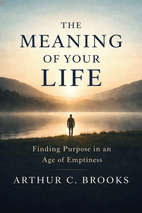
Welcome to a collection of quotes from Arthur C. Brooks' book "The Meaning of Your Life." These lines capture the book's central message: that meaning is not something you find once, but something you build every day through love, purpose, and honest self reflection.
You will find quotes that challenge modern assumptions about success and happiness, and others that offer simple yet profound reminders about what truly matters. Brooks writes with clarity and warmth, making complex ideas feel personal and actionable. Each quote stands alone as a nudge toward a more examined life.
Top Quotes from The Meaning of Your Life
“Your life does have meaning, and you can find it.”
The author states the central promise of the book early in the chapter.
It delivers a direct, hopeful reassurance to readers who feel lost. The simplicity and certainty of the statement make it a powerful anchor for the entire chapter.
“The biggest error people tend to make (as George Bailey did in the movie) is to assume that their significance is all about what they do in worldly terms—their success at work, for example—as opposed to whom they touch in deep and positive ways.”
The author explains the difference between résumé virtues and eulogy virtues during the discussion of significance.
It crystallizes a universal human trap—mistaking achievement for worth—and offers a clear corrective. The reference to It's a Wonderful Life makes the insight relatable and memorable.
“It wouldn't be me at all,” he said, “because no one can upload my soul.”
A taxi driver responds to the idea of uploading one's brain to the cloud.
This simple, intuitive rejection of techno-utopia resonates with the reader's own sense that the self is more than data.
“The paradox is that hedonism, the pursuit of pleasure for its own sake, leads to anhedonia, which is the inability to enjoy pleasure of any kind.”
Psychiatrist Anna Lembke, author of 'Dopamine Nation,' as quoted in the chapter.
This succinctly captures the destructive cycle of addiction, showing how chasing pleasure ultimately destroys the ability to experience it.
“I must get above the noise. And since the noise is coming from inside myself, it means I must transcend myself.”
The author recounts the Dalai Lama's central insight about quieting inner chatter.
This line crystallizes the chapter's core theme of transcendence and self-overcoming in a simple, memorable way.
“Everything can be taken from a man but one thing: the last of the human freedoms—to choose one's attitude in any given set of circumstances, to choose one's own way.”
Viktor Frankl, quoted by the author, on the ultimate human freedom.
This line distills the essence of human agency and resilience, reminding readers that even in the worst conditions, we can control our response.
“Become a student of beauty, and it will reveal the meaning of your life.”
The author's advice after describing how Olivier Messiaen found meaning through music and birds in a Nazi prison camp.
It is a concise, actionable call that encapsulates the chapter's central thesis: actively engaging with beauty unlocks life's purpose.
Themes Behind the Quotes
A strong thread throughout these quotes is the idea that meaning comes from connection, not accomplishment. Brooks pushes back against the modern obsession with productivity and status, arguing that we find purpose in the people we touch and the love we share. Another recurring theme is the danger of chasing pleasure directly, which often leads to emptiness. Instead, meaning emerges when we focus on something larger than ourselves, whether that is beauty, principle, or service to others.
The book also emphasizes the power of inner work. Many quotes point to the need to quiet the ego, transcend our own noise, and choose our attitude even when circumstances are harsh. Brooks draws on philosophy, spirituality, and personal experience to show that meaning is not a riddle to be solved but a mystery to be lived. The path involves humility, wonder, and a willingness to sit with uncomfortable truths.
Quotes by Chapter
Chapter 1: The Meaning of Meaning
“To let meaning unfold before you is to make the most of every day—even the bad ones.”
The author concludes the introductory roadmap by describing the reward of the meaning journey.
It reframes meaning not as a destination but as a continuous process that enriches all experiences. The inclusion of 'even the bad ones' adds realistic comfort.
“A journey of progress toward deep meaning is what it means to be a fully alive human being.”
The author summarizes the lifelong nature of the meaning quest near the end of the introduction.
It elevates the search for meaning from a task to the very essence of human vitality. The phrasing 'fully alive human being' inspires and dignifies the struggle.
Chapter 2: The Right Side of Your Brain
“These experiences cannot be simulated, only lived and experienced in real life.”
The author lists clues for recognizing numinous, right-hemisphere experiences.
It encapsulates the core thesis that genuine meaning is irreducible and must be lived, not digitally replicated.
“The things you really care about the most, which can never be “solved,” are complex. The things you care about less but can solve with knowledge and technology are complicated.”
The author distinguishes between complex and complicated challenges in life.
This distinction clarifies a common confusion, showing why reducing meaning to solvable problems leads to emptiness.
“Instead of naturally encountering mystery and meaning as your grandparents did, today we are stuck “in the 2D realm of representation” as well as with “an obsession with mechanism, reductionism, lumpen matter; an emotional coarsening; the loss of higher values such as goodness, beauty, and truth.””
Iain McGilchrist's description of the modern condition, quoted by the author.
It powerfully diagnoses the cultural shift away from depth and transcendence toward a flat, mechanistic worldview.
Chapter 3: Interrupt the Doom Loop
“A foolish consistency is the hobgoblin of little minds, adored by little statesmen and philosophers and divines.”
Ralph Waldo Emerson in his essay 'Self-Reliance,' as discussed in the chapter.
This line memorably dismisses the fear of inconsistency, encouraging readers to think independently rather than conform to rigid expectations.
“Nothing can bring you peace but yourself. Nothing can bring you peace but the triumph of principles.”
Emerson's conclusion to 'Self-Reliance,' cited near the end of the chapter.
It powerfully reinforces the idea that inner peace comes from self-reliance and adherence to one's own principles, not from external validation.
“I have always loved you passionately and have never been unfaithful to you ever, even in my thoughts.”
Dostoyevsky's last words to his wife Anna, recounted in the chapter.
It reveals the depth of love and redemption after overcoming addiction, illustrating the meaningful life he found beyond the doom loop.
Chapter 4: Three Big Questions You Must Ask
“The unexamined life is not worth living.”
Socrates' famous maxim quoted by the author to emphasize the importance of examining life.
It is a timeless reminder that a life without deep questioning lacks meaning, and it succinctly captures the chapter's central theme.
“But it is the willingness and capacity to wonder and inquire about things large and small that are the essence of our uniquely human consciousness.”
The author's own statement distinguishing humans from other animals by their capacity to wonder.
It powerfully articulates that the essence of human consciousness and meaning lies not in answers but in the act of questioning itself.
“Death lies heavily on him who, though to all the world well known, is stranger to himself alone.”
Seneca's warning from the tragedy Thyestes about self-knowledge, quoted by the author.
It highlights the danger of being a stranger to oneself despite external recognition, resonating with the chapter's call for self-examination.
“Aporia, the fruit of deep contemplation, is best when it disequilibrates your thinking in an uncomfortable way.”
The author's definition of aporia as a state of intellectual discomfort from deep contemplation.
It succinctly explains why embracing puzzlement is essential for personal growth and meaning, directly linking to the chapter's method.
Chapter 5: Give Your Heart Away
“Without her I am, in the words of the Zen Buddhist koan introduced in the last chapter, no more than the sound of one hand clapping. She completes me. She is my second hand clapping. There is a secret sound that only we can hear.”
The author describes the mystical bond with his wife, Ester.
This poetic metaphor captures the idea that love completes us and creates a unique, transcendent connection, resonating with anyone who feels their partner is essential to their wholeness.
“Over a lifetime, a romance lifts you and your partner from the realm of physical attraction to a transcendent understanding of the essence of life itself.”
From the discussion of Plato's Ladder of Love in the chapter.
It encapsulates the transformative power of romantic love, moving from the physical to the profound meaning of life, inspiring readers to see love as a path to deeper understanding.
“Unfortunately, for millions of people—especially young adults for whom life otherwise seems so promising— the door to the right hemisphere seems stuck closed. True romantic love is harder for many people to find than ever before.”
The author diagnoses the current 'love depression' and crisis of connection.
It highlights a contemporary cultural malaise, making readers reflect on modern difficulties in finding love and the need to reengage with deep, complex emotions.
“Pornography decomposes the human craving for love—which is a craving for meaning—by unnaturally isolating the natural sexual component.”
The author critiques pornography as a simulation of love that undermines meaning.
It succinctly explains how a substitute for love fragments the quest for meaning, offering a clear warning about the dangers of replacing authentic connection with artificial pleasure.
Chapter 6: Transcend Yourself
“If you are what you ought to be, you will set fire to all [of] Italy, and not only yonder.”
Saint Catherine of Siena wrote this in a letter to Stefano Maconi about finding life's meaning.
Its bold, metaphorical language inspires readers to realize the immense impact of living in alignment with one's true purpose.
“It’s like saying Picasso doesn't exist because he can’t be found inside Picasso's paintings.”
The author recalls his father's response to cosmonaut Gherman Titov's argument that he didn't find God in space.
This clever analogy makes the case for believing in the unseen with humor and clarity, challenging narrow empiricism.
“What I need—and we all need—is to gain peace and perspective on life by being much freer from this self-focus.”
The author reflects on his own self-focus and the need to transcend it.
It captures a universal human struggle and offers a clear, relatable goal for finding peace.
Chapter 7: Look for Your Calling
“Before you reach enlightenment,” says the master, “you will chop wood and carry water.”
The master says this to the novice monk in a Zen Buddhist story.
It captures the paradox that meaningful work is not about escaping mundane tasks but embracing them as part of the journey. The line sticks because it defies the common expectation of advancement and reward.
“He was mistaken in envisioning a promotion from this work to something more elevated as a reward, because meaning could be found in whatever he might dedicate himself to doing in a spirit of love and humility.”
The author explains the moral of the Zen story about the monk who expected a different job after enlightenment.
This reframes the pursuit of meaning: it is not about the type of work but the attitude of love and humility brought to it. Readers find it liberating because it applies to any job, no matter how humble.
“There is almost nothing in life more disempowering than feeling superfluous to the world.”
The author discusses the importance of serving others and being needed in one's work.
This line powerfully encapsulates how significance—the third dimension of meaning—is undermined when we feel unnecessary. It resonates because it names a universal fear of irrelevance.
“If you are not needed, then your answer to the question “For whom does my life matter?” is “No one.””
The author elaborates on the consequences of feeling superfluous.
It directly connects the feeling of being needed to life's meaning, making an abstract concept painfully concrete. Readers often find this a stark and memorable wake-up call.