The Infinity Machine Quotes
by Sebastian Mallaby
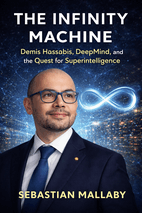
These quotes from Sebastian Mallaby's The Infinity Machine capture the thrilling, anxious, and deeply human story behind the race to build artificial general intelligence. They range from moments of personal revelation to big picture reflections on science and destiny, often feeling like dispatches from the frontier of human thought.
You will find lines that echo with ambition, doubt, and wonder. Some come from late night epiphanies, others from conversations between geniuses. What makes this book so quotable is the raw honesty of its subjects and the way they articulate ideas that are both ancient and brand new.
Top Quotes from The Infinity Machine
“Artificial intelligence heralds a transformation more profound than anything since Homo sapiens acquired the capacity for abstract thought, some seventy thousand years ago.”
Narrator describing the significance of artificial intelligence.
It places AI alongside the most transformative events in human history, emphasizing its magnitude.
“I sit at my desk at two a.m., and I feel like reality is staring at me, screaming at me. “Literally, screaming at me. Trying to tell me something if I could just listen hard enough.””
Demis Hassabis describing his personal experience of the mystery of reality during a conversation with the author.
It vividly conveys the profound wonder and existential urgency that drives his quest to build AI, humanizing the technologist.
“'S fun?” Watson asks Crick, early on in Life Story. “Oh, the big questions,” Crick responds. “What is man? What is life? How did we come to be the way that we are?”
Dialogue from the film Life Story, which inspired Hassabis's scientific ambition.
It captures the existential curiosity that drives Hassabis and many scientists, framing AI as a quest for ultimate understanding.
“Standing on the precipice, teetering at the edge, Hassabis had pulled off his greatest Jedi mind trick ever.”
After a disastrous E3 demo crash, Hassabis still wins the award for best upcoming game.
This climactic sentence captures the drama and near-magic of Hassabis's ability to triumph against overwhelming odds. It reinforces the Jedi metaphor while foreshadowing the unsustainable cost of his charisma.
“Obviously, we are building AGI to be positive in the world, but AGI is definitely momentous in the same way that the bomb was.”
Demis Hassabis comparing AGI to the atomic bomb.
It captures the profound sense of responsibility and historical significance that drives DeepMind's mission.
“Maybe Al is more like fire and language. Or maybe it’s as big as the emergence of the prefrontal cortex in humans.”
Demis Hassabis, comparing the significance of AGI to pivotal milestones in human evolution.
The powerful metaphor elevates the conversation about AI to the level of fundamental human achievements, making the scale of change feel both awe-inspiring and relatable.
“Would I be happier looking back on building a multibillion-dollar business or helping solve intelligence?”
Hassabis recalls the decision that Larry Page framed for him during their walk at the castle.
This line distills the core trade-off between financial success and transformative scientific impact, a dilemma that resonates with anyone pursuing a mission-driven career.
Themes Behind the Quotes
One major theme is the transformative scale of artificial intelligence, seen as a shift comparable to the emergence of abstract thought or the discovery of fire. The quotes reflect a sense that this technology is not just another invention but a fundamental turning point in human history.
Another theme is the personal and moral struggle of the pioneers. They wrestle with the desire to understand the universe, the tension between doing good and the risk of creating something uncontrollable, and the loneliness of pursuing an idea that few others can grasp. There is also a recurring motif of destiny and flow, as if the discovery of intelligence is an inevitable, almost spiritual calling.
Quotes by Chapter
Introduction: The Sweetness
“But the truth is that the prospect of discovery is too sweet.”
Geoffrey Hinton explaining to philosopher Nick Bostrom why he continues AI research despite dangers.
It encapsulates the irresistible allure of discovery, echoing Oppenheimer's 'technically sweet' and highlighting the moral complexity of scientific progress.
Chapter 2: “Deep Philosophical Questions”
“I would like to understand before I croak. I would like to understand, and then I'm perfectly fine to shuffle off my mortal coil.”
Hassabis states his ultimate goal in life, revealing his indifference to death if he can achieve comprehension first.
The raw, candid phrasing contrasts grand ambition with mortal humility, making the pursuit of knowledge feel both noble and deeply human.
“We don’t speak in first order logic and yet we can understand each other.”
Hassabis criticizes the symbolic AI approach while discussing its limitations with David Silver.
It succinctly exposes a fundamental flaw in early AI assumptions, highlighting the gap between rigid logic and the messy, inductive nature of real intelligence.
“He wants to do good, but can he be good?”
The narrator reflects on Demis Hassabis's struggle to stay true to his values amid the volatile AI race.
This terse, moral question distills the central ethical tension of the book, forcing readers to consider whether good intentions can survive in a high-stakes, competitive world.
“I think information is the fundamental unit.”
Demis Hassabis expresses his view on the fundamental nature of reality.
It succinctly captures the core philosophical premise of the chapter—that reality is informational at its base.
Chapter 3: The Jedi
“They liked us, but they wanted our soul in exchange for the money.”
Hassabis explains why he rejected a venture capitalist's offer that demanded half the equity.
This sharp, memorable metaphor exposes the predatory side of early-stage funding and Hassabis's refusal to surrender control. It highlights a key tension between ambition and integrity.
“Who would've thought that you can actually inspire people too much?” he reflected, years later. “Well, you can, because you can get to the point where you are deluding your team, and then they are deluding you also.”
Hassabis looks back on the failure of Republic: The Revolution and the trap of over-inspiration.
This self-aware confession reveals the paradoxical downside of extreme charisma, showing how vision can become delusion. It adds depth to Hassabis's character and offers a cautionary insight for any leader.
“You are trying to build a system that can figure things out without human instruction. Rich Sutton was laying out a road that stretched all the way to the horizon. I wanted to reach that horizon. That was it for me.”
Silver recalls his motivation after reading Sutton's textbook on reinforcement learning.
This line captures the relentless, horizon-chasing ambition that drives AI pioneers, making it both aspirational and deeply personal.
Chapter 4: The Gang of Three
“Write my own rules, because there's a lot of bullshit around. A lot of bullshit.”
Shane Legg reflecting on the lesson he learned from his youth.
It reveals Legg's rebellious, iconoclastic personality and his rejection of conventional wisdom, which later drives his unconventional approach to AI.
“Intelligence measures an agent's ability to achieve goals in a wide range of environments.”
Legg and Hutter's definition of intelligence, from Legg's PhD work.
This succinct, formal definition of intelligence as generality underpins the entire field of artificial general intelligence and challenges narrow benchmarks like the Turing test.
“It was amazing to find Shane because it's like finding an oasis, right? Until then, as far as I knew, I was the only person thinking about these subjects.”
Hassabis recalling his emotional reaction to meeting Legg.
It highlights the profound isolation Hassabis felt in his AI ambitions and the validation he found in a like-minded collaborator, emphasizing the importance of connection in innovation.
“A mission-driven start-up—a Manhattan Project, as Hassabis liked to say—could surely be funded by the right sort of investor: a billionaire, or possibly a multibillionaire, with the stomach for the long horizon.”
Hassabis argues to Legg that they should start a company despite the lack of immediate product prospects.
It encapsulates the audacious, almost hubristic ambition of the DeepMind founders, framing their venture as a historic undertaking requiring extreme patience and capital.
Chapter 6: Atari
“It was Demis’s destiny to build this one.”
Peter Thiel reflects on Hassabis's unique drive and mission.
This line captures the venture capitalist's belief in the founder's predestined role, emphasizing the power of mission-driven entrepreneurs.
“And speaking with him almost made your brain break.”
Luke Nosek describes the overwhelming impact of talking to Demis Hassabis.
It vividly conveys the intensity and visionary obsession that Hassabis exuded, making his quest for AGI seem both thrilling and daunting.
“Isaac Newton, Alan Turing, all my heroes. I could feel them in the bones of the stone, their intellect and vision. They were almost calling out to me.”
Hassabis describing his vivid imagination while walking through Cambridge.
This quote illustrates how Hassabis sees himself as part of a lineage of great thinkers, inspiring his ambition.
Chapter 7: Thiel Trouble
“That God is present in nature, so understanding nature is a spiritual endeavor.”
Demis Hassabis, referencing the philosopher Spinoza to explain his view of science as a spiritual pursuit.
This quote elegantly bridges science and spirituality, offering a profound and personal perspective on why the pursuit of knowledge is deeply meaningful.
“It feels like the flow of the universe is going in this direction, towards discovering the answers. And I'm part of that flow, I’m going with that flow, and it's exhilarating.”
Demis Hassabis, expressing his sense of purpose and excitement about building AGI.
The line conveys a rare blend of humility and exhilaration, capturing the emotional drive behind scientific ambition and making it resonate with anyone who feels called to a grand mission.
“We had no connection to him. Obviously, we were irrelevant nobodies from North London.”
Suleyman tells Hassabis that Thiel wasn't meeting or engaging with DeepMind.
Captures the painful reality of a startup's perceived insignificance to a powerful, distant investor, and the frustration of being ignored.
Chapter 8: Get Google
“I just thought, look, I'll go to Google. I'll get a shitload of computers and then I'll solve intelligence.”
Hassabis explains his mindset after deciding to accept Google's offer.
It captures the raw, unfiltered ambition and simplicity of Hassabis's goal, making his mission feel both audacious and relatable.
“We can’t have a giant corporation control AGI. This is not a good thing for humanity.”
Elon Musk responds to Luke Nosek's news that Google is about to buy DeepMind.
This line foreshadows the enduring debate about AI safety and corporate control, giving voice to a concern that has only grown more urgent.
Chapter 9: Intuition
“Great!” Hassabis thought to himself. “If he thinks it's impossible, it should be pretty impressive if we do it.”
Demis Hassabis reacts to Sergey Brin's skepticism about cracking Go.
This line captures the defiant, ambitious spirit of the DeepMind team, turning doubt into motivation and foreshadowing their eventual success.
“Intuition amounted to a clever algorithm of some kind —an algorithm that science could discover.”
The author describes Hassabis's belief that intuition is not magical but computational.
It articulates a core philosophical premise of the book—that human intuition can be reduced to algorithmic processes, demystifying a key aspect of intelligence.
“Human intuition was not so magical after all. A machine could reproduce it with the trick of mapping one thing onto another.”
After the deep learning network successfully mimicked human move prediction.
A powerful conclusion that validates the team's approach and challenges the notion of human exceptionalism, making it a memorable turning point.