The Black Swan Quotes
by Nassim Nicholas Taleb
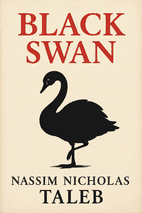
This collection brings together some of the most striking ideas from Nassim Taleb's book. You'll find sharp observations about uncertainty, risk, and human nature. The quotes challenge how we think about luck and prediction.
What makes The Black Swan so quotable is its blend of philosophy and practicality. Taleb writes with a mix of anger and wit. His lines stick with you because they force you to rethink comfortable assumptions. Each one feels like a small revelation about the world's unpredictability.
Top Quotes from The Black Swan
“If you know that you are vulnerable to prediction errors, and if you accept that most “risk measures” are flawed, because of the Black Swan, then your strategy is to be as hyperconservative and hyperaggressive as you can be instead of being mildly aggressive or conservative.”
Taleb introduces the barbell strategy for managing uncertainty and Black Swan risks.
This counterintuitive advice—to avoid moderate risk and instead combine extreme caution with extreme speculation—offers a concrete, actionable framework for thriving in an unpredictable world.
“This idea that in order to make a decision you need to focus on the consequences (which you can know) rather than the probability (which you can’t know) is the central idea of uncertainty.”
Taleb explains the core lesson from Pascal's wager applied to decision-making under uncertainty.
It summarizes the book's epistemological heart: since probabilities of rare events are incalculable, wise decisions hinge on weighing possible outcomes, not guessing odds.
“Put yourself in situations where favorable consequences are much larger than unfavorable ones.”
Taleb distills the principle of asymmetry that runs throughout his recommendations.
This crisp, memorable maxim captures the essence of how to harness positive Black Swans while protecting against negative ones, making it a practical mantra for risk-takers and thinkers alike.
“It is easier for the rich to get richer, for the famous to become more famous.”
From the discussion of Matthew effects and cumulative advantage.
It succinctly captures the self-reinforcing nature of success and inequality, a core theme of the book.
“Fractals should be the default, the approximation, the framework. They do not solve the Black Swan problem and do not turn all Black Swans into predictable events, but they significantly mitigate the Black Swan problem by making such large events conceivable.”
Taleb concludes his discussion on fractal randomness and its limitations.
It clearly defines the practical value of fractals while honestly acknowledging they are not a cure-all for uncertainty.
Themes Behind the Quotes
One major theme is embracing uncertainty by focusing on the size of potential outcomes rather than trying to calculate precise probabilities. The quotes urge us to prepare for rare, high impact events by being both hyperconservative and hyperaggressive, avoiding middle of the road approaches.
Another theme is the role of asymmetry and cumulative advantage. Success often breeds more success, while outliers like fractals help us conceive of extreme events. These ideas together challenge the illusion that we can predict or control the world, pushing us instead to build resilience and seize favorable asymmetries.
Quotes by Chapter
Chapter One - The Apprenticeship of An Empirical Skeptic
“It took me close to a decade and a half to find that thinker, the man who made many swans gray: Mandelbrot—the great Benoit Mandelbrot.”
Taleb describes his long search for someone who truly understood randomness.
This line captures the personal quest and the pivotal role of Mandelbrot in transforming black swans into gray swans.
“Was Galileo legally blind? Even the great Galileo, with all his alleged independence of mind, was not capable of taking a clean look at Mother Nature.”
Taleb criticizes Galileo's claim that nature is written in geometric figures like triangles and circles.
The rhetorical question underscores how even brilliant minds can be blinded by Platonic conditioning.
“It was, as the saying goes, margaritas ante porcos, pearls before swine.”
After economists rejected Mandelbrot's fractal ideas.
The vivid idiom concisely expresses the frustration of offering valuable insights to those unable to appreciate them.