The Automatic Millionaire, 20th Anniversary Edition — Interactive Mindmaps

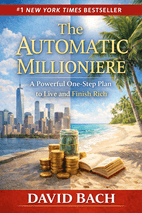
The Automatic Millionaire, 20th Anniversary Edition by David Bach Book Cover

by David Bach

David Bach's The Automatic Millionaire, 20th Anniversary Edition presents a timeless wealth-building system centered on automating savings and investments, using principles like the Latte Factor. It offers a practical, behavior-focused plan for anyone seeking financial security without relying on complex budgets or willpower.

On Insta.page you also get an Apply This Book tool that lets you combine insights from up to 3 books to solve your specific situation.

Chapter mindmaps

Free preview: chapters 1–4 are fully interactive. Click any node to expand or collapse. Subscribe to unlock the rest.

Chapter 1: Introduction

Key concepts: Introduction

1. Introduction

The Financial Crisis in America

  • The traditional American Dream of home ownership and financial security has become elusive for many
  • Post-COVID economic challenges (job loss, inflation, high interest rates) have worsened financial stress
  • Alarming statistics: low household savings, lack of emergency funds, widespread credit card debt
  • Even baby boomers face precarious retirements, heavily reliant on Social Security

The Reader's Financial Reality

  • Personal check-in: Are you living paycheck to paycheck or drowning in debt?
  • Illustrates the long-term cost of minimum payments on debt
  • Creates urgency and readiness for the solutions presented in the book

The Core Philosophy of Wealth Building

  • Wealth building is a steady 'tortoise's approach,' not a get-rich-quick scheme
  • You don't need a high income or immense discipline to become wealthy
  • Small daily savings (the Latte Factor) can compound into significant wealth over time
  • The rich prioritize paying themselves first, and homeownership is a key wealth builder

The Automation Imperative

  • Any financial plan requiring manual effort and constant discipline is doomed to fail
  • Automation is the single most powerful step to guaranteed financial success
  • An automated system runs in the background, freeing you from worry and saving time
  • Transforms philosophy into a practical 'one-step plan' for living and finishing rich

The Book's Roadmap

  • Begins with the inspiring true story of 'the original Automatic Millionaires'
  • Provides exact, actionable steps to replicate their success
  • Each chapter ends with clear 'Automatic Millionaire Action Steps'
  • Designed to be read and implemented quickly with confident encouragement

Chapter 2: Chapter One: Meeting the Automatic Millionaire

Key concepts: Chapter One: Meeting the Automatic Millionaire

2. Chapter One: Meeting the Automatic Millionaire

The Skeptical Advisor and the Unassuming Millionaires

  • Introduction of Jim and Sue McIntyre, an ordinary-looking couple with modest incomes
  • Financial advisor David Bach's initial skepticism about their early retirement plans
  • The couple's appearance contradicts typical expectations of wealth

Revealing a Surprising Net Worth

  • Despite $50,000 combined income, the couple has no debt and owns two homes outright
  • Their net worth approaches $2 million with significant retirement savings and assets
  • They generate rental income and work for enjoyment rather than necessity

The "Average" Couple's Simple Blueprint

  • Practice "Pay Yourself First" by automatically saving before paying bills
  • Eliminate wasteful "small stuff" spending (their version of "The Latte Factor")
  • Buy a home and pay it off fast using accelerated payment strategies
  • Live debt-free with cash-only spending except for mortgage

The True Secret: Automation Over Willpower

  • The couple admits they possess no special discipline or willpower
  • They made every smart financial behavior automatic through systems
  • Used payroll deductions, automatic transfers, and scheduled payments
  • Created a foolproof system that builds wealth without constant decision-making

The Author's Personal Transformation

  • The author applied the McIntyres' principles to his own finances
  • Systematically automated all financial processes including saving and investing
  • Achieved the same outcome, becoming an Automatic Millionaire himself
  • Proves the system is replicable and not just a unique anecdote

A Universally Accessible Path

  • The McIntyres' story represents a blueprint available to anyone
  • Success doesn't require high income, intelligence, or extraordinary discipline
  • The barrier is simply the decision to set up automated systems
  • Empowering call to action for readers to begin their own journey

The Foundational Principle

  • The entire system is built on the single, powerful principle of automation.
  • Automation removes the need for constant willpower, discipline, or budgeting.
  • By making financial actions automatic, success becomes inevitable and stress-free.

Author's Personal Validation

  • The author applied the system to his own finances after discovering the McIntyres' story.
  • His personal success serves as a second, verified case study proving the method works.
  • This firsthand experience adds credibility and authority to the advice given.

Blueprint for Universal Application

  • The system is presented not as a unique anomaly but as a replicable plan.
  • It is designed to be achievable by anyone, regardless of income or financial savvy.
  • The reader is positioned as the next potential success story by simply choosing to follow the steps.

The Transformational Promise

  • Adopting the system promises a fundamental shift in one's relationship with money.
  • The change leads to lasting financial security and peace of mind.
  • It frames financial success as an automatic byproduct of a set system, not a lifelong struggle.

Chapter 3: Chapter Two: The Latte Factor: Becoming an Automatic Millionaire on Just a Few Dollars a Day

Key concepts: Chapter Two: The Latte Factor: Becoming an Automatic Millionaire on Just a Few Dollars a Day

3. Chapter Two: The Latte Factor: Becoming an Automatic Millionaire on Just a Few Dollars a Day

The Spending Treadmill vs. True Wealth

  • Challenges the myth that high income is required for wealth building
  • Identifies the real problem as spending habits, not income level
  • Describes the cycle of earning more and spending more, leaving savings unchanged
  • Illustrates that lifestyle inflation prevents wealth accumulation regardless of salary

The Birth of The Latte Factor Concept

  • Originates from a classroom interaction with a woman named Kim
  • Reveals how small daily expenses ($11 before lunch) accumulate significantly
  • Demonstrates mathematically that $5/day invested could grow to nearly $1.2 million
  • Shows the symbolic cost of unconscious spending patterns

Understanding The Latte Factor Metaphor

  • Not an attack on coffee but a metaphor for habitual unconscious spending
  • Applies to any non-essential: bottled water, snacks, subscriptions, cigarettes
  • Emphasizes recognizing personal spending patterns rather than specific products
  • Illustrates with examples: $3.50/day becomes $12,600 in a decade

The Mathematics of Small Consistent Savings

  • $5/day ($150/month) at 10% grows to $948,611 in 40 years
  • $10/day ($300/month) grows to nearly $1.9 million in 40 years
  • A couple saving $20/day together could amass over $3.7 million
  • Frames saving as working one hour daily for your future self
  • Highlights the power of compound interest as the 'eighth wonder of the world'

Overcoming Common Objections

  • Addresses skepticism about investment returns and inflation
  • Counters the belief that large sums are needed to start investing
  • Dismantles excuses that prevent people from beginning to save

Practical Implementation Steps

  • Identify your personal Latte Factor through conscious awareness
  • Track every single expense for one day to create immediate awareness
  • Use modern tools like YNAB for tracking and Acorns for automated micro-investing
  • Reveals that $27/day thoughtlessly spent wastes $10,000 annually
  • Commit to automatic savings to harness compound interest

Dismantling Common Rationalizations

  • The author counters the 'I'll never earn a 10% return' objection by promising to share strategies for solid long-term growth.
  • Addresses inflation concerns by noting that having $1 million in the future is infinitely better than having $0 from not starting.
  • Challenges the belief that you need a lot of money to invest, stating you can begin automatic plans with as little as a dollar a day.
  • Asserts that the claim 'I don't waste a penny' is almost certainly untrue upon closer, honest examination of spending.

The Personal Latte Factor Challenge

  • The core call to action is to identify your personal Latte Factor by tracking every single expense for one day.
  • Recommends using a simple paper form for the initial tracking to create a powerful 'shock value' of awareness.
  • Acknowledges that banking apps or budgeting tools can be useful for long-term tracking after the initial exercise.
  • The goal is to find $5-$10 per day that can be systematically redirected from spending to automatic investing.

Modern Tools for Money Tracking and Saving

  • Recommends 'You Need a Budget' (YNAB) as a tool focused on awareness of where your money is and where it goes, though it requires a subscription.
  • Highlights Acorns as an app that automates saving by rounding up purchases and investing the spare change into low-cost ETFs.
  • Notes that Acorns has democratized investing for small amounts, making it simple and accessible for over ten million users.

The Imperative of Comprehensive Tracking

  • Emphatically states that to uncover true spending patterns, you must track every single expense.
  • Specifies that tracking must include cash, credit cards, checks, and even minor items like toll bridge fees.
  • Asserts this comprehensive approach is the only way to reveal hidden spending, no matter how trivial items may seem.

A Case Study: The Skeptical Radio Host

  • Recounts a story of a national radio host who initially dismissed the Latte Factor as 'too dumb.'
  • After a $100 bet and tracking his expenses, the host discovered he was spending $50 daily on dining out, totaling over $16,800 annually.
  • This wake-up call led the high-earning, low-saving host to restart his 401(k) contributions, demonstrating how unconscious spending sabotages financial health.

The Real Cost and Opportunity of Daily Spending

  • Illustrates that small daily expenses are a metaphor for mindless spending; for example, $27.39 daily equals $10,000 wasted annually.
  • Flipping the script, investing that same $27.39 daily at a 10% return over 40 years could grow to approximately $4.4 million.
  • The core lesson is about recognizing the massive opportunity cost of frivolous spending versus the power of consistent investing.

Harnessing the Power of Compound Interest

  • Cites Albert Einstein calling compound interest the 'eighth wonder of the world' for its staggering growth potential.
  • Encourages using online calculators (like Investor.gov) to personalize the numbers and visualize the long-term impact.
  • Emphasizes that this 'mathematical miracle' rewards patience and discipline, turning small, consistent investments into life-changing wealth.

Automatic Millionaire Action Steps

  • Acknowledge that spending habits are more critical to wealth-building than the size of your income.
  • Take the one-day Latte Factor Challenge to track all expenses and uncover your personal spending leaks.
  • Commit to the principle of 'living on a little less' and systematically saving the difference.
  • Spend ten minutes with a compound interest calculator to tangibly visualize your potential financial future.

Chapter 4: Chapter Three: Learn to Pay Yourself First

Key concepts: Chapter Three: Learn to Pay Yourself First

4. Chapter Three: Learn to Pay Yourself First

The Budgeting Myth and Its Failure

  • Budgets are joyless, restrictive, and work against human nature
  • They prioritize paying everyone else first, leaving little for yourself
  • This approach is labeled as 'financially backwards'
  • Budgeting is compared to a failed restrictive diet

Flawed Paths to Wealth

  • Win it (lottery/gambling)
  • Marry it (comes with costs)
  • Inherit it (out of your control)
  • Sue for it (unpredictable)
  • Budget for it (deprivation-based struggle)

The Pay Yourself First Philosophy

  • Allocate money to future savings before any bills or expenses
  • Government already uses this principle via automatic tax withholding
  • Adopt automatic systems based on behavior, not willpower
  • The only proven, reliable wealth-building method

The Hours for You Test

  • Calculate: Amount saved last week ÷ hourly wage = Hours worked for yourself
  • Most people work less than one hour weekly for their future
  • Saving 10-15% equals working one hour daily for your future
  • Reframes savings from percentages to tangible time commitment

The Practical Pay Yourself First Plan

  • Decide to prioritize your future first
  • Open a pretax retirement account (401(k) or IRA)
  • Fund with minimum 10% of gross income
  • Make the process completely automatic

Implementation and Mindset Shift

  • Link savings rate directly to financial class aspirations
  • No investment strategy matters without this foundational habit
  • Forget budgeting and get-rich-quick schemes
  • Dual secret: Decide to Pay Yourself First and Make It Automatic

Breaking Down the Perceived Pain of Saving

  • Saving 10% on a $50,000 salary equates to about $14 per day, making the goal feel more tangible and achievable.
  • Using pretax retirement accounts can significantly reduce the day-to-day impact on your spendable income.
  • The chapter reframes saving from a large, abstract sacrifice into a manageable daily decision.

The Pay Yourself First Wealth Benchmark

  • Provides a clear formula linking savings rate to financial class: Dead Broke (spend > earn), Poor (save 0%), Middle Class (5-10%), Upper Middle Class (10-15%), Rich (15-20%), Rich Enough to Retire Early (20%+).
  • Establishes a measurable goal, allowing readers to choose their desired financial future and the corresponding action.
  • Transforms the abstract concept of "wealth" into a specific, behavioral target defined by your savings percentage.

The Non-Negotiable Foundation of Wealth

  • No investment secret, stock tip, or scheme matters if you haven't first mastered the habit of Paying Yourself First.
  • All financial knowledge is meaningless without this foundational practice.
  • Wealth building cannot begin if all other financial obligations consume your income before you save for your own future.

The Threshold of Action: Two Critical Questions

  • Moves the reader from mindset to implementation by posing two practical questions: HOW (the system) and WHERE (the destination) for the money.
  • Creates a direct bridge to the next chapter, which is dedicated to providing the answers.
  • Emphasizes that changing your thinking must now lead to changing your behavior.

The Automatic Millionaire Action Plan

  • Distills the entire chapter's secret into two parts: 1) Decide to Pay Yourself First, 2) Make It Automatic.
  • Presents this combination as the simple, guaranteed path to lasting financial security.
  • Provides an immediate action checklist: forget budgeting, forget get-rich-quick schemes, make the commitment, and choose your savings percentage based on your desired future.

Core Philosophical Takeaways

  • Action supersedes information; understanding is useless without implementation.
  • Wealth building starts with you—your future must be the first bill paid, not the last.
  • Simplicity is powerful; the system boils down to two core principles: Pay Yourself First and Make It Automatic.
  • The next step is mechanical; after the commitment, you must build the automatic system that executes it.

Continue exploring The Automatic Millionaire, 20th Anniversary Edition