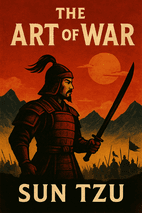
The Art of War Sun Tzu - Complete Edition — Interactive Mindmaps

The Art of War Sun Tzu - Complete Edition by Sun Tzu Book Cover

by Sun Tzu

Sun Tzu's The Art of War - Complete Edition presents the ancient strategic treatise on achieving victory through preparation, deception, and psychological insight. This foundational text is essential for leaders, executives, and strategists navigating competition in business, law, or conflict.

On Insta.page you also get an Apply This Book tool that lets you combine insights from up to 3 books to solve your specific situation.

Chapter mindmaps

Free preview: chapters 1–4 are fully interactive. Click any node to expand or collapse. Subscribe to unlock the rest.

Chapter 1: Introduction

Key concepts: Introduction

1. Introduction

The Universal Philosophy of Victory

  • Emphasizes intelligence and preparation over brute force
  • Focuses on achieving objectives with minimal conflict and disruption
  • Contains a moral dimension advocating for success with honor and restraint
  • Transforms from conquest manual to guide for ethical leadership

The Strategist Behind the Scrolls

  • Sun Tzu as military general and philosopher from Spring and Autumn period
  • Blends Daoist ideas of balance with practical military strategy
  • Emphasizes knowing both oneself and one's opponent
  • Views war as grave necessity to minimize suffering

A Text's Journey Across Millennia

  • Originated as vital text for Chinese generals and statesmen
  • First Western translation by Jesuit missionary Joseph-Marie Amiot
  • Influenced Japanese samurai ethos and modern Western leadership
  • Demonstrates ability to transcend original cultural context

A Modern Edition for Contemporary Challenges

  • Modernizes language while preserving philosophical depth
  • Includes integrated annotations clarifying historical concepts
  • Provides chapter-by-chapter interpretations for modern applications
  • Designed as practical companion for navigating contemporary complexity

Core Principles and Applications

  • Timeless strategy addressing fundamental truths about human nature
  • Wisdom over force: victory through superior strategy
  • Ethical framework emphasizing restraint and responsible power
  • Universal application beyond warfare to business and personal development

Chapter 2: Chapter 1 - Laying Plans

Key concepts: Chapter 1 - Laying Plans

2. Chapter 1 - Laying Plans

The Nature and Gravity of Warfare

  • Warfare is the most serious undertaking of a state, a matter of survival.
  • Success is not a product of chance but of rigorous analysis and study.
  • Meticulous planning creates the conditions for victory before battle is joined.

The Five Constant Factors (The Foundation of Strategy)

  • The Moral Law (Dao): The unifying force aligning people and ruler in shared purpose.
  • Heaven (Tian): Natural cycles, seasons, and forces (Yin/Yang) to harmonize with.
  • Earth (Di): Physical terrain, distances, and tactical implications of ground.
  • The Commander (Jiang): Leadership virtues of wisdom, sincerity, benevolence, courage, and strictness.
  • Method and Discipline (Fa): Organizational machinery, logistics, and military structure.

Strategic Assessment and Comparative Analysis

  • Victory is predicted by comparing mastery of the Five Factors against the enemy.
  • The side where these factors are most favorably aligned holds the strategic advantage.
  • This assessment, often done pre-mobilization, is the true measure of potential success.

The Principle of Deception

  • All warfare is based on deception.
  • Actively shape enemy perception by feigning disorder, weakness, or fear.
  • The goal is to lure the enemy into overconfidence and create exploitable errors.

Core Strategic Maxims for Victory

  • Attack where the enemy is unprepared; appear where you are not expected.
  • If the enemy is united, work to divide them.
  • Avoid a direct, prolonged fight with a strong enemy; provoke and exhaust them instead.
  • Know yourself and know your enemy; victory is then never in doubt.

Chapter 3: Analysis of Chapter 1

Key concepts: Analysis of Chapter 1

3. Analysis of Chapter 1

The Nature of Warfare

  • War is a grave matter of state survival, not to be approached casually
  • Demands rigorous study, preparation, and strategic thought over brute force
  • Determines the survival or ruin of the state

The Five Constant Factors for Success

  • Dao (The Way): Moral harmony between leadership and people, shared purpose
  • Tian (Heaven): Natural forces, weather, seasons, time, and cosmic balance
  • Di (Earth): Tangible terrain, geography, and strategic use of ground
  • Jiang (Leadership): Commander's virtues of wisdom, sincerity, courage, and discipline
  • Fa (Discipline): Organizational structure, command, supply, and control systems

Deception and Strategic Assessment

  • All warfare is based on deception as a pivotal tactic
  • Create false appearances: feign weakness when strong, disorder when ordered
  • Knowledge is supreme: know yourself and know your enemy for victory
  • Every campaign begins with comparative assessment of factors against the enemy

Speed and Economy in Conflict

  • Avoid protracted conflict which exhausts resources and morale
  • Swift, decisive campaigns are superior to lengthy wars
  • Prolonged war leaves one vulnerable to third-party intervention
  • Ultimate skill is to subdue the enemy's will without battle

Chapter 4: Chapter 2 - Waging War

Key concepts: Chapter 2 - Waging War

4. Chapter 2 - Waging War

The Foundation of Military Readiness

  • Meticulous preparation of personnel, weapons, and supplies is essential before any campaign
  • A fully equipped force includes soldiers, chariots, support craftsmen, and financial reserves
  • All essential resources must be sheltered and protected to ensure seamless advancement

The Strategic Imperative of Speed

  • Avoid hesitation and prolonged campaigns that drain resources and morale
  • Swift, decisive action prevents weapons from rusting and morale from declining
  • Delay risks financial exhaustion, weakened forces, and devastating enemy counterattacks

The Crippling Costs of Protracted Warfare

  • Prolonged campaigns exhaust state finances and social stability
  • Resources drain, prices rise, taxes increase, and agricultural production suffers
  • Nothing harms a kingdom more than the logistical expenses of extended conflict

Sustaining Strength Through Enemy Resources

  • Skilled generals shorten campaigns by sustaining armies at enemy expense
  • Aim to capture vastly more supplies than the enemy possesses
  • Disrupt enemy supply lines, ambush detachments, and capture convoys to relieve home state burden

Integrating Captured Assets and Personnel

  • Reward troops generously for capturing enemy equipment like chariots
  • Integrate captured equipment into your own forces after removing enemy markings
  • Treat prisoners with respect, feed them well, and utilize their skills to strengthen your army

The General's Role as Arbiter of National Fate

  • Victory lies in achieving decisive results, not in prolonged campaigns
  • Master generals become caretakers of the people's fate and national prosperity
  • Focus on swift, conclusive wins that protect the state and enhance its long-term prestige

Continue exploring The Art of War Sun Tzu - Complete Edition