The 5 Types of Wealth Key Takeaways

by Sahil Bloom
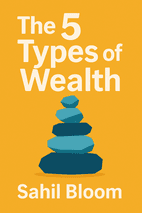
The 5 Types of Wealth by Sahil Bloom Book Cover

5 Main Takeaways from The 5 Types of Wealth

True wealth is multidimensional, not just financial.

The book defines five types of wealth—time, social, mental, physical, and financial—arguing that focusing solely on money leads to Pyrrhic victories where you win financially but lose in relationships, health, or joy. Tracking all five areas with a Wealth Score provides a holistic view of prosperity, helping you avoid the dissatisfaction of an imbalanced life.

Intentionality in all areas of life is key to fulfillment.

This involves defining your 'enough,' setting a Life Razor for clarity in chaos, and regularly reassessing priorities through tools like monthly check-ins. By acting before regret strikes—as emphasized in elder wisdom—you can course-correct early and align daily choices with your True North, rather than chasing societal defaults.

Time is your most finite resource; invest it wisely.

Concepts like memento mori and the Red Queen Effect highlight time's scarcity and the trap of busyness without progress. To build Time Wealth, prioritize high-leverage activities, say no relentlessly using tests like Right Now, and balance time types (creation vs. management) to free up energy for what truly matters.

Deep relationships are the foundation of long-term happiness.

Social wealth—strong ties with family, friends, and community—is the greatest predictor of health and happiness, surpassing wealth or IQ. Tools like the Relationship Map and 'Front-Row People' help you invest in depth over breadth, combat loneliness, and earn status through authenticity, not material displays.

Define your 'enough' to avoid the hedonic treadmill.

Financial wins quickly become the new baseline, leading to perpetual dissatisfaction. By writing down your 'Enough Life' scenario, living below your means, and harnessing compounding through automated investments, you can achieve financial independence as a tool for freedom, not an endless pursuit of status.

Executive Analysis

Sahil Bloom's central argument is that true prosperity requires balancing five interconnected types of wealth: time, social, mental, physical, and financial. The book rejects the singular chase for money, showing how Pyrrhic victories—winning financially while losing elsewhere—lead to emptiness. Instead, it advocates for intentionality through frameworks like the Wealth Score and Life Razor, which help readers design a life aligned with core values rather than societal pressures.

This book matters because it provides a practical, holistic framework for modern readers overwhelmed by burnout and comparison. Blending ancient wisdom (like memento mori and ikigai) with contemporary examples (from Marc Randolph to Naval Ravikant), it sits at the intersection of personal development and life design, offering actionable tools—such as the 30-Day Challenge and Energy Calendar—to cultivate lasting fulfillment beyond material success.

Chapter-by-Chapter Key Takeaways

One Thousand Years of Wisdom (Chapter 1)

  • Love and relationships form the bedrock of lasting fulfillment, as emphasized by elders with decades of lived experience.

  • Money’s role in happiness diminishes sharply after meeting basic needs; chasing wealth often leads to a treadmill of dissatisfaction.

  • Comparison corrodes contentment: Even extreme wealth can’t shield against the human tendency to measure oneself against others.

  • Intentionality matters: Prioritize health, repair small issues (emotional or physical), and express gratitude—before time forces your hand.

Try this: Reflect on elder wisdom to prioritize health, relationships, and gratitude before time forces your hand.

The Five Types of Wealth (Chapter 2)

  • Avoid Pyrrhic victories: Winning financially while losing relationships, health, or joy is a net loss.

  • Expand your scoreboard: Track all five wealth types—time, social, mental, physical, and financial—to gauge true prosperity.

  • Adapt with seasons: Priorities shift over time; balance means adjusting focus, not achieving perfection.

  • Define “enough”: Financial wealth requires curbing insatiable expectations as much as growing assets.

  • Act before regret strikes: Use life’s inevitable “lights” of clarity to course-correct early, not mourn lost opportunities later.

Try this: Audit your life across all five wealth types to identify imbalances and define what 'enough' means for you.

The Wealth Score (Chapter 3)

  • Your Wealth Score is a compass, not a judgment. It reveals where to direct energy for a balanced life.

  • Imbalances are normal. Few people score evenly across all dimensions—this is a starting line, not a finish line.

  • Progress is dynamic. Reassessing your score annually (or during major life changes) ensures alignment with evolving priorities.

  • Money is just one piece. True wealth integrates time, relationships, health, and purpose alongside finances.

Try this: Calculate your Wealth Score annually to guide energy allocation and accept that imbalances are normal starting points.

The Life Razor (Chapter 4)

  • Clarity in Chaos: A Life Razor acts as a fixed point to navigate uncertainty, much like Apollo 13’s Earth reference.

  • Identity Anchors: It reflects your core values, helping you make aligned decisions (e.g., Marc Randolph’s family-first identity).

  • Ripple Effects: Small, consistent actions reinforce priorities and inspire others.

  • Adaptability: Revisit and refine your Life Razor as life circumstances change.

  • Action Over Abstraction: The best razors are specific, actionable, and rooted in daily choices.

Try this: Craft a personal Life Razor—a simple, actionable statement of core values—to navigate daily decisions and chaos.

Your True North (Chapter 5)

  • Direction > Speed: Define your “True North” with clear goals and anti-goals to avoid Pyrrhic victories.

  • Work Smart, Not Hard: Adopt high-leverage systems (like Messi’s pacing or Buffett’s patience) for disproportionate results.

  • Balance Through Seasons: Use a “dimmer switch” approach—prioritize without neglecting other areas of life.

  • Regular Check-Ins: Monthly/quarterly reviews keep you aligned and agile.

  • Answers Lie Within: Write a letter to your future self. Clarity on your desired future helps ask the right questions now.

  • The chapter closes with the author’s poignant letter to his 2014 self, underscoring that wisdom often resides within—waiting to be unlocked through reflection and intentionality.

Try this: Write a letter to your future self to clarify your True North, then set systems for high-leverage actions and regular check-ins.

The Big Question (Chapter 6)

  • Family bonds fade faster than you realize—prioritize shared moments before routines pull you apart.

  • Childhood is a blink—be present during the years your kids actively seek your presence.

  • Friendships require pruning—invest in depth over breadth as you age.

  • Partners shape your life’s trajectory—choose someone who adds meaning, not just companionship.

  • Work relationships matter—seek coworkers who energize, not drain, your spirit.

  • Solitude is inevitable—learn to cherish it as a gift, not a burden.

  • The chapter closes with Alexis’s haunting refrain: “It’s later than you think.” A reminder that time’s impermanence isn’t a threat—it’s a call to live with intention, before the curtain falls.

Try this: Act with urgency on relationships by scheduling meaningful time with family and friends, remembering 'it's later than you think.'

A Brief History of Time (Chapter 7)

  • Memento mori reminds us to value finite time, not fear it.

  • Relativity reshaped time: It’s subjective, not absolute.

  • The Red Queen Effect traps us in perpetual busyness without progress.

  • Attention residue undermines focus; constant switching has steep costs.

  • Kairos > Chronos: Prioritize impactful moments over mere efficiency.

  • The solution lies not in running faster, but in running smarter—investing energy where it yields the greatest return.

Try this: Shift from chasing efficiency to seeking impactful moments (Kairos) by auditing how you spend your time and attention.

The Three Pillars of Time Wealth (Chapter 8)

  • Awareness precedes action: Recognize time’s scarcity to jolt yourself out of complacency.

  • Attention amplifies impact: Focused effort on high-leverage activities creates outsized results.

  • Control is freedom: Owning your time allows alignment with personal values and happiness.

  • Progression matters: Build awareness first, sharpen attention next, and cultivate control last—each pillar reinforces the others.

Try this: Build time wealth sequentially: first, acknowledge its scarcity; then, sharpen focus; finally, cultivate control over your schedule.

the Time Wealth Guide (Chapter 9)

  • Confront finite time to reprioritize relationships and goals.

  • Track energy expenditures to optimize your schedule.

  • Focus on 5 priorities—eliminate the rest.

  • Separate urgent vs. important to avoid burnout.

  • Simplify tasks with constraints and micro-actions to beat拖延.

  • Flow Requires Ritual: Design a sensory-based boot-up routine to trigger deep focus.

  • Delegate Strategically: Profile tasks, set expectations, and iterate with feedback.

  • Say No Relentlessly: Use the Right Now and New Opportunity tests to guard your time.

  • Balance Time Types: Prioritize creation and ideation by batching management tasks.

  • Invest in Energy: Allocate freed time to activities that replenish and energize you.

Try this: Conduct a time audit to identify energy drains, then implement constraints like batching and delegation to protect high-priority tasks.

Summary: Time Wealth (Chapter 10)

  • Time wealth starts with mindset: Recognizing time’s scarcity reshapes how you allocate attention.

  • Clarity beats busyness: Define 2–3 non-negotiable priorities and guard them fiercely.

  • Control is earned: Proactive planning (like the Energy Calendar) prevents reactive burnout.

  • Small shifts compound: A week-long audit can reveal patterns that, when adjusted, unlock lasting change.

Try this: Define 2-3 non-negotiable priorities for your week and use an Energy Calendar to proactively plan rather than react.

The Big Question (Chapter 11)

  • Prioritize depth over distraction: The quality of a few key relationships outweighs superficial busyness.

  • Define your Front-Row People: Regularly reflect on who matters most—and act accordingly.

  • Resist technological erosion: Combat loneliness by prioritizing in-person presence and emotional availability.

  • Live with intentionality: Life’s fragility, as seen in Aubrie’s story, demands proactive love and gratitude.

  • Social Wealth = Stability: True fulfillment stems from connections, not achievements or material success.

  • Final note: “Find your Front-Row People. Cherish them. Be one to someone else.”

Try this: List your 'Front-Row People' and plan one intentional action this week to strengthen each of those relationships.

The Uniquely Social Species (Chapter 12)

  • Relationships are foundational: Strong social ties are the single greatest predictor of long-term health and happiness, surpassing wealth, IQ, or genetics.

  • Loneliness is a silent crisis: Chronic isolation harms health more than smoking or obesity, exacerbated by technology that prioritizes digital over in-person interaction.

  • Proximity matters: Physical closeness to loved ones offers irreplaceable emotional and psychological benefits, often overlooked in pursuit of financial or career goals.

  • Balance optimization with connection: Sacrificing social bonds for short-term gains risks long-term well-being, as humans thrive not in isolation but in community.

Try this: Prioritize physical proximity and in-person interactions with loved ones to combat the health risks of chronic loneliness.

The Days Are Long but the Years Are Short (Chapter 13)

  • Childhood’s “magic years” are non-renewable: Prioritize presence before influence naturally shifts to peers.

  • Absence has hidden costs: Kids remember missed moments far longer than professional accolades.

  • Balance requires intentionality: Define success on your terms, blending work ethic with family engagement.

  • Contextualize sacrifices: Involve loved ones in your “why” to transform absence into shared purpose.

  • Reject autopilot: Challenge societal defaults—design a life where career and family coexist without resentment.

Try this: Involve your family in your career 'why' to transform work sacrifices into shared purpose and preserve childhood moments.

The Three Pillars of Social Wealth (Chapter 14)

  • Depth is non-negotiable: Cultivate a small circle of trusted relationships through vulnerability and shared struggles.

  • Breadth combats loneliness: Engage intentionally with communities to build belonging beyond your inner circle.

  • Earned > Bought: Pursue respect through mastery and character, not material displays.

  • Time is finite: Invest in Social Wealth now—neglected relationships atrophy.

  • Choice is power: Like Rohan, focus on what you control: who you surround yourself with and how you show up for them.

Try this: Invest in both depth (close circles) and breadth (community) of relationships, focusing on earned respect through character.

The Social Wealth Guide (Chapter 15)

  • Audit relationships using the Relationship Map to focus energy on supportive connections.

  • Align with your partner’s love language and avoid Gottman’s Four Horsemen to strengthen romantic bonds.

  • Implement rituals like the Life Dinner and Helped/Heard/Hugged to maintain intentional communication.

  • Prioritize empathy over solutions when loved ones seek support.

  • Prioritize others’ emotional needs with “helped, heard, or hugged.”

  • Master conversations by creating doorknobs, listening loudly, and balancing eye contact.

  • Build relationships through value-aligned interactions and thoughtful follow-ups.

  • Assemble a personal brain trust for diverse, honest advice.

  • Conquer public speaking with structured preparation and mindset shifts.

  • Bought status is a trap: External validation through possessions creates dependency, not freedom.

  • Earned status endures: Focus on cultivating relationships, skills, health, and purpose—prizes that money can’t shortcut.

  • Test your choices: Use the two status tests to avoid Diderot’s fate and invest in what truly builds Social Wealth.

  • As Naval Ravikant warns, “Play stupid games, win stupid prizes.” Choose earned-status games—their rewards outlast the fleeting thrill of a scarlet robe.

Try this: Map your relationships to identify which to nurture, which to maintain, and which to release, then communicate using empathy and active listening.

Summary: Social Wealth (Chapter 16)

  • Depth, Breadth, and Earned Status are interdependent; neglecting one weakens the others.

  • Use the Social Wealth Score to diagnose gaps and track progress.

  • Proactively design systems to strengthen relationships—don’t leave them to chance.

  • The Relationship Map is a tangible tool to prioritize connections that truly matter.

  • True status isn’t bought—it’s earned through authenticity and contribution.

Try this: Use the Social Wealth Score to diagnose gaps in depth, breadth, or status, and design monthly rituals to strengthen key connections.

The Big Question (Chapter 17)

  • Curiosity is a longevity tool: It enhances cognitive health, emotional resilience, and life satisfaction.

  • Modern life stifles curiosity: Busyness and perceived time constraints push adults toward routine over exploration.

  • Reconnect with your inner child: Reflect on what your younger self would prioritize—joy, wonder, and growth.

  • Hank’s legacy: A life of “Mental Wealth” isn’t about wealth or fame but sustained curiosity, love, and small daily adventures.

  • Hank’s story closes with a glimpse of his ninety-ninth birthday: reading the newspaper, savoring simple routines, and crediting his longevity to marrying “a good woman.” His example urges readers to protect their curiosity—not just for survival, but for a life rich in texture and meaning.

Try this: Dedicate 15 minutes daily to a curiosity-driven activity, reconnecting with the wonder and joy of your inner child.

A Tale as Old as Time (Chapter 18)

  • Purpose is universal yet personal: From the Buddha’s enlightenment to ikigai, every culture grapples with defining purpose, but it must be rooted in individual authenticity.

  • Resist equilibrium: Societal norms push toward conformity; true fulfillment requires actively defending your uniqueness, as seen in Bezos’s warning against “blending in.”

  • Growth over comfort: Ancient philosophies like arete and the Eightfold Path prioritize lifelong growth, not static success.

  • Redefine success: Ikigai isn’t about monetizing passion but integrating purpose into daily life, whether through work, relationships, or creativity.

  • You are the hero: The fight to live authentically is arduous but essential—stagnation is a slow death, while distinctiveness fuels Mental Wealth.

Try this: Defend your unique purpose against societal conformity by regularly asking if your actions align with your authentic self.

The Three Pillars of Mental Wealth (Chapter 19)

  • Purpose: Define a personal mission—no matter how small—that aligns actions with meaning. It’s linked to longevity and fulfillment, not external validation.

  • Growth: Embrace a growth mindset. Progress hinges on effort, not innate ability, and daily learning fuels resilience.

  • Space: Prioritize stillness. Whether through meditation, walks, or rituals, space sharpens focus, sparks creativity, and buffers against burnout.

  • Together, these pillars form a scaffold for Mental Wealth: a life lived intentionally, adaptively, and with room to breathe.

Try this: Establish daily habits that nurture purpose, growth, and space, such as a morning mission statement, learning goal, and quiet time.

The Mental Wealth Guide (Chapter 20)

  • Design Around Energy: Prioritize pursuits that energize you, even if they’re initially challenging.

  • Simplify to Master: Teaching others exposes gaps in your knowledge—fill them deliberately.

  • Retain Strategically: Use spaced repetition to convert short-term learning into long-term mastery.

  • Question Assumptions: Uncover hidden opportunities by redefining problems through Socratic inquiry.

  • Think Day: Monthly intentional solitude unlocks creativity and strategic clarity.

  • Power Walk: Daily walks enhance creativity, connection, and cognitive health.

  • Power-Down Ritual: Structured closure to workdays improves boundaries and mental well-being.

  • 1-1-1 Journaling: A five-minute nightly practice builds gratitude, reduces stress, and tracks growth.

  • These tools prioritize space and reflection to cultivate mental wealth in high-stakes, fast-paced environments.

Try this: Schedule a monthly 'Think Day' for solitude and strategic reflection, and implement a nightly 1-1-1 journal for gratitude and learning.

Summary: Mental Wealth (Chapter 21)

  • Mental wealth hinges on purpose, growth, and space—three pillars that require ongoing nurturing.

  • Regular self-assessment (via the Mental Wealth Score) helps track alignment with these pillars.

  • Goal-setting must balance aspirational targets (“goals”), risk mitigation (“anti-goals”), and sustainable habits (“systems”).

  • The ikigai exercise bridges personal passions with real-world impact, offering a practical path to purpose discovery.

Try this: Conduct a quarterly ikigai exercise to ensure your goals, anti-goals, and systems are aligned with your core passions and values.

The Big Question (Chapter 22)

  • Control Compounds: Physical Wealth isn’t just about health—it’s a mindset. Small actions (like Dan’s gym routine) build self-trust, empowering broader life changes.

  • Future Self as Stakeholder: Daily habits write the story of your eightieth birthday. EFT helps align today’s choices with the life you want to live.

  • Trade-offs Matter: Luck and Dahlstrom’s stories reveal that true wealth means valuing your body’s longevity over temporary rewards.

  • Your Body is Your Home: Treat it with the care you’d give a house you plan to live in for decades—repair small issues early, invest in maintenance, and avoid destructive shortcuts.

  • The chapter closes with a challenge: Every choice today is a vote for the version of yourself you’ll become. Dance floors don’t wait for last-minute preparations.

Try this: Treat every daily health choice as a vote for your future self, using techniques like EFT to align actions with long-term well-being.

The Story of Our Lesser World (Chapter 23)

  • Historical Rhythms: Humanity’s view of the body has oscillated between celebration and neglect, shaped by cultural, religious, and economic forces.

  • Foundations Over Fads: Basic practices (movement, nutrition, sleep) yield more lasting results than trendy products.

  • The 80/20 Rule: Prioritize simplicity—avoid getting lost in the noise of an overcomplicated wellness landscape.

  • Legacy of Obsession: From Vitruvius to CrossFit, the pursuit of physical perfection reflects deeper human desires for meaning and mastery.

Try this: Focus on foundational health practices—movement, nutrition, sleep—over trendy products, applying the 80/20 rule for simplicity.

The Three Pillars of Physical Wealth (Chapter 24)

  • Three Pillars Rule: Movement, Nutrition, and Recovery form the foundation of physical health. Start with Level 1 in each and progress as habits solidify.

  • Extremes ≠ Essentials: Bryan Johnson’s regimen is aspirational but unnecessary. Focus on consistency, not complexity.

  • Sleep Is Non-Negotiable: Prioritize it as rigorously as diet or exercise.

  • Progress > Perfection: Small, daily actions compound into lifelong health dividends.

  • You’re Player 1: Customize your approach using the provided framework—no $2 million budget required.

Try this: Start with Level 1 habits in movement, nutrition, and recovery, and progress only after consistency is achieved, prioritizing sleep above all.

The Physical Wealth Guide (Chapter 25)

  • Start Small: Use the Thirty-Day Challenge to build foundational habits.

  • Routine Matters: A structured morning routine enhances energy and focus.

  • Balance Intensity: Mix strength, cardio, and recovery for sustainable fitness.

  • Eat Wisely: Prioritize whole foods and protein without rigid dieting.

  • Sleep Like a Pro: Consistency and environment are critical for rest.

  • Breathe to Reset: Simple techniques manage stress and promote calm.

Try this: Launch a 30-Day Challenge for one physical habit, like a morning routine or whole foods focus, and track your progress with accountability.

Summary: Physical Wealth (Chapter 26)

  • Holistic health hinges on three pillars: Move daily, eat whole foods, prioritize recovery.

  • Measure progress: Use the Physical Wealth Score to identify weaknesses and track improvements.

  • Start small, then compound: The 30-Day Challenge bridges intention to action, with social accountability amplifying success.

  • Plan for the long game: Systems > willpower. Design routines that outlast motivation.

Try this: Measure your Physical Wealth Score to identify weak pillars, then design a system—like meal prepping or sleep hygiene—to automate consistency.

The Big Question (Chapter 27)

  • Hedonic adaptation traps us: Financial wins quickly become the new baseline, perpetuating dissatisfaction.

  • Define your “Enough Life”: Write down what balance looks like for you—geography, relationships, financial cushion—to combat subconscious escalation.

  • Societal pressure distorts priorities: True wealth lies in autonomy over time, health, and purpose, not external validation.

  • Conscious choices matter: Regularly revisit your definition of “enough” to avoid ethical compromises and lifestyle inflation.

  • Fulfillment is internal: As the Cool Runnings quote underscores, “If you’re not enough without it, you’ll never be enough with it.”

Try this: Write down your detailed 'Enough Life' scenario to combat hedonic adaptation and revisit it quarterly to stay grounded in your values.

The Financial Amusement Park (Chapter 28)

  • Wealth’s Trade-Offs: Fugger’s life underscores the cost of prioritizing money over relationships and purpose.

  • Money as Abstraction: From barley to Bitcoin, money’s value increasingly relies on collective belief, not physical reality.

  • Historical Precedent: Financial innovation (paper money, fractional banking) solved past problems but introduced new vulnerabilities.

  • Modern Discipline: In a world of endless financial “games,” success hinges on ignoring distractions and adhering to timeless principles.

  • Risk Awareness: Speculative instruments often prioritize novelty over substance; true wealth grows through patience, not hype.

Try this: Ignore financial noise and speculative games by adhering to timeless principles of patience and discipline in your wealth-building.

The Three Pillars of Financial Wealth (Chapter 29)

  • Pillars are universal: Wealth-building relies on growing income, managing expenses, and investing the difference.

  • Compounding is non-negotiable: Start early, invest consistently, and prioritize time in the market.

  • Lifestyle creep is the enemy: Let income outpace spending to widen the wealth-building gap.

  • Financial independence is personal: Define your “enough” and climb the five levels at your own pace.

  • Wealth changes problems, not life: Money solves financial stress but doesn’t address deeper questions of purpose or happiness.

  • By mastering these principles, anyone can build financial security—no lottery tickets or Silicon Valley exits required.

Try this: Automate savings and investments to harness compounding, and consciously resist lifestyle creep by letting income outpace spending.

The Financial Wealth Guide (Chapter 30)

  • Asset trade-offs: Every investment class balances returns, risk, and effort—choose based on your capacity for hassle.

  • Hassle-adjusted returns: Passive investments often outperform high-maintenance options when accounting for time/energy costs.

  • Self-investment supremacy: Prioritize spending on growth-oriented personal investments—they compound across all areas of life.

Try this: Prioritize investments with high hassle-adjusted returns, like index funds, and allocate resources to self-investment for cross-domain compounding.

Summary: Financial Wealth (Chapter 31)

  • Money is a tool, not a goal: Its value lies in enabling freedom, not status.

  • Live below your means to harness compounding; even small, consistent investments grow exponentially.

  • Focus on high-leverage systems (index funds, automation) over get-rich-quick schemes.

  • Define financial “enough” to avoid endless chasing—true wealth is the ability to live on your terms.

Try this: Define your financial 'enough' number based on desired freedom, not status, and use automation to live below your means consistently.

Continue Exploring