Talking to Strangers Quotes
by Malcolm Gladwell
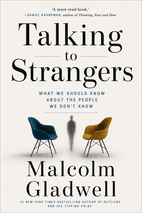
This collection brings together some of the most striking lines from Malcolm Gladwell's exploration of how we interact with people we don't know. You'll find observations about misjudgment, the limits of intuition, and the hidden flaws in our assumptions about others.
What makes the book so quotable is its ability to turn everyday encounters into lessons about human nature. Gladwell draws on real stories of spies, criminals, and tragic misunderstandings to challenge how we think about truth and transparency. These quotes capture moments of insight that stay with you long after you read them.
Top Quotes from Talking to Strangers
“If we were more thoughtful as a society—if we were willing to engage in some soul-searching about how we approach and make sense of strangers—she would not have ended up dead in a Texas jail cell.”
The author's thesis after introducing Sandra Bland's story.
It captures the book's central argument and moral urgency, urging self-reflection.
“And if the CIA's best can be misled so completely, so many times, then what of the rest of us?”
The narrator reflects on the repeated betrayals suffered by the CIA despite its expertise.
This rhetorical question universalizes the problem, forcing readers to confront their own vulnerability to deception.
“How is it that meeting a stranger can sometimes make us worse at making sense of that person than not meeting them?”
The central puzzle posed by the chapter after examining Chamberlain and the bail study.
This question frames the chapter's core theme and forces readers to reconsider the value they place on personal interaction in understanding others.
“The issue with spies is not that there is something brilliant about them. It is that there is something wrong with us.”
The author's concluding reflection after recounting how Montes spied for years undetected.
Shifts the focus from the spy's cunning to our own blindness, encapsulating the chapter's theme.
“Defaulting to truth is a problem. It lets spies and con artists roam free. Or is it?”
The author reflects on the Madoff case, introducing the paradox of truth-default.
This line succinctly captures the central dilemma of the chapter, forcing readers to reconsider whether trusting strangers is always wise.
“Transparency is a myth—an idea we've picked up from watching too much television and reading too many novels where the hero's “jaw dropped with astonishment” or “eyes went wide with surprise.””
The author concludes the discussion of the surprise experiment conducted by psychologists Schiitzwohl and Reisenzein.
This blunt dismissal of a deeply held belief forces readers to question how much of their understanding of others is borrowed from fiction rather than reality.
“We all accept the flaws and inaccuracies of institutional judgment when we believe that those mistakes are random. But Tim Levine's research suggests that they aren't random—that we have built a world that systematically discriminates against a class of people who, through no fault of their own, violate our ridiculous ideas about transparency.”
The author connects Levine's findings to the broader issue of wrongful convictions.
This passage crystallizes the book's central argument: our bias against mismatched individuals leads to a systematic injustice that is far from random.
Themes Behind the Quotes
One major theme is the failure of transparency. We tend to believe that people's outward behavior reveals their inner feelings, but the book shows this belief is often wrong. This leads to systematic errors in judging strangers, especially when their demeanor doesn't match our expectations.
Another theme is the default to truth. Humans are wired to trust others, which is usually helpful but also makes us vulnerable to deception. Gladwell examines how this tendency combines with institutional biases to create tragic outcomes, from wrongful convictions to intelligence failures. The quotes reflect on the costs of both trusting too much and trusting too little.
Quotes by Chapter
Introduction: “Step out of the car!”
“I am up today just praising God, thanking His name. Definitely thanking Him not just because it’s my birthday, but thanking Him for growth, thanking Him for the different things that He has done in my life over this past year.”
Sandra Bland in her YouTube video 'Sandy Speaks' on her birthday.
It reveals her joyful and grateful spirit, making her tragic death even more haunting.
“Even though I have made some mistakes, I have definitely messed up, He still loves me, and I want to let my Kings and Queens know out there that He still loves you too.”
Sandra Bland concluding her birthday video.
Shows her compassion and message of unconditional love, contrasting with the harsh treatment she later received.
“Think about how hard it was. Sandra Bland was not someone Brian Encinia knew from the neighborhood or down the street. That would have been easy: Sandy! How are you? Be a little more careful next time.”
The author emphasizing the difficulty of interactions between strangers.
It illustrates the challenge of understanding strangers and the tragic consequences of failure.
Chapter One: Fidel Castro’s Revenge
“The most sophisticated intelligence service in the world had been played for a fool.”
After describing how Cuba's documentary exposed CIA operations, the narrator sums up the humiliation.
It starkly captures the irony and scale of the CIA's failure, making the reader question the infallibility of powerful institutions.
“We were all just taken aback that one of our own could betray us that way.”
The Mountain Climber describes the shock when Aldrich Ames was revealed as a traitor.
It highlights the profound blindness even experienced professionals have to betrayal from within their own ranks.
Chapter Two: Getting to Know der Führer
“You would never notice him in a crowd and would take him for the house painter he was.”
Chamberlain describing his first impression of Hitler in a letter to his sister.
This line starkly contrasts Hitler's ordinary appearance with his monstrous actions, highlighting the danger of judging character by looks alone.
“In short I had established a certain confidence which was my aim, and on my side in spite of the hardness and ruthlessness I thought I saw in his face I got the impression that here was a man who could be relied upon when he had given his word.”
Chamberlain's conclusion after his first meeting with Hitler, writing to his sister.
This quote encapsulates the tragic misjudgment of appeasement, showing how personal interaction can create false trust in a duplicitous adversary.
“The people on the computer's list were 25 percent less likely to commit a crime while awaiting trial than the 400,000 people released by the judges of New York City.”
From the study comparing judge decisions to an AI's recommendations.
This striking statistic reveals the superiority of data-driven decisions over human intuition when assessing strangers, challenging our faith in face-to-face encounters.
Chapter Three: The Queen of Cuba
“The Queen of Cuba takes note of all that the U.S. intends, by means that all around her do not dream of.”
This was a paraphrase of Shakespeare taped to Ana Montes's cubicle at the DIA.
It reveals the spy's brazenness and the central irony that the people around her failed to see the truth despite the hint.
“She went to Cuba as a CIA distinguished intelligence analyst.”
Brian Latell remarks on Montes's sabbatical funded by the CIA.
Highlights the audacity and the glaring oversight that allowed a spy to be rewarded with access.
“I never trusted her, but for the wrong reasons, and that's one of my great regrets.”
CIA specialist Brian Latell reflecting on his suspicions about Montes.
Demonstrates how even seasoned analysts misattribute their unease, missing the real danger.
Chapter Four: The Holy Fool
“I gift-wrapped and delivered the largest Ponzi scheme in history to them, and somehow they couldn’t be bothered to conduct a thorough and proper investigation because they were too busy on matters of higher priority.”
Harry Markopolos testifies before Congress about his failed attempts to alert the SEC about Madoff.
This quote is both damning and poignant, illustrating the frustration of a whistleblower ignored by those in power, and it highlights institutional failure.
“If everyone on Wall Street behaved like Harry Markopolos, there would be no fraud on Wall Street—but the air would be so thick with suspicion and paranoia that there would also be no Wall Street.”
The author explains Tim Levine's argument about the trade-off of defaulting to truth.
This powerful statement encapsulates the necessary balance between trust and vigilance, making the evolutionary logic behind truth-default memorable.
“Being deceived once in a while is not going to prevent us from passing on our genes or seriously threaten the survival of the species. Efficient communication, on the other hand, has huge implications for our survival.”
The author quotes Tim Levine to explain why humans evolutionarily default to truth.
This provides a compelling evolutionary rationale for truth-default, making the trade-off clear and reinforcing the chapter's core insight.
Chapter Five: Case Study: The Boy in the Shower
“I cannot say 1000 percent sure that it was sodomy. I did not see insertion. It was a sexual act and / or way over the line in my opinion, whatever it was.”
Michael McQueary emailed the lead prosecutor to correct what he felt was a distortion of his testimony about seeing Jerry Sandusky in the shower.
This line reveals the profound uncertainty that undermines the prosecution's narrative of a straightforward rape, showing how even a witness can be unsure of what he saw.
“National media and public opinion has totally in every single way ruined me. For what?”
McQueary lamented the personal destruction caused by the public's black-and-white interpretation of his ambiguous role in the Sandusky case.
It captures the human cost of the default to truth and the rush to judgment, forcing readers to confront the collateral damage of a scandal.
“Do you think that if you were the president of Penn State, confronted with the same set of facts and questions, you would have behaved any differently?”
The author, Malcolm Gladwell, directly challenges the reader at the end of the section recounting Graham Spanier's conviction.
This question implicates the reader in the same failure of perception and default to truth, making the chapter's central thesis personal and uncomfortable.
“But remember, doubts are not the enemy of belief; they are its companion.”
The narrator reflects on the ambiguity surrounding the complaints against Sandusky and why they did not lead to action.
It elegantly summarizes the book's core argument about the difficulty of overcoming our default to truth, even when doubts arise.
Chapter Six: The Friends Fallacy
“Transparency is the idea that people's behavior and demeanor—the way they represent themselves on the outside—provides an authentic and reliable window into the way they feel on the inside.”
This is the author's formal definition of the concept of transparency, introduced after analyzing a Friends scene.
It succinctly captures a core assumption we make about strangers, setting up the chapter's central challenge to that assumption.
“But if you didn’t know him, what would you have thought? Would you have concluded that he was cold? Unfeeling? When we confront a stranger, we have to substitute an idea—a stereotype—for direct experience. And that stereotype is wrong all too often.”
The author reflects on his father's calm response to a home invasion, contrasting it with how a stranger might misinterpret that demeanor.
It illustrates the dangerous gap between internal emotion and external expression, highlighting how stereotypes fail when judging strangers.
“Accurately and quickly communicating our emotions to one another was of such crucial importance to the survival of the human species, he argued, that the face had developed into a kind of billboard for the heart.”
The author summarizes Charles Darwin's argument from 'The Expression of the Emotions in Man and Animals'.
This vivid metaphor—'billboard for the heart'—makes Darwin's intuitive but flawed theory memorable and sets up the chapter's counter-evidence.
Chapter Seven: A (Short) Explanation of the Amanda Knox Case
“There was never any physical evidence linking either Knox or her boyfriend to the crime.”
The author summarizes the lack of forensic evidence against Amanda Knox and Raffaele Sollecito.
This stark statement underscores the fundamental injustice of the case, reminding readers that convictions can proceed without any material proof.
“Yet it took a ruling by the Italian Supreme Court, eight years after the crime, for Knox to be finally declared innocent.”
The author describes the long legal battle that ended with Knox's acquittal.
The delay highlights the failure of the justice system to correct a wrongful conviction, making the passage a powerful indictment of institutional inertia.