Streetwise Quotes
by Lloyd Blankfein
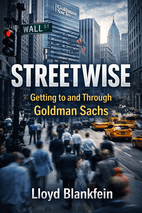
This collection pulls from Lloyd Blankfein's memoir 'Streetwise', a book packed with sharp observations about class, ambition, and the strange path from a Brooklyn housing project to the top of Goldman Sachs. You'll find lines that hit you with humor one moment and gut-punch you with honesty the next.
What makes the book so quotable is Blankfein's knack for turning uncomfortable truths into crisp, memorable phrases. He writes about feeling like an impostor, the shame of where you came from, and the weird relief of almost getting fired. These are the kind of quotes you underline, screenshot, and send to a friend.
Top Quotes from Streetwise
“I struggle with ambivalence. I spend half my time wanting to give stuff to my kids, the other half tormenting them for having stuff I gave them that I didn’t have.”
The author reflects on his upbringing in public housing and how it affects his parenting.
This line captures the conflicted feelings of a parent who grew up with less, torn between generosity and resentment. It's relatable and honest.
“I still feel so sad when I think about the waste of my dad's brains and effort.”
After describing his father's job sorting mail and a machine that could replace it but wasn't used until retirement.
This poignant moment highlights the human cost of inefficiency and unrealized potential. It resonates with anyone who has seen loved ones stuck in dead-end jobs.
“As God is my witness,” I proclaimed, “I'll never share a bedroom again—unless, of course, it's with someone I want to share a bedroom with.”
After watching Gone With the Wind, the author adapts Scarlett O'Hara's famous line to his own cramped living situation.
This humorous twist on a classic quote reveals the author's wit and longing for privacy, making it memorable and relatable.
“I remember his expression as blank, probably because he was feeling all of those things and more, the way that pure white light is what you get when you mix every color at once.”
Lloyd Blankfein describes his father's silent reaction to learning he was accepted to Harvard.
The metaphor of white light containing all colors brilliantly captures the complex, unspoken emotions parents feel when a child's success simultaneously brings pride and loss.
“What embarrasses me when I think about it today is not that I was trying to assimilate into this strange, new environment—who doesn’t at that age? It's the shame I felt about where I was from.”
Lloyd Blankfein recalls his early attempts to fit in at Harvard and the discomfort he later felt about his own background.
This honest self-critique reveals a universal struggle: the painful realization that striving to belong can sometimes lead to distancing ourselves from our roots.
“You never quite forget that feeling of stopping at a traffic light and rolling backward down the hill.”
The author recalls learning to drive a manual transmission in Spain.
It vividly evokes a universal moment of vulnerability and learning, making the memory instantly relatable.
“I was throwing away my education and my future. FOR THIS YOU WENT TO HARVARD?”
The author's mother's reaction when he told her he was leaving law to trade gold.
It encapsulates the familial and societal pressure to follow a conventional prestigious career path, and the shock of a risky pivot.
Themes Behind the Quotes
A major theme is the tension between origins and success. Blankfein constantly wrestles with the shame of his past and the guilt of his present, whether remembering his father's wasted potential or the moment he realized his value to a superior. The feeling of being an outsider never quite fades, even after he makes it. He argues that this discomfort can actually be a strength, a source of drive and perspective that insiders lack.
Another thread is the cost of ambition. The quotes reveal a man caught between wanting to give his children everything and resenting them for having it. There is also a recurring sense of irrelevance and futility, even in high stakes work, that echoes the same dead end feeling his father faced. The book is ultimately about the strange burden of outperforming your own expectations while never quite shaking the fear of falling back.
Quotes by Chapter
Chapter 1: Advantages
“I only knew stickball and street games and felt like an alien.”
The author describes his experience at an upscale summer camp surrounded by athletic, privileged kids.
This line powerfully captures the feeling of being an outsider and the cultural gap between his urban upbringing and the suburban world.
Chapter 2: Getting Out
“That world was about to become my past. Harvard was almost another planet, one of brilliance, privilege, and financial ease. And here it was, offering me a bridge, welcoming me in.”
Lloyd Blankfein reflects on receiving his Harvard acceptance letter and the profound shift it represented.
These lines distill the central theme of upward mobility—the tension between the world one leaves behind and the promise of a new one—into a vivid, hopeful image of a bridge.
“All the money that I’ve since given to Harvard and other schools has been for financial aid, with the thought that less privileged students shouldn't have to face the kind of disheartening choice I did, between rowing crew and cleaning crew.”
Lloyd Blankfein explains his motivation for donating to financial aid programs.
The stark dichotomy between 'rowing crew and cleaning crew' powerfully symbolizes how economic constraints force talented students to sacrifice opportunities that shape their futures.
Chapter 3: Glimpses Beyond
“There was that chip on my shoulder, always looking for someone to knock it off.”
The author reflects on his law school experience and his persistent feelings of insecurity despite academic success.
This line captures the enduring defensiveness that comes from a disadvantaged background, and it resonates because many readers recognize the struggle of carrying past baggage into new environments.
“I think the truth is that coming from where I did, I still felt like an impostor.”
The author analyzes why he held himself back in law school, undershooting his potential.
This raw admission of impostor syndrome is deeply relatable, especially among high achievers who feel they don't truly belong, and it humanizes the author's journey.
“The real test of openness isn’t when the member of a minority group can break through, It's when someone from a minority only has to be marginally better than others, not soar above and beyond, to get a job.”
The author reflects on the discriminatory hiring practices of prestigious law firms in the 1970s.
This sharp redefinition of equality challenges superficial notions of meritocracy and forces readers to consider systemic barriers that persist even after visible breakthroughs.
Chapter 4: Lawyer, Briefly
“I liked tax law because it was intricate and complicated. Then I started to hate it because it was intricate and complicated.”
The author describes his initial attraction and subsequent aversion to tax law.
This paradoxical statement captures the dual nature of complex systems, resonating with anyone who has experienced both fascination and frustration with their chosen field.
“That feeling of being somewhere you don't quite belong can be an advantage.”
The author reflects on his discomfort at exclusive clubs with his boss John Baity.
This counterintuitive insight reframes outsider status as a source of empathy and self-awareness, offering a positive perspective on insecurity.
“The cases I worked on were worth a lot of money to our clients, but they had no real impact on their business, or anything else, going forward. It all brought me back to thinking about my dad's job at the post office, which could have been automated way earlier. Though the stakes were higher, I had the same feeling of irrelevance and futility.”
The author concludes his description of the tax litigation work.
This passage powerfully connects high-stakes corporate law to his father's menial work, expressing a deep existential dread about the meaninglessness of effort despite financial success.
Chapter 5: Gold Mettle
“Title? What title? Call yourself contessa if you want to!”
Dennis Suskind, the head of bullion trading, responds to the author's question about his title at J. Aron.
It reveals the firm's irreverent, meritocratic culture where titles are meaningless, and it's a memorable line that captures the contrast with the formal law firm world.
“The whole place felt like Penn Station at rush hour.”
The author describes the chaotic atmosphere of the J. Aron trading floor.
The simile is relatable and vividly contrasts the quiet law library with the trading floor's noise and chaos.
“Even in the age of Bitcoin, aka “digital gold,” the real thing retains its elemental power over the human psyche.”
The author reflects on people's fascination with holding a physical gold bar.
It connects timeless human psychology to modern finance and offers a thoughtful observation on the enduring allure of tangible assets.
Chapter 6: From Gold Man to Goldman
“In the Goldman Sachs universe, I was in a trading division in a banking culture; a commodities person at the bottom of the industry hierarchy around equities, fixed income, currency, and commodities; and a salesman, not a trader. In other words, I was the lowest of the low in an underperforming part of a very successful firm that was determined to stay that way.”
The author, Lloyd Blankfein, describes his perceived status within Goldman Sachs after joining the J. Aron division.
This brutally honest self-assessment captures the rigid hierarchy and prestige dynamics on Wall Street. It resonates because it articulates a universal feeling of being undervalued despite working for a top firm.
“I was caught in a vicious circle of not being invited to engage in discussions because I had little to contribute and never having anything to contribute because I wasn’t permitted to expand my knowledge.”
Blankfein explains how the secrecy and compartmentalization at J. Aron prevented him from learning the business.
This line perfectly captures the Catch-22 of professional stagnation—when exclusion from information makes it impossible to gain the expertise needed to be included. It resonates with anyone who has felt locked out of growth opportunities.
“When he returned with his bags, he got in and said that since he was in a hurry, would I mind making my own way home? I swallowed hard and got out of the car, realizing what my value to him was.”
After months of being ignored by head gold trader Richard Pront, Blankfein finally gets a ride uptown, only to be dismissed when Pront makes a grocery stop.
This anecdote is a poignant and humorous illustration of being used and discarded, capturing the feeling of realizing one's low status in a cutthroat environment. It sticks with readers because of its vivid, almost cinematic humiliation.
“You must have been nervous,” he said. No, I wasn't. I figured I was brighter and cheaper and willing to work harder than most of the people on the floor. Dennis looked at me as if he were disappointed by my answer. “Of course, you could have been fired. We were thinking about it.” “Oh, then I’m really relieved.”
After a round of layoffs, Blankfein's boss Dennis tries to comfort him but instead stokes anxiety when Blankfein shows too much confidence.
The exchange reveals the bizarre psychological games and insecurity embedded in corporate culture, where confidence is punished and fear is expected. It's a darkly funny moment that underscores the irrationality of workplace power dynamics.
Chapter 8: De-Vals and Re-Vals
“Fear of failure weighs heavily on people—almost as much as fear of success.”
Opening line of Chapter 8.
It articulates a universal human struggle with both fear of failure and success, setting a reflective tone for the chapter.
“Betting with or against central banks (usually the latter) could be a way to make a lot of money.”
Describing the speculative opportunities within the European Exchange Rate Mechanism.
It captures the high-stakes, almost adversarial relationship between traders and central banks, a core theme in currency markets.
“The Goldman Sachs business card shifted the burden of proof the way a degree from Harvard did: People assumed you were smart and would add value unless and until you demonstrated otherwise.”
Author explains how Goldman Sachs's reputation helped the fledgling forex team compete against established banks.
The analogy between the Goldman business card and a Harvard degree is memorable and underscores the practical power of institutional prestige.
“If I lacked the kind of precise mind needed to do what Tim did, there was no world in which I could ever do what Armen did. But I could do something they probably couldn't have done without me, which was to assemble and coordinate a lot of disparate pieces and people.”
The narrator reflects on his own role compared to his colleagues Tim O'Neill and Armen.
This line resonates because it humbly acknowledges personal limitations while celebrating the unique value of coordination and leadership—a powerful reminder that different talents are equally essential.
Chapter 9: Innovation
“The necessity of breaking into a saturated market is the mother of financial innovation.”
Opening line of the chapter on innovation.
It rephrases a classic proverb to frame the chapter's core theme, making it memorable and immediately resonant for readers interested in how innovation arises from constraints.
“If you were too steeped in the old world of finance, you might see the objections more clearly than the opportunity.”
The author reflects on the mindset required to embrace technological change at J. Aron in the late 1980s.
This captures a universal truth about resistance to change and the importance of perspective, striking a chord with anyone who has faced entrenched thinking in their field.
“The greatest liability we faced with physical commodities was reputational.”
After recounting a minor oil spill incident, the author remarks on the broader risks of dealing in physical commodities.
It succinctly highlights that reputation can outweigh financial risk, a lesson that resonates strongly in today's business environment where public perception is critical.