Stories That Stick — Interactive Mindmaps

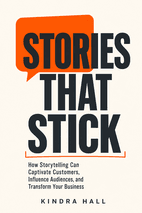
Stories That Stick by Kindra Hall Book Cover

by Kindra Hall

Buy on Amazon

As an Amazon Associate, we earn from qualifying purchases.

Kindra Hall's Stories That Stick argues that the central problem in business is the gap between a company and its customers, investors, employees, or executives, and that stories are the bridges that close it. Hall presents four story types—value, founder, purpose, and customer—and a craft-focused method for finding, shaping, and telling them, written for entrepreneurs, salespeople, recruiters, managers, and leaders who need to persuade and build trust.

On Insta.page you also get an Apply This Book tool that lets you combine insights from up to 3 books to solve your specific situation.

Chapter mindmaps

Free preview: chapters 1–4 are fully interactive. Click any node to expand or collapse. Subscribe to unlock the rest.

Chapter 1: 1.  The Gaps in Business and the Bridges That Close (and Don’t Close) Them

Key concepts: 1.  The Gaps in Business and the Bridges That Close (and Don’t Close) Them

The Gaps in Business and the Bridges That Close (and Don’t Close) Them

The Gap Is the Real Problem

  • Business exists to move value profitably from company to customer
  • Gaps appear everywhere: customers, investors, employees, executives
  • Extra gum's fall shows a gap, not one bad marketing decision
  • Those who close gaps best win in selling, pitching, and recruiting

Three Elements of a Strong Bridge

  • Attention: make the audience notice the bridge exists
  • Influence: move the audience to take the desired action
  • Transformation: change the audience so the gap stays closed
  • Most attempts use only one or two elements and fail

Why Most Bridges Fail

  • Talking at audiences instead of engaging them
  • Flashy substitutes mistaken for real connection (stunts, pop-ups)
  • Crowded pitch decks read aloud to distracted listeners
  • Repeated mission statements that employees feel nothing about

Short-Lived Bridges

  • Cute ads get clicks but 90 percent of purchases are returned
  • Holiday discounts and contests produce temporary spikes only
  • Pitches that fail to close leave the gap open
  • Talent leaves as soon as the incentive shrinks

Storytelling as the Complete Bridge

  • 95 percent of gum decisions are unconscious; features alone fail
  • Storytelling carries attention, influence, and transformation at once
  • Listeners supply their own images and emotions, blurring message and listener
  • Anchor messages in the customer's lived experience at the moment of choice

Chapter 2: Introduction: Slovenia, JFK, and the Story That Kidnapped My Husband

Key concepts: Introduction: Slovenia, JFK, and the Story That Kidnapped My Husband

Introduction: Slovenia, JFK, and the Story That Kidnapped My Husband

The Power of Willing Attention

  • Description alone rarely moves people to act; willingness is the real gap
  • Stories invite attention rather than demand it, turning it into captivation
  • Absorbed listeners lower resistance and adopt the story's perspective
  • Slovenian boutique clerk's Eight & Bob story felt like a gift, not a pitch

Attention, Influence, Transformation

  • Attention: a story carries the listener into its world
  • Influence: absorption makes listeners adopt perspectives inside the story
  • Transformation: the change persists after the story ends
  • Drowning-accident story changed pool-draining habits; Eight & Bob created converts

Extra Gum: Building the Story Bridge

  • Checkout gum purchases are unconscious two-second decisions; features couldn't connect
  • Research revealed sharing gum as a deeper emotional driver of human closeness
  • Juan and Sarah video told a love story through foil-wrapper sketches and a proposal
  • Long version ran first digitally; 100M+ views and reversed declining sales

Reframing What a Business Really Does

  • Transit company saw its real work as helping customers keep promises
  • Title companies reframed paper-pushing as making the American dream possible
  • Stories change what teams believe they deliver, not just what customers buy

Where Stories Begin and How to Measure Them

  • Stories start in the teller's brain and find a home in the receiver
  • Measure stories by what stays: changed preference, lasting memory, urge to share
  • Force depends on the teller carrying the story whole into another's imagination

Chapter 3: 2.  Once Upon a Brain

Key concepts: 2.  Once Upon a Brain

Once Upon a Brain

The Hospital's Fund-Raising Gap

  • Maricopa Medical Center: safety-net hospital serving low-income patients
  • Copa Ball donors felt distant from the people the hospital served
  • Repeated rational appeals and credentials had gone flat
  • A story could close the gap facts couldn't cross

How Story Acts on the Brain

  • Paul Zak's experiments linked stories to oxytocin release
  • Story group's oxytocin rose 47 percent, boosting generosity
  • Donations rose 261 percent when oxytocin and cortisol both climbed
  • Attention alone or trust alone was not enough

Storyhacking the Copa Ball

  • New casting rule: choose stories first, then find speakers
  • Lineup featured patients and personal connections, not doctors
  • Donations more than doubled the previous year's total
  • Hasson's brain-synchronization work explains the effect

The Memory Effect and Its Catch

  • Oxytocin activates the HOME empathy circuit via dopamine
  • Stories are remembered and were passed down before writing
  • Requirement one: an actual story, not a slide deck of facts
  • Requirement two: many stories are weak, so strength matters

Key Takeaways

  • Cast for lived experience rather than title
  • Aim for captivation and trust at once
  • Keep working until the material has genuine story shape
  • Screen candidate stories for strength before committing

Chapter 4: 3.  What Makes a Story Great

Key concepts: 3.  What Makes a Story Great

What Makes a Story Great

The Power of Storytelling

  • Storytelling is ubiquitous but rarely questioned; greatness requires more than existence.
  • Stories help people remember, cooperate, teach, entertain, share, and survive.
  • Harari: fiction enables large-scale cooperation, making states and institutions possible.
  • Business pendulum swung from logic to story as buzzword, often misapplied.

Super Bowl Ads: Story Beats Spectacle

  • Quesenberry and Coolsen found story outperforms sex, humor, celebrity, and puppies.
  • Puppy alone insufficient; narrative context made 'Puppy Love' most shared ad.
  • Volkswagen's Darth Vader ad earned $100M free publicity via story.
  • Super Bowl draws over a third of Americans, quieting for commercials.

From Thesis Defense to Buzzword

  • 2004 thesis defense argued humans are story-making creatures; initially rejected.
  • Story became unchallenged label attached to posts, missions, and taglines.
  • Walgreens 'Our Story' was seawater sourcing copy, not a story.
  • Warby Parker lens cloth showed real story: hundred-word founding tale.

Four Ingredients of Great Stories

  • Identifiable characters: separate individuals we can care about, not companies or products.
  • Authentic emotion: belongs to characters or circumstances, enabling empathy.
  • Significant moment: specific point in space, time, or circumstance that zooms in.
  • Specific details: descriptive, unexpected images that make the world feel familiar.

Characters and Emotion

  • Characters need not be heroes; M&M's are products made into characters.
  • Emotion can be ordinary frustration, wonder, or curiosity.
  • Without emotion, there is no empathy and less impact.
  • Audience reaction is not the emotion; it must belong to the story.

Significant Moment and Specific Details

  • Significant moment zooms in like a magnified map patch, pulling story from general flow.
  • School executives replaced broad phrases with cafeteria, playground, and lobby scenes.
  • Specific details signal storyteller understands the listener.
  • Boombox places story for 1980s audience; stroller-in-trunk for parents.

Cultural Relevance and Testing

  • Tom Burrell rewrote scripts for African American viewers; Marlboro man in sweater drew huge response.
  • Advertisers once shot same script with white and black actors, ignoring cultural differences.
  • Steller Collective 2018 survey tested brand messages to isolate compelling components.
  • Four ingredients put to the test: characters, emotion, moment, details.
You've reached the end of the free mindmaps

Next chapter: “4.  The Value Story” is locked

See every chapter of Stories That Stick as an interactive mindmap — and unlock all 700+ book summaries with audio and AI Q&A.

$0.00 due today · 7 days free, then $89.99/year ($7.49/mo) · Cancel anytime before day 7

plus sales tax where applicable

Continue exploring Stories That Stick