Smarter Faster Better Key Takeaways
by Duhigg, Charles
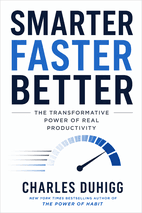
5 Main Takeaways from Smarter Faster Better
Productivity Comes from Smart Psychological Choices, Not Just Hard Work
The book argues that true productivity is about leveraging mental models and principles like internal locus of control, rather than merely putting in more hours. Examples include Atul Gawande protecting time for what matters and the eight universal principles that drive high performance across fields.
Cultivate Motivation by Practicing Choice and Connecting to Personal Meaning
Motivation can be learned by making deliberate choices and linking tasks to core values, as seen in boot camp transformations and nursing home rebellions. Targeted praise for effort, not innate traits, reinforces this sense of control and sustains self-determination.
Build Teams Where Psychological Safety Allows Everyone to Contribute Freely
Successful teams, like those at Google and Saturday Night Live, require leaders to model vulnerability and establish norms that protect each member's voice. This trust enables decentralized decision-making and innovation, as individuals willingly cede control to the group.
Use Mental Models and Probabilistic Thinking to Focus and Make Better Decisions
To avoid cognitive tunneling, proactively build mental models through storytelling, as in aviation crises. For decisions, adopt a Bayesian approach by embracing uncertainty, thinking in aggregates, and calibrating assumptions based on diverse experiences.
Foster Innovation and Data Insight Through Structured Processes and Creative Desperation
Innovation, as shown in Disney's Frozen, emerges from idea brokers and desperate creativity. Similarly, absorbing data requires active interaction and disfluency, like in Cincinnati's schools, to transform information into knowledge and combat cognitive bias.
Executive Analysis
Charles Duhigg's "Smarter Faster Better" posits that the essence of productivity lies in psychological mastery rather than technological tools or sheer hustle. The book's core insights—from harnessing motivation through choice and meaning, to building psychologically safe teams, to employing mental models for focus and Bayesian thinking for decisions—form an integrated system. Each principle reinforces the others: for example, a sense of control (motivation) empowers individuals to contribute in teams, while team trust enables agile management and innovation through structured processes like those used in the FBI's kidnapping case.
This book matters because it translates academic research into practical tools for anyone seeking to enhance their performance. By grounding its advice in stories from diverse fields like aviation, healthcare, and entertainment, Duhigg provides a versatile guide that stands out in the crowded productivity genre. Readers learn to cultivate habits that lead to sustainable success, making it a valuable resource for individuals and leaders alike.
Chapter-by-Chapter Key Takeaways
Introduction (Introduction)
Productivity is about smart choices, not heroic effort. It’s the art of obtaining meaningful rewards with the least wasted effort, not a grind of endless sacrifice.
Busyness is not the same as productivity. The story of Atul Gawande illustrates that truly productive people protect time for what matters most, including family and leisure, rather than being constantly "on."
The modern productivity challenge is psychological, not technological. While tools and apps promise efficiency, real mastery comes from understanding the mental models, team dynamics, and decision-making frameworks that high performers use.
Universal principles exist. The author’s research suggests that a small set of core ideas—eight, in this case—explain why some people and companies achieve so much more than others, regardless of their field.
Try this: Audit your daily activities to distinguish between mere busyness and truly productive work that aligns with your core goals.
1. Motivation: Reimagining Boot Camp, Nursing Home Rebellions, and the Locus of Control (Chapter 1)
Internal locus of control—the belief you influence your own destiny—is a learnable skill linked to greater success, health, and happiness.
Motivation can be taught by putting people in situations where they must practice making choices and feel the resulting sense of control.
Effective targeted praise focuses on effort and choices (e.g., "you worked hard"), not innate traits (e.g., "you're smart"), to reinforce an internal locus.
The most powerful motivational choices combine personal control with personal meaning. Linking a difficult action to a core value or goal (asking "why") makes self-motivation more sustainable.
Small, even subversive, acts of self-assertion can have outsized psychological benefits, proving to ourselves that we are still agents in our own lives.
Apathy is often rooted in an emotional dysfunction; the feeling of reward for making choices becomes disconnected.
The internal locus of control is strengthened by consistently practicing self-determination
Try this: Practice making small, deliberate choices in your daily routine and connect each task to a personal value to strengthen your internal motivation.
2. Teams: Psychological Safety at Google and Saturday Night Live (Chapter 2)
Psychological safety is universal: The dynamics that make a comedy writers' room or a Google engineering team successful are the same: team members need to feel safe to speak up and feel that others are socially sensitive.
Leaders set the tone: Safety is established from the top down. Leaders must model vulnerability, invite participation, practice active listening, and address conflicts openly.
It's about behaviors, not friendships: Teams don't need to be friends, but they do need disciplined norms that contain conflict and protect each member's voice. Social sensitivity is a learnable, critical skill.
Ceding control builds strength: Effective teamwork requires individuals to willingly give some control to the group. This is only possible in an environment of trust, where everyone feels their contributions are valued.
Try this: As a leader, model vulnerability by sharing your own uncertainties and actively solicit input from all team members to build psychological safety.
3. Focus: Cognitive Tunneling, Air France Flight 447, and the Power of Mental Models (Chapter 3)
Mental models are cognitive scaffolds: They provide a framework to manage information overload, helping us choose where to direct attention.
Control focus by controlling your model: When overwhelmed, consciously replace a failing mental model with a simpler, more robust one.
Proactive storytelling is preparation: Narrating your life and anticipating scenarios builds mental models in advance, so you’re prepared to focus correctly in a crisis.
Thinking cannot be delegated: Checklists and computers can fail. The ultimate responsibility for deciding what deserves attention rests with the individual.
Try this: Develop mental models by mentally rehearsing upcoming challenges and creating simple frameworks to guide your attention during complex tasks.
Next chapter: “4. Goal Setting: Smart Goals, Stretch Goals, and the Yom Kippur War” is locked
Keep learning from Smarter Faster Better — and unlock all 700+ book summaries with audio, mindmaps and AI Q&A.
$0.00 due today · 7 days free, then $89.99/year ($7.49/mo) · Cancel anytime before day 7
plus sales tax where applicable