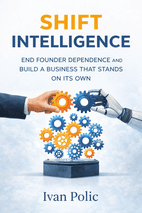
Shift Intelligence — Interactive Mindmaps

Shift Intelligence by Ivan Polic Book Cover

by Ivan Polic

Ivan Polic's Shift Intelligence provides a practical methodology for founders to codify their critical knowledge into systems and processes, building a resilient, scalable organization that operates independently of its creator.

On Insta.page you also get an Apply This Book tool that lets you combine insights from up to 3 books to solve your specific situation.

Chapter mindmaps

Free preview: chapters 1–4 are fully interactive. Click any node to expand or collapse. Subscribe to unlock the rest.

Chapter 1: Foreword

Key concepts: Foreword

1. Foreword

Endorsement of Character and Practicality

  • Personal endorsement from Navy SEAL Commander Rich Diviney vouching for the authors' steady minds and genuine care
  • Frames the book as a practical toolkit, not abstract inspiration, for leaders feeling intense pressure
  • Promises to provide language for unspoken problems and immediate, sturdy tools

The 3 A.M. Crisis: A Personal Breaking Point

  • Authors' business revenue dropped 93% during the 2008 financial collapse
  • Ivan's experience of panic, shame, and dread while facing layoffs and financial ruin
  • Mariana's resolve to force a conversation despite being kept in the dark
  • The shared turning point where 'everything changed' through facing the crisis together

Diagnosing the Founder-Dependence Trap

  • The 'hidden trap' where a business depends entirely on the founder to hold it together
  • Founder's control begins as a strength but becomes a fatal design flaw
  • Neuroscience insight: chronic stress shifts brain to survival mode, crippling strategic thought
  • Founder-dependent businesses have over 70% failure rate upon founder's exit
  • Frames the problem as a design challenge requiring a 'better roadmap'

Roadmap to Freedom: Book Structure

  • Part I: Operating System Shift - Rewiring business to run on distributed trust
  • Part II: Marketplace Shift - Transferring brand credibility from founder to organization
  • Part III: Inner World Shift - Releasing personal identities and habits fueling dependence
  • Part IV: Sustaining Momentum - Installing governance to protect newfound freedom

Core Principles and Invitation

  • Founder-dependence is a design flaw, not a character flaw
  • Chronic stress has neurological costs that impair leadership and radiate anxiety
  • Ultimate business risk is reliance on one person; resilience requires distributed systems
  • Goal is a 'transferable' business that thrives independently of founder's daily involvement
  • Change begins with asking: 'Where does my business still depend on me to survive?'

Chapter 2: Chapter 1

Key concepts: Chapter 1

2. Chapter 1

The Failed Deal: A Moment of Truth

  • A promising acquisition collapsed due to concerns about leadership depth despite impeccable systems and certifications
  • Externally airtight businesses can still have the founder as the central nervous system and bottleneck
  • Owner-dependent businesses cannot be sold for true freedom or full value
  • The revelation shifts the goal from selling to fundamentally rebuilding for independence

Why Systems and Delegation Fall Short

  • Systems manage tasks but don't build trust and independent judgment required for true scalability
  • Smooth operations are often mistaken for genuine scalability
  • Delegation of tasks is not the same as true empowerment and ownership transfer
  • Real freedom comes from removing the founder's gravitational pull on decision-making

The Pandora Case Study: The Visionary Bottleneck

  • Tim Westergren's personal vision for Pandora initially attracted employees and investors
  • Reverence for the founder led teams to default to 'What would Tim say?' instead of innovating
  • The founder's embodiment of vision prevented others from authentically leading or evolving the company
  • Founder-dependency caused Pandora to lose its adaptive edge to competitors like Spotify

Diagnostic Practices: Finding the Hidden Levers

  • Invisible Dependency Inventory: Review what stalls without founder input to identify learned dependence
  • People vs. Process Reflection: Determine if operations run on robust systems or specific people
  • Emotional Ownership Scan: Assess trust levels and identify gaps between assigned responsibility and genuine empowerment

Key Takeaways

  • Founder-dependency creates ceilings on business value, scalability, and founder freedom
  • Systems manage operations but people scale businesses through independent judgment
  • True empowerment requires ownership transfer, not just task delegation
  • Founders must evolve from central problem-solvers to architects of leadership environments
  • Honest diagnosis of dependency patterns must precede meaningful change

Chapter 3: Chapter 2

Key concepts: Chapter 2

3. Chapter 2

The High Cost of Control

  • Enforcement leadership creates physical and emotional toll, including burnout and stress-related illness.
  • Tight control trains teams for compliance over contribution, leading to technical soundness but emotional disengagement.
  • The underlying belief is that without constant oversight, everything would fall apart, creating a brittle organizational culture.
  • Frustration with team performance often masks deeper grief and fear within the leader.

The Shift: Interest Over Instinct

  • Transformation begins with small experiments in relinquishing control over meetings, decisions, and habits.
  • When leaders resist the urge to interrupt or correct, initiative emerges organically from team members.
  • Asking team members what they want reveals unmet needs for responsibility, flexibility, and mentorship.
  • Getting genuinely interested in people unlocks their investment in the business and fosters ownership.

Why Clarity Isn't Connection

  • Enforcement leadership often stems from underlying fear that becomes the company's rhythm.
  • Control trains teams to stay small and safe, resulting in 'quiet resignation' rather than active participation.
  • A leader's grip becomes the limitation on the greatness they seek by capping engagement and innovation.
  • People fade rather than fight not from laziness but from feeling excluded from full participation.

From Managing Behavior to Building Belief

  • Essential shift: Stop asking 'Why aren't they stepping up?' and start asking 'What have I made unsafe to care and speak about?'
  • Engagement begins with interest in people's potential rather than management of their performance.
  • People stay and fight for a future they believe includes them; without that belief, they disengage.
  • Disengagement delivers only a fraction of capability and is more destructive than outright resistance.

Case Study: Whitney Wolfe Herd and Psychological Safety

  • Initial necessary control in Bumble's early days led to hesitation and slowed decision-making as the company grew.
  • Realization that psychological safety was as crucial inside the company as for the app's users.
  • Intentional design for safety through cross-level feedback, celebrating smart risks, and creating space for respectful conflict.
  • Cultivating belief instead of controlling behavior allowed ownership to emerge, scaling capacity and enabling successful IPO.

Proof Practices: Making the Shift Tangible

  • Build a Curiosity Map: Replace performance reviews with conversations about what's important outside work and what success would unlock.
  • Stop Answering First: Withhold your voice in meetings for the first ten minutes to create space for others to lead.
  • Give Away the Next Win: Deliberately give credit or leadership opportunities to others to communicate belief and invite growth.
  • Culture change requires deliberate practice, not just intention, starting with simple, concrete actions.

Key Takeaways

  • Enforcement creates short-term clarity but leads to long-term disengagement, stunted growth, and personal burnout.
  • High performance is unlocked by creating psychological safety and trust that invite full participation.
  • The shift begins with the leader's mindset: choosing interest over instinct, trust over tension, and people over pressure.
  • Teams only take risks and show initiative when they feel safe from undue judgment for well-intentioned efforts.
  • Transformation can begin with simple actions: listening first, delegating meaningful opportunities, and getting genuinely curious.

Chapter 4: Chapter 3

Key concepts: Chapter 3

4. Chapter 3

The Initial Friction: A War Room Exposes Coherence Gaps

  • Department heads communicated defensively, reporting upward rather than collaborating across functions
  • Standard operating procedures existed but failed to address deeper coherence issues within the team
  • Intentional exposure of friction was necessary to build real trust through shared discomfort
  • Early meetings were guarded and protracted, focused on performance and deflection rather than problem-solving

The Turning Point: From Dependency to Distributed Trust

  • A genuine question between logistics and quality leads sparked open exchange instead of blame
  • Team dynamics softened, leading to voluntary data-sharing and collaborative problem-solving
  • War room sessions streamlined from lengthy meetings to 30-minute focused coordination
  • Founder's restraint allowed team members to address misalignments directly without intervention
  • Transition occurred from single-leader dependency to trust distributed across functions

Systems as the Scaffolding for Trust

  • Systems and roles reflect and hold existing trust rather than creating it through control
  • Systems are products of healthy interactions, not just the sum of their parts (Rich Diviney insight)
  • War room became a ritual providing rhythm and muscle memory for independent judgment
  • Proper structure makes leadership optional and distributes intelligence collectively
  • Structure enables business to thrive without founder's constant oversight

A Personal Evolution: From 80 Hours to Two

  • Author reduced weekly involvement from 80 hours to just 2 hours over three years
  • Gradual redesign of environments allowed others to lead confidently
  • Successful sale to private equity firm demonstrated business could stand independently
  • Freedom defined as deep coherence where major decisions unfold without founder input
  • Team autonomously protected culture without requiring founder oversight

Learning from Parallel Journeys: Katia Beauchamp's Blueprint

  • Birchbox founder faced bottlenecks where her clarity bred caution in team members
  • Mapping roles, decisions, and accountabilities through cross-functional sessions designed structure for ownership
  • Clear, shared maps allowed teams to move boldly without waiting for founder sign-off
  • Design choices are never neutral—they either reinforce dependence or distribute coherence
  • Trust emerges from shared understanding rather than enforced playbooks

Proof Practices: Building Cohesive Ecosystems

  • Decision Rights Audit: Map stalled decisions to identify ownership confusion and clarify involvement levels
  • Role Integrity Circles: Cross-functional leads compare role perceptions to surface overlaps and build precision trust
  • Weekly Rhythm Reset: Short, consistent reflection cadence to assess progress and redesign rhythms
  • Practices embed shared leadership into company architecture as rituals
  • Move from founder reliance to inherent organizational rhythm

Core Principles and Transformative Insights

  • Systems hold alignment rather than create it—they sustain existing trust
  • Clear structure distributes trust, transforming dependency into collective accountability
  • Freedom is operational coherence, not physical distance from the business
  • Intentional ecosystems make founder presence optional for daily operations
  • Progress from control to distributed trust requires patience but yields transformation

Continue exploring Shift Intelligence