Scale Quotes
by Geoffrey West
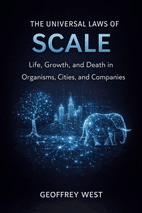
This page collects some of the most thought provoking lines from Geoffrey West's Scale. You will find insights about life, death, cities, and the hidden mathematics that governs them. What makes this book so quotable is how West takes complex scientific ideas and turns them into simple, striking observations that stick with you long after you put the book down. The quotes range from profound truths about mortality to surprising facts about ants and skyscrapers. They challenge common assumptions and reveal deep patterns in nature and society. Each line is crafted to make you think, and often to rethink what you thought you knew.
Top Quotes from Scale
“Life is probably the most complex and diverse phenomenon in the universe, manifesting an extraordinary variety of forms, functions, and behaviors over an enormous range of scales.”
The author opens the chapter by describing the vast diversity of life.
This sentence immediately establishes the grandeur and mystery of life, setting the stage for the search for underlying order. It resonates because it captures the awe-inspiring complexity that the book aims to demystify.
“It's extremely difficult to kill a city! On the other hand, it's relatively easy to kill animals and companies—overwhelmingly, almost all of them eventually die, even the most powerful and seemingly invulnerable.”
The author contrasts the resilience of cities with the mortality of organisms and companies.
This striking contrast highlights a central paradox explored in the book, making readers rethink what they know about cities. The blunt, memorable phrasing drives home the idea that cities are fundamentally different from other complex systems.
“No human being has ever lived for more than 123 years, and very few companies have lived for much longer—most have disappeared after 10 years.”
The author reflects on the limits of human and corporate lifespans.
This concrete, surprising fact challenges assumptions about longevity and mortality, both personal and organizational. It prompts reflection on why such hard limits exist and what they imply for our understanding of life and business.
“No one wants to die. Even people who want to go to heaven don’t want to die to get there. And yet death is the destination we all share. No one has ever escaped it, and that is how it should be, because death is very likely the single best invention of life. It’s life's change agent. It clears out the old to make way for the new.”
Steve Jobs' view on death, as quoted by the author.
It provides a powerful and memorable perspective on death as necessary for evolution, resonating with readers' existential reflections.
“The Industrial Revolution was the socioeconomic equivalent of the Big Bang.”
The author describes the transformative impact of the Industrial Revolution on human society.
This analogy powerfully equates a historical economic shift with a cosmic event, emphasizing its profound and world-altering significance.
“Cities are the crucible of civilization, the hubs of innovation, the engines of wealth creation and centers of power, the magnets that attract creative individuals, and the stimulant for ideas, growth, and innovation. But they also have a dark side: they are the prime loci of crime, pollution, poverty, disease, and the consumption of energy and resources.”
The author summarizes the dual nature of cities as both engines of progress and sources of major challenges.
This balanced, poetic statement captures the essential paradox of urban life, making it memorable and thought-provoking.
“Rather than being bored to death, our actual challenge is to avoid anxiety attacks, psychotic breakdowns, heart attacks, and strokes resulting from being accelerated to death.”
After discussing Keynes's and Darwin's mistaken predictions that technology would create more leisure time.
This darkly ironic reversal of the promised future captures the paradox of modern life: time-saving innovations have actually compressed our time, leading to stress and health crises.
Themes Behind the Quotes
A central theme is the idea of scaling laws and how they govern everything from metabolism to city growth. West shows that size is not arbitrary, but constrains and shapes life, organizations, and even companies. Another major thread is the contrast between biological mortality and the near immortality of cities. While animals and companies inevitably die, cities tend to persist and adapt. The quotes also explore the dual nature of urban life, where innovation and creativity come hand in hand with crime and resource consumption. Finally, the book warns about the accelerating pace of modern existence, driven by exponential growth, and the urgent need to understand these patterns before they overwhelm us.
Quotes by Chapter
Introduction, Overview, and Summary
“This is the main focus of this book. I will explain the nature and origin of these systematic scaling laws, how they are all interrelated, and how they lead to a deep and broad understanding of many aspects of life and ultimately to the challenge of global sustainability.”
The author summarizes the book's core mission after presenting examples of scaling laws.
This declaration clearly articulates the ambitious goal of the book, linking quantitative patterns to profound questions about life and sustainability. It gives readers a compelling roadmap for what follows.
2: THE MEASURE OF ALL THINGS: An Introduction to Scaling
“The smaller the body the greater its relative strength. Thus a small dog could probably carry on his back two or three dogs of his own size; but I believe that a horse could not carry even one of his own size.”
Galileo's pronouncement on relative strength and scaling limits, as quoted by the author.
This succinctly captures the counterintuitive scaling principle that smaller creatures are relatively stronger, challenging linear thinking and underscoring the constraints of size.
“It is sobering to realize that words written long ago in Hebrew, Greek, and Latin, based on opinion, intuition, and prejudice, can so overwhelmingly outweigh scientific observational evidence and the logic and language of mathematics.”
The author reflects on the persecution of Galileo and the enduring power of ancient dogma over scientific evidence.
This resonates deeply as a timeless warning about the persistence of irrational belief systems and the fragility of objective truth in the face of authority.
“Thus, ants have, in fact, the correct strength appropriate for a creature of their size, just as we do, so there's nothing extraordinary or surprising about their lifting one hundred times their own weight.”
The author debunks the Superman comic's claim that ants have super-strength by explaining scaling laws.
It elegantly reveals how a common misconception arises from ignoring nonlinear scaling, demonstrating the clarifying power of quantitative thinking.
“The strongest man in the world in 1956 was actually the middleweight champion because he was overperforming relative to his weight. Ironically, the weakest of all of the champions from this scientific scaling perspective is the heavyweight, despite the fact that he lifted more than anyone else.”
From the analysis of weightlifting data at the 1956 Olympics, comparing actual performance to the scaling law prediction.
It overturns intuitive notions of strength by showing that scaling laws reveal a different champion, highlighting how a scientific perspective can reframe our understanding of achievement.
3: THE SIMPLICITY, UNITY, AND COMPLEXITY OF LIFE
“But of the construction and growth and working of the body, as of all else that is of the earth earthy, physical science is, in my humble opinion, our only teacher and guide.”
D'Arcy Thompson's statement on the role of physical science in biology.
It encapsulates the book's thesis that physical science can explain biological phenomena, inspiring a quantitative approach.
“Metabolism is the fire of life .. . and food, the fuel of life.”
Author's definition of metabolism.
It is a simple, vivid metaphor that captures the essence of life's energy processes.
“The search for fundamental principles that govern how the complexity of life emerges from its underlying simplicity is one of the grand challenges of twenty-first-century science.”
Author's statement on the grand challenge of complexity science.
It highlights the central quest of the book and modern science, appealing to curiosity about complexity.
4: THE FOURTH DIMENSION OF LIFE: Growth, Aging, and Death
“Although living things occupy a three-dimensional space, their internal physiology and anatomy operate as if they were four-dimensional.”
The author explains the geometric origin of quarter-power scaling in life.
Captures the profound idea that life effectively operates in a fourth dimension, challenging our perception of space.
“Such an animal would have a beating heart but no pulse!”
Describing the theoretical minimum size of a mammal where pulsatile flow fails.
Strikingly vivid image of a creature with a beating heart but no pulse, illustrating evolutionary constraints.
“Fractal geometry has literally given life an added dimension.”
Conclusion about the role of fractal geometry in biology.
A concise, poetic summary of the chapter's central theme.
“Quarter-power scaling laws are perhaps as universal and as uniquely biological as the biochemical pathways of metabolism, the structure and function of the genetic code, and the process of natural selection.”
Comparing scaling laws to fundamental biological universals.
Elevates quarter-power scaling to the level of genetic code and natural selection, emphasizing its importance.
5: FROM THE ANTHROPOCENE TO THE URBANOCENE: A Planet Dominated by Cities
“It is in the very nature of an exponential that the future becomes the present at an increasingly more rapid pace, so much so that by the time a problem has arisen it's often too late to address it successfully.”
The author explains why exponential growth lulls us into complacency until crises suddenly become urgent.
This line distills the core danger of exponential trends into a clear warning, resonating with anyone concerned about sustainability or risk management.
“Only in the last few minutes, corresponding to a tiny fraction of its entire existence and just before this bacterial universe comes to an oblivious end, is there any visible action in the container.”
From the author's thought experiment about exponential bacterial growth in a closed container.
This line powerfully illustrates how exponential growth can remain invisible until the very moment of collapse, serving as a stark metaphor for humanity's trajectory on a finite planet.
6: PRELUDE TO A SCIENCE OF CITIES
“There is no logic that can be superimposed on the city; people make it, and it is to them, not buildings, that we must fit our plans.”
From Jane Jacobs' writings, as cited in the chapter, criticizing top-down urban planning.
This line succinctly captures the human-centered philosophy that cities are shaped by their inhabitants, not by abstract designs, making it a timeless rebuke to planners who ignore social reality.
“The real essence of a city is its people— they provide its buzz, its soul, and its spirit, those indefinable characteristics we viscerally feel when we are participating in the life of a successful city.”
The author reflects on what truly defines a city beyond its physical infrastructure.
It poetically articulates the intangible, vital human element that makes cities alive and unique, resonating with anyone who has experienced urban life deeply.
“Cities are emergent complex adaptive social network systems resulting from the continuous interactions among their inhabitants, enhanced and facilitated by the feedback mechanisms provided by urban life.”
The author's translation of Shakespeare's 'What is the city but the people?' into a scientific framework.
This definition bridges the qualitative human experience with a quantitative, network-based scientific perspective, encapsulating the chapter's core thesis about cities as complex systems.
“She is, in fact, primarily remembered for her fight to preserve the integrity of lower Manhattan and for her insights into the nature of cities and how they function, including recognizing the critical roles of diversity and community in creating a vibrant urban socioeconomic ecology.”
The author assesses Jane Jacobs' legacy after noting her own wish to be remembered for economics.
It highlights the enduring impact of Jacobs' urban vision, emphasizing how her real contributions lie in understanding cities as social ecosystems.
7: TOWARD A SCIENCE OF CITIES
“To a good approximation, the data closely follow a simple straight line rather than falling randomly all over the graph, clearly indicating that the variation is not arbitrary but follows a highly constrained systematic behavior.”
Describing the scaling of gas stations with city size across European nations.
This passage highlights the surprising regularity found in urban data, challenging the assumption that cities are too complex for simple mathematical laws.
“Thus the larger the city the more innovative “social capital” is created, and consequently, the more the average citizen owns, produces, and consumes, whether it's goods, resources, or ideas.”
Discussing superlinear scaling of socioeconomic quantities like wages and patents.
It captures the positive feedback of urban agglomeration, explaining why cities attract people and generate wealth, innovation, and diversity.
“Apparently, the good, the bad, and the ugly come together hand in glove as an integrated, almost predictable package.”
After noting that crime, pollution, and disease also increase with city size proportionally to positive indicators.
This memorable phrasing encapsulates the dual nature of urban growth—opportunity and risk are inseparable, making it a powerful takeaway for readers.
“O repeat: cities are an emergent self- organizing phenomenon that has resulted from the interaction and communication between human beings exchanging energy, resources, and information.”
Summarizing the underlying dynamics of cities as complex adaptive systems.
It elegantly states the core concept of cities as emergent phenomena, tying together the chapter's scientific perspective with a holistic view of human interaction.
8: CONSEQUENCES AND PREDICTIONS: From Mobility and the Pace of Life to Social Connectivity, Diversity, Metabolism, and Growth
“This is the underlying scientific reason why we all sense that life is faster in a New York City than in a Santa Fe and that it has ubiquitously accelerated during our lifetimes as cities and their economies grew.”
The author explains the 15 percent rule linking city size to the pace of life.
It directly connects a universal human intuition—that life feels faster in bigger cities—to a quantitative scientific explanation, making the theory both relatable and memorable.