Rich Dad's CASHFLOW Quadrant Key Takeaways
by Robert T. Kiyosaki
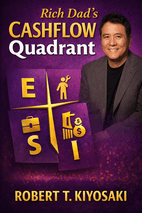
5 Main Takeaways from Rich Dad's CASHFLOW Quadrant
Your income source, not your job title, determines your financial future.
The CASHFLOW Quadrant divides earners into Employees (E), Self-Employed (S), Business Owners (B), and Investors (I). Moving from the left side (E/S) to the right side (B/I) shifts you from trading time for money to building systems and invested capital that generate passive income, which is the path to true wealth.
True wealth is measured by passive income covering expenses, not salary.
Financial freedom occurs when your passive income from assets exceeds your monthly expenses. This requires focusing on acquiring income-generating assets like businesses or investments, rather than relying on a paycheck or job security.
Build a business system that works without you for scalable wealth.
To succeed as a Business Owner (B), you must create or acquire a system that operates independently of your daily labor. This can be through building your own, franchising, or network marketing, allowing the business to generate income whether you're present or not.
Financial education turns risky speculation into calculated wealth-building.
Risk comes from ignorance, not investing itself. By developing financial literacy—understanding cash flow, financial statements, and market dynamics—you can make informed decisions that minimize risk and identify true assets that put money in your pocket.
Start with small, disciplined steps to build momentum toward financial freedom.
Take 'baby steps' like controlling cash flow, reducing debt, and investing in education. Consistent action, even on a small scale, compounds over time, cures fear, and builds the skills and mindset needed for long-term wealth.
Executive Analysis
The five key takeaways collectively form the book's central thesis: that financial freedom is achieved by shifting from the left side of the CASHFLOW Quadrant (E/S) to the right side (B/I). This transition requires a mindset change from seeking job security to building systems and assets that generate passive income, underpinned by financial education and actionable steps. Kiyosaki argues that wealth is not about earnings but about how you manage and multiply money through strategic business ownership and investing.
This book matters because it provides a practical framework for escaping the 'rat race' and taking control of one's financial destiny. It stands out in personal finance by focusing on income sources rather than mere budgeting, urging readers to mind their own business, seek mentors, and embrace disappointment. Its impact lies in bridging theory with application, making it essential for aspiring entrepreneurs and investors.
Chapter-by-Chapter Key Takeaways
Which Quadrant Are You In? (Introduction)
The CASHFLOW Quadrant reveals that your financial trajectory is determined by your income source, not your job title.
The left side (E/S) trades time for money; the right side (B/I) uses systems and invested capital to generate money.
The parable of Ed and Bill underscores the critical choice between linear effort ("hauling buckets") and building systemic, automated wealth ("pipelines").
Achieving financial freedom is a conscious journey from seeking job security (left side) to building financial security (right side), requiring new skills and a fundamental shift in mindset.
Try this: Identify which quadrant you currently earn from and envision moving to the right side by building income-generating systems.
Why Don’t You Get a Job? (Chapter 1)
Financial freedom and job security are not the same goal. The pursuit of freedom may require rejecting the apparent safety of a paycheck.
It doesn't take money or a formal education to make money. It takes a dream, determination, a willingness to learn, and leveraging your unique assets.
The CASHFLOW Quadrant (E, S, B, I) defines how income is generated. Moving from the left side (E-S) to the right side (B-I) represents a shift from you working for money to your money working for you.
Your mindset and values determine your natural quadrant. The core philosophical difference between "money isn't important" and "money is important for freedom" profoundly shapes your financial path.
The right-side quadrants (B and I) offer superior tax advantages and pathways to wealth that are not typically available to employees and the self-employed.
Long-term consequences matter. Small differences in your chosen quadrant compound over a lifetime, leading to vastly different outcomes in terms of time, freedom, and wealth.
Try this: Reject the illusion of job security and commit to building financial freedom through assets, starting with your unique dreams and determination.
Different Quadrants, Different People (Chapter 2)
True wealth is measured by the length of time your passive income can cover your expenses, not by your salary.
The Investor (I) quadrant is defined by generating current, ongoing income from assets, distinct from saving or professional financial services.
Fear of risk is the main barrier to becoming an investor, but risk can be managed through education and skill.
A historic shift from defined-benefit to defined-contribution pensions has transferred all retirement risk to individuals, making investor education essential.
Security-minded strategies like excessive diversification and reliance on mutual funds are often born of fear, not informed investing.
In the Information Age, personal financial responsibility and actively learning to manage investment risk are non-negotiable for long-term security.
The journey toward financial freedom is accessible to everyone, provided they cultivate the necessary skills and resolve. For those who have already reached this goal, the author offers congratulations and a request: share your story and guide others if they seek direction, but always allow them to find their own way among the many paths available.
A central theme emerges here: while financial freedom is liberating, it is not cheap. Its price isn't counted in money, advanced education, or even high risk. Instead, the currency is personal—paid in dreams, burning desire, and the capacity to overcome the disappointments that inevitably arise along the way. The author challenges readers to ask themselves if they are willing to pay this price, illustrating the choice through the contrasting lives of his two fathers. One paid the price for freedom; the other did not, but he still paid a different price in terms of missed opportunities or unfulfilled potential.
The B-Quadrant Quiz
Transitioning to a practical tool, the author presents a definitive test for anyone in or entering the B-Quadrant (Business Owner). The core question is: "Can you leave your business for a year or more and return to find it more profitable and running better than when you left it?" Answering "yes" signifies that you have built a true, system-driven business that operates independently of your daily presence. This is the essence of a successful business owner, distinguishing them from those who are merely self-employed.
Achieving financial freedom requires personal qualities like determination and skill, and those who succeed should act as guides, not dictators, for others on their journeys.
The real cost of financial freedom is measured in intangible assets: your dreams, your desire, and your resilience against setbacks.
A genuine business owner builds a system that thrives and grows without their constant involvement, as validated by the B-Quadrant Quiz.
Try this: Calculate how long your savings would last without income, then focus on acquiring assets that generate ongoing passive income to extend that timeline indefinitely.
Why People Choose Security over Freedom (Chapter 3)
Wealth ≠ Security: Money alone, especially money tied solely to your labor, does not create true security. Financial education is the real asset that prepares you for economic change.
Freedom's Blueprint: Ultimate financial freedom is found in mastering both the B (Business Owner) and I (Investor) quadrants, where systems and money work for you.
You Are the Architect of Your Wealth: Your boss pays you; they do not make you rich. Your financial future is determined by how you manage your paycheck and use your spare time.
The Strategic Sequence: For most people, the safest and most effective path is to build a successful Business first. This provides the necessary cash flow and real-world education to then become a successful Investor.
Embrace Change: Economic downturns and shifts are not just threats; they are periods where wealth is transferred. The educated and prepared can navigate these times to their advantage.
Try this: Develop a plan to master both the B and I quadrants, starting by building a business to generate cash flow for investments.
The Three Kinds of Business Systems (Chapter 4)
The fundamental goal for a B is to own a system that works independently of their daily labor.
There are three main avenues: building your own (high risk/high reward), buying a franchise (lower system risk, requires adherence), or joining a network marketing company (low entry cost, focuses on personal development).
Failure is an integral part of the learning process on the path to success in the B quadrant.
A business is a "system of systems"; weakness in any one area (accounting, marketing, etc.) can cause the entire enterprise to fail.
The transition from the left side to the B quadrant is less about what you do and more about who you become: a leader who can work with people, handle rejection, and think systematically.
Try this: Choose one of the three business systems—building, franchising, or network marketing—and take the first step to create an enterprise that operates without you.
You Cannot See Money with Your Eyes (Chapter 5)
Profit is determined at purchase, not sale. An investment must be sound based on its intrinsic economics, not future speculation or tax tricks.
Manage debt strategically. Avoid large personal debt; when using leverage, ensure the asset pays for itself.
Distinguish facts from opinions. Financial survival depends on factual data (from financial statements), not on commonly held beliefs or advice.
Nothing is inherently an asset. An item is only an asset if the financial numbers of the transaction show it putting money in your pocket.
Conduct due diligence. You must learn to verify facts for yourself to avoid being the “patsy” in the financial game, where most people end up indebted to the system.
Try this: Analyze every potential purchase or investment using financial statements to ensure it puts money in your pocket from the start.
Becoming Who You Are (Chapter 6)
Developing personal financial literacy and accuracy with numbers is non-negotiable for reducing risk and accelerating wealth creation.
Common financial platitudes often serve the mindset of the left side of the Quadrant and should be questioned as you develop your own vision.
Technology has democratized access to financial education, making it easier to build necessary skills.
While you can pursue success at any speed, there are no shortcuts—meaningful achievement requires dedicated learning and effort.
The ultimate value lies in cultivating the ability to see your finances and goals from multiple, informed perspectives.
Try this: Dedicate time weekly to improve your financial literacy through books, courses, or tools like the CASHFLOW game to see money with clarity.
How Do I Get Rich? (Chapter 7)
The journey to wealth is an internal one, requiring a shift in core beliefs and self-talk from a mindset of scarcity and security to one of abundance and freedom.
Mastering your emotions—particularly the fear of losing—is more critical than mastering technical investing skills. Success requires emotional neutrality toward wins and losses.
The behavioral pattern of “cutting your losers and riding your winners” is a hallmark of a winning investor’s psychology and can be applied to life decisions beyond finance.
The perceived risk of the right side of the Quadrant is often an illusion created by fear. The actions themselves can be simple, but they require a person who loves the game and sees setbacks as part of the process.
Seeking guidance from mentors who have successfully made the crossing and cultivating a positive support group are invaluable for navigating the emotional challenges of the journey.
Try this: Audit your self-talk for scarcity mindset phrases and replace them with abundance-focused statements to emotionally prepare for investing.
Be the Bank, Not the Banker (Chapter 8)
Experience Over Money: Start small in the B or I quadrant. The intellectual process is the same regardless of the number of zeros involved; experience and reputation eventually allow you to create wealth with little or no money.
Mind the Laws: Financial success is deeply tied to understanding legal and market changes, which are the engines of great wealth transfers. What is "legal" is a complex field open to strategic navigation.
The Strategic Formula: The tax code systematically rewards the specific strategy of building businesses (via entities like C corporations) and using the cash flow to buy investment real estate for sheltering income and building assets.
The Fundamental Choice: You must choose between the security of the E/S quadrants (with its higher effective taxes) and the freedom of the B/I quadrants (which requires more knowledge and personal responsibility).
Get Specialized Advice: Your team is critical. Seek professional guidance from advisors who understand and operate within the quadrant you are targeting.
Try this: Consult with a tax advisor or attorney who understands B and I quadrant strategies to structure your entities for optimal tax advantages.
Take Baby Steps (Chapter 9)
Start impossibly small. Resist the urge for a great leap; consistent baby steps create lasting change and compound over time.
Action cures fear and creates learning. Mistakes made while doing are more valuable than perfect plans never started. Break free from "analysis paralysis."
Adopt an "underachiever" mindset for daily goals. Set and achieve small, written goals daily to build unstoppable momentum toward your big dream.
Your financial statement is your reality X-ray. It clearly shows whether you are building an Industrial-Age liability portfolio or an Information-Age asset column.
Aim for the rich cash-flow pattern. Focus on acquiring income-generating assets that work for you, moving your primary focus from earned income to passive income.
Retrain your brain with tools like the CASHFLOW game. Developing the financial intelligence for the B and I quadrants requires engaging, repetitive emotional and mental education, not just theoretical knowledge.
Think long-term, delay gratification, and harness compounding. These three behaviors, identified in a global study, are the hallmarks of those who build lasting wealth from any starting point.
Try this: Today, set one small, achievable financial goal—like tracking expenses for a week—and complete it to build momentum.
Step 1: It’s Time to Mind Your Own Business (Chapter 10)
Conventional financial advice often programs people to build security for others instead of wealth for themselves.
"Minding your own business" means actively building and managing your own asset column, not just working for a paycheck.
The journey to financial independence starts with two non-negotiable actions: honestly assessing your current finances with a personal statement and setting clear, written goals for building passive income and reducing debt.
Passive income from assets is highlighted as the key metric for financial progress, distinct from earned income from a job.
Try this: Create a personal financial statement to honestly assess your asset column versus liabilities, and set a written goal to increase passive income.
Step 2: Take Control of Your Cash Flow (Chapter 11)
More money exacerbates poor cash-flow management; it does not fix it.
True financial literacy involves seeing the "two sets of books": your liability is someone else's asset.
Good debt is used by others to make you richer; bad debt you pay for yourself, making you poorer.
The path to the Financial Fast Track requires shifting from being a debtor in the Rat Race to becoming a creditor and asset owner.
Immediate financial control starts with paying yourself first and executing a disciplined, accelerated plan to eliminate all bad debt.
Try this: Pay yourself first by allocating a portion of your income to assets before paying bills, and create a plan to eliminate consumer debt.
Step 3: Know the Difference Between Risk and Risky (Chapter 12)
True risk is ignorance. The common belief that investing is inherently risky is a misconception; the real danger is a lack of financial knowledge.
Cash flow direction defines everything. An asset puts money in your pocket; a liability takes money out. This simple lens determines the safety or risk of any purchase.
Job security is an illusion. Relying on a single paycheck while expenses mount is the riskiest financial position, offering no protection against economic change.
Education mitigates risk. The process of becoming financially literate and intelligent transforms speculative "risky" actions into calculated "risks."
Time is your first investment. Dedicating regular hours each week to financial education is the fundamental, low-risk action that makes all subsequent wealth-building possible.
Try this: Dedicate two hours this week to learning about a specific investment, like rental properties, to transform ignorance into educated risk-taking.
Step 4: Decide What Kind of Investor You Want to Be (Chapter 13)
Wealth is built by solving problems. Shift your mindset from avoiding financial problems to seeking them, as they contain the greatest opportunities.
Know your investor type. Honestly assess whether you are a Type C (needs an expert), Type B (seeks answers), or Type A (seeks problems). The goal is to develop the skills to operate as a Type A.
Business before investing. The foundational step is to become a B (business owner) first. This provides the cash flow, education, and time required to be a successful I (investor).
Specialize to accelerate. Don't dabble. Become an expert at solving one specific type of financial or business problem. Depth of knowledge attracts wealth faster than broad, shallow diversification.
The system is asymmetrical. Tax laws and financial incentives often favor the informed investor and business owner. Acquiring financial education is the key to accessing these advantages.
Start small and educate continuously. Begin with actionable steps: analyze local properties, consult with brokers, attend seminars, and consistently invest in your financial and business education.
Try this: Identify one type of financial problem you enjoy solving, such as real estate turnaround, and commit to becoming an expert in that niche.
Step 5: Seek Mentors (Chapter 14)
Mentors provide critical guidance by highlighting what is financially important, such as building assets for passive income over relying on a salary.
Both positive role models and reverse role models (bad examples) offer valuable lessons for your financial journey.
Spiritual principles can inform financial discipline, emphasizing resistance to temptation and the importance of delayed gratification.
Choose mentors who have actually achieved the goals you set; avoid taking advice from those who haven't walked the path.
The people you spend the most time with profoundly influence your future; regularly audit your inner circle to ensure it aligns with your aspirations.
Self-reflection through exercises like listing your six key contacts can reveal necessary personal changes and reduce blame on others.
Try this: List the six people you spend the most time with and evaluate if their mindsets align with your financial goals; seek a mentor who has achieved what you want.
Step 6: Make Disappointment Your Strength (Chapter 15)
Disappointment is not the barrier to success; your reaction to it is. Blaming others stops learning, while facing the pain turns failure into an asset.
Emotional preparedness is key. Expecting setbacks allows you to remain calm and think clearly when they occur, preventing impatience from derailing long-term goals.
Never face new challenges alone. A standby mentor is your most valuable resource for navigating the unforeseen lessons hidden within disappointment.
True learning happens in the arena, not the stands. You will never have all the answers beforehand, so you must start small, take action, and be willing to make mistakes as the primary tuition for your education.
Try this: When you face a setback, write down three lessons learned without blaming others, and discuss them with a mentor to strengthen your resolve.
Step 7: The Power of Faith (Chapter 16)
Your own belief in yourself is the most critical determinant of your success; external criticism can be used as fuel for motivation.
Your self-talk is a direct reflection of your deepest beliefs and must be consciously examined.
Excuses and fears voiced at emotional moments are "personal truths" that often mask deeper, more empowering truths about your desires and capabilities.
Building wealth is intertwined with building self-trust; you must become trustworthy with yourself before you can be trustworthy with money.
The daily discipline of choosing your larger, more courageous self over your inner "tiny person" of doubt is essential for progress.
The journey requires facing what you need to learn, not avoiding it, as this is the path to opening new possibilities.
Try this: Practice daily affirmations that reinforce your belief in your ability to achieve financial freedom, especially when doubts arise.
In Summary (Chapter 17)
Your Job vs. Your Wealth: Your employer's responsibility is your job; your responsibility is your financial freedom.
Build Pipelines, Don't Haul Buckets: Shift your focus from active earned income to constructing passive or portfolio cash flow systems.
Start Simple and Disciplined: Begin with a basic plan to control spending, reduce consumer debt, and invest regularly for the long term.
Use the Frameworks as a Mirror: The Quadrant, investor levels, and types are designed to help you understand yourself and chart your personalized course.
Embrace the Lifelong Process: The initial commitment is the most difficult phase; the journey of financial education and asset building becomes integrated into your life.
Try this: Review your financial plan regularly using the Quadrant framework to ensure you're building pipelines of passive income, not just hauling buckets.
Continue Exploring
- Read the full chapter-by-chapter summary →
- Best quotes from Rich Dad's CASHFLOW Quadrant → (coming soon)
- Explore more book summaries →