Razorblade Tears Quotes
by S. A. Cosby
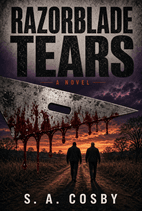
This page gathers lines from Razorblade Tears that hit hard and stay with you. You will find raw dialogue between dangerous men and hurting parents, sharp narration that makes scenes feel immediate, and inner monologue that exposes grief, rage, and regret without dressing them up. Some lines are brutal, some are sad, and some are darkly funny in a way that fits the story.
The novel is quotable because S. A. Cosby writes with a directness that lands. The language stays plain and tense, then turns unexpectedly tender or violent. These are the kind of lines readers underline, text to friends, or think about long after the book is closed.
Top Quotes from Razorblade Tears
“It was bad enough being a Black man in the good ol’ US of A and talking to the cops. You always felt like you were on the edge of some imaginary precipice during any interaction with an officer of the law. If you were an ex-con, it felt like the precipice was covered in bacon grease.”
Two detectives arrive at Ike’s door early in the morning.
It captures the ordinary dread of police contact for a Black ex-con in a single, darkly vivid image.
“Ike stared down at his hands. His empty hands. Hands that had held his boy when he was barely ten minutes old. The hands that had shown him how to tie his shoes. The hands that had rubbed salve on his chest when he'd had the flu.”
At the funeral, Ike stares at his empty hands after letting go of Mya’s hand.
The litany of fatherly touches makes his loss and regret physical.
“His boy was dead. He would be dead longer than he had ever been alive.”
Ike reflects on Isiah after telling Buddy Lee about the desecrated grave.
It distills grief into a stark, haunting fact about the permanence of loss.
“It didn't seem fair for a man to mourn someone abundantly that he had loved so miserly.”
Ike sits with Mya’s silence after she asks whether he will go looking for Isiah’s killers.
It captures the guilt and imbalance of grieving someone he failed to love well.
“Ike thought one of the worst things you could give a man was a clipboard. He'd been at the mercy of men with clipboards. They could keep you out of a gated community or put you on a bus to prison. Give a man a clipboard and watch his true nature come out.”
Ike waits at a gated community guardhouse and watches the guard approach.
It turns a mundane object into a sharp comment on power, gatekeeping, and vulnerability. The observation feels lived-in and quietly damning.
“Trying to hold all this agony and grief inside was like wrestling a bag of pythons. The grief was choking the life out of him.”
Ike finally voices the grief he has been holding in as he asks Slice for help.
The metaphor makes grief feel physical, constricting, and inescapable.
“Ike was sick to death of tears. His own, Mya’s. Isiah was the star in their universe. When he had died that star had collapsed in on itself creating a black hole. That black hole swallowed every ounce of joy they had ever felt.”
Ike watches Tangerine cry after she admits Isiah and Derek died because of what she told them.
The black-hole metaphor turns grief into a cosmic force that erases every trace of joy.
Themes Behind the Quotes
The quotes keep circling around grief and fatherhood. Two men are forced to sit with loss, regret, and the ways they failed their sons, and the novel connects that personal pain to larger questions about forgiveness, acceptance, and whether it is possible to change after damage is done.
Another thread is the cost of violence and the way power works on people. Police suspicion, prison records, economic pressure, and old ideas about toughness all shape how these characters move through the world. The book also looks at loyalty, guilt, and the struggle to do something decent with a life that has mostly been marked by bad choices.
Quotes by Chapter
Part 1 - Chapters 1 to 5
“You didn’t have to say it. I might just cut grass for a living but I know an insult when I hear it. You think my son was some kind of monster and you made sure everybody at his funeral knew it. My boy was less than five feet away from you, and you couldn't shut the fuck up about how his sins were forgivable. His abominable sins.”
— Ike
After the funeral, Ike confronts Rev. Johnson at his car about the sermon’s repeated talk of abominable sin.
It transforms grief into a righteous indictment of religious judgment and asserts Isiah’s dignity.
“He should have walked across that goddamn glacier instead of waiting for it to melt.”
— Ike
After the funeral, Ike sits with an empty glass and thinks about how he waited for time to heal things with Isiah.
The glacier metaphor captures years of stubborn silence and the painful realization that waiting can become its own failure.
Part 2 - Chapters 6 to 10
“We out here trying to find out who killed our children, and you flirting with a lesbian. Are you taking this seriously? Are you really?”
— Ike
After Buddy Lee asks whether Amelia is gay, Ike confronts him in the truck about treating the investigation lightly.
Ike’s anger reveals how grief has sharpened his need for seriousness and control.
“He didn’t recognize his own voice. He realized Ike Randolph was taking a back seat to the action. This was Riot speaking.”
As Ike violently interrogates Bryce at the Blue Anarchists’ shop, he senses his old violent self taking over.
The split between Ike and Riot shows how grief and rage can fracture a person.
Part 3 - Chapters 11 to 14
“Don't you ever, as long as you got breath in your lungs, ever let somebody short us on a deal. They asked for MAC-10s, they take the MAC-10s. This ain't motherfucking Burger King. You got people out here thinking we soft-ass punks. What does that patch on your back say?”
— Grayson
Grayson twists Dome’s ear after learning the MAC-10 sale fell through.
It distills Grayson’s brutal authority and the threat behind the club’s code. The Burger King line makes the menace darkly quotable.
“Death had laid his cold hand on this place and stilled its heart.”
Ike and Buddy Lee enter Derek and Isiah’s empty town house.
It makes the home itself feel like a casualty, turning grief into something physical and eerie.
“For a few years it had been magic. But magic was just sleight of hand, and eventually the magician's assistant had seen every trick.”
Buddy Lee looks at an old photo of Christine and remembers their marriage.
The metaphor turns young love into a trick that inevitably loses its wonder, deepening the regret.
“Dance with me. Just one dance and I'll never bother you again for the rest of your life.”
— Buddy Lee
Buddy Lee recalls asking Christine to dance in a flashback.
It captures the charm and doomed romance that still haunts him. The remembered sweetness sharpens the loss.
Part 4 - Chapters 15 to 20
“Chopping up your first body is disgusting. Your second is tiresome. When you're doing your fifteenth, it's all muscle memory.”
After Buddy Lee and Ike dispose of a body, Buddy Lee reflects on how routine the brutality has become.
It chillingly normalizes atrocity through repetition. The blunt cadence makes the horror feel matter-of-fact.
“Human beings were wired to get used to just about anything. That didn’t make you hard. It made you indoctrinated.”
Ike reflects on violence while cleaning up after the killing and the wood chipper.
It reframes toughness as desensitization rather than strength. The paradox lands with quiet moral force.
“This is who I am. I can’t change. I don't want to, really. But for once I’m gonna put this devil inside me to good use.”
— Buddy Lee
At Derek’s grave, Buddy Lee speaks to his dead son about the violent path he has chosen.
It is a bleak self-reckoning that refuses easy redemption. The line turns his worst impulses into a weapon for revenge.
“How about five against a .38? What do you think about them odds?”
— Jazzy
During the biker standoff in Ike's shop, Jazzy draws a .38 on Dome and the others.
It flips the power dynamic with cool defiance and makes the receptionist the decisive threat.
Part 5 - Chapters 21 to 24
“I can't take it, Ike. I don’t want to get a call about them finding your body after your truck done run off the road because you drunk. I'm barely holding on as it is. If it wasn’t for Arianna, I wouldn't even get out of bed in the morning. She's the only thing that matters now, and I can't do this by myself.”
— Mya
Mya confronts Ike in the kitchen after he stays out all night and drinks, pleading with him not to leave her to raise Arianna alone.
It captures grief turning every absence into a feared death and the raw terror of being left alone with a grandchild.
“He didn’t intend to speak about them in the past tense, but the words flew out of his mouth like hornets riled from their nest.”
After Ike refers to 'what we had' while asking Mya whether their marriage still matters, the narration notes his unintentional past tense.
The hornets metaphor makes his slip feel like a self-inflicted wound, revealing fear that their shared life is already gone.
“Ike folded his wide paw of a hand around Mya’s. Over the last few months, death had carved a valley between them as deep as grief and as wide as heartbreak. Now another man’s death had bridged that gap, if only for a moment.”
After Ike admits he and Buddy Lee are handling things, Mya touches his shoulder and they briefly reconnect.
It captures the tragic irony that another man's death creates a fragile bridge between two people broken by their son's murder.
“I'd expect this from Mom and Gerald, but for some reason I thought you might be different. I thought you might at least pretend to be happy for me. Stupid, right?”
— Derek
In Buddy Lee's memory, Derek responds after Buddy Lee jokes about which groom will be the wife.
It lays bare the wound of a father's casual cruelty and the painful hope Derek had that his dad might accept him.
Part 6 - Chapters 25 to 28
“Go inside. Lock the door. Go upstairs with Arianna. Don't come down until I come get you.”
— Ike
When Mya says a car followed her home, Ike orders her to lock herself and Arianna upstairs.
It distills Ike’s instinct to protect his family into a terse, fearful command. The abrupt shift from ordinary morning to threat makes the line linger.
“We in too deep now, homie. The only way out is through.”
— Ike
Ike rejects Buddy Lee's offer to let him walk away after the Breed follow Mya home.
The line has the fatalistic clarity of someone who knows the only path is forward. It also seals the partnership between Ike and Buddy Lee.
“There was a flatness to his voice that Ike had never heard. He realized Buddy Lee was fully prepared to die over that jackknife.”
Buddy Lee holds a bodyguard at gunpoint to get back his grandfather's knife.
It reveals how much the knife means to Buddy Lee and how far he will go. A small heirloom becomes a measure of his pride and loss.
Part 7 - Chapters 29 to 31
“I think if you figure out at one point in your life you was a terrible person, you can start getting better. Start treating people better.”
— Ike
During the same bar conversation, Ike tells Buddy Lee that acknowledging past wrongdoing is the start of becoming better.
It frames redemption as a practical process, not a single apology, and shows Ike extending grace while still holding Buddy Lee accountable.
“We gonna find Tangerine. We gonna find who did this. We're done letting them down.”
— Ike
After Buddy Lee says they will find Tangerine and the killer, Ike vows they are done letting their sons down.
It turns grief and regret into a plainspoken promise of action, giving the chapter a hard-won forward momentum.
Part 8 - Chapters 32 to 33
“We know we ain't shit. You ain't gotta tell us. We do enough of that to ourselves every day. But that don't mean our boys should rot in the ground while your boyfriend gets to skip all across God's green earth because you're too chickenshit to come forward.”
— Buddy Lee
After Tangerine accuses both fathers of hypocrisy, Buddy Lee admits their failures but demands she help find the killers.
His humility makes his resolve more convincing; he refuses to let self-disgust excuse inaction.
“Lunette’s body did a shuddering box step as bullets tore through her chest and belly. Her floral housedress was drenched in blood, turning the daisies on it to roses.”
During the ambush at Tangerine’s house, Lunette is caught in the gunfire.
The floral dress turning to roses makes the violence feel obscenely beautiful and immediate.