Rapid Google Ads Success Quotes
by Claire Jarrett
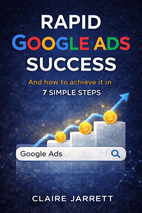
Inside you will find lines that reveal the hidden rules of Google Ads and the mindset shifts needed to succeed. Jarrett's advice is grounded in real campaigns, not theory. She explains why broad keywords waste money, how quality scores can punish you, and why hope is not a strategy.
The book earns its quotable status by being brutally honest. Jarrett calls out Google's profit motives and the traps that advertisers fall into when following bad advice or platform defaults. These quotes cut through the marketing fluff and give you something to remember and share.
Top Quotes from Rapid Google Ads Success
“Google is incentivised to spend as much of your ad budget as possible and they constantly release updates to their Google Ads platform before those changes have been proven to increase profitability.”
The author explains why Google's interests don't align perfectly with advertisers.
This line clearly exposes the inherent conflict of interest, making readers aware that not all platform updates are beneficial to their bottom line.
“It's not a conspiracy, it’s just business.”
The author clarifies that Google's actions are motivated by profit, not malice.
A succinct, memorable line that reframes frustration into a rational understanding of Google's incentives, empowering readers to act accordingly.
“In my experience over the past 17 years of managing Google Ads, I've identified that the single biggest factor determining whether your ads will work or not is your mindset.”
The author shares her key insight from decades of hands-on work.
It shifts the focus from technical tactics to the psychological approach, emphasizing that patience and data-driven thinking are crucial for success.
“Google doesn't care how long you've been running your business or how great you are at running it. All it cares about are their searchers — how quickly can they find the perfect solution using Google's search engine.”
The author explains Google's core priority of relevance over advertiser loyalty.
This reframes the advertiser's mindset from entitlement to performance, emphasizing that success depends solely on serving the user's needs.
“Google definitely ‘punishes’ people who've been doing a bad job with their Google Ad accounts. Even if it's because of following Google’s own recommendations. Go figure!”
The author comments on the often frustrating nature of Google's Quality Score system.
This wry observation captures the irony many advertisers feel—following Google's advice can still lead to penalties—making it relatable and memorable.
“Sadly, hope will get you nowhere with Google. The lack of clicks will lead to Google ‘rewarding’ you with a low Quality Score.”
This follows the example of a client bidding on the name of an online tool based on hope rather than data.
The ironic use of 'rewarding' and the stark dismissal of hope as a strategy makes this both quotable and a powerful warning against wishful thinking in PPC.
“I've had a client seeking to bid on keywords such as “sales trainers”, only for Google to match it against people who want to buy shoes!”
The author describes a real-world example of keyword mismatch.
It humorously highlights how Google Ads can misinterpret keywords, a frustration many advertisers recognize. This anecdote makes the abstract concept of keyword ambiguity tangible and memorable.
Themes Behind the Quotes
A central theme is the tension between Google's profit motives and the advertiser's goal of cost effective conversions. Many quotes highlight how following Google's own recommendations can lead to wasted spend and lower performance. Another major theme is the crucial role of keyword selection and quality score. The book stresses that picking the right keywords and organizing them tightly into themed ad groups is the foundation of success. Broad match keywords are portrayed as dangerous and expensive.
A third theme is the necessity of active monitoring and the use of negative keywords. Jarrett emphasizes that leaving a campaign unattended invites disaster. Finally, the quotes convey a realistic view of competition and conversion rates. Not every campaign can achieve high quality scores, and sometimes your visitors truly want a competitor. Accepting these realities and adjusting expectations is part of the mindset shift needed for long term success.
Quotes by Chapter
CHAPTER 1 - WHAT YOU MUST KNOW ABOUT GOOGLE ADS (EVEN IF YOU ARE NOT MANAGING THEM YOURSELF)
“That one accidental click had modified every single Ad Group. It added hundreds of broad match keywords.”
A story about a client who accidentally applied a Google recommendation, causing a spike in costs.
A vivid, concrete example of the real damage a single misguided click can do, reinforcing the danger of blindly following platform suggestions.
CHAPTER 2 - HOW DOES GOOGLE ADS WORK, AND WHY DOES IT MATTER?
“Luckily, most people have no idea how Google Ads work - or they wouldn't click on them as often.”
Opening of the chapter, the author makes a wry observation about user behavior.
It immediately hooks the reader with a counterintuitive truth that highlights the hidden effectiveness of ads and the ignorance of the average user.
“Established competitors means there is money to be made in this market. Not finding any is NOT a sign of a great product - it's a sign that your product or service is doomed to fail.”
Section on analyzing competition, warning against the illusion of a market without rivals.
It delivers a blunt, memorable reality check that forces readers to rethink their assumptions about competition and validates the necessity of market validation.
“People make decisions based on emotions and then rationalise them logically.”
Discussion of landing page benefits, explaining how to appeal to both emotional and logical drivers.
This concise psychological insight is actionable and universally applicable, helping marketers craft messages that resonate on a deeper level.
CHAPTER 3 - KEYWORDS ARE THE KEY
“Picking the right keywords is the single most important factor in your campaign.”
Opening of the chapter, setting the central theme.
This statement directly establishes the core premise of the chapter, making it memorable and actionable for readers.
“The lower your Quality Score, the higher your cost per click.”
Part of the explanation about the client's mistake with low-intent keywords.
It succinctly captures a critical cause-and-effect relationship that drives home the financial impact of poor keyword choices.
“Broad keywords will get matched against irrelevant terms, making them a waste of money.”
Discussion on keyword match types, with an example of a client whose ads showed for 'Xbox game Rage 2'.
This vivid warning sticks with readers, highlighting the danger of broad match and reinforcing the need for precise targeting.
“And that’s why you should never leave your Google Ads account unmonitored.”
Conclusion of a client story where an unmonitored campaign attracted unqualified leads.
It delivers a powerful, no-excuses lesson that resonates with anyone who has experienced account drift, emphasizing active management.
CHAPTER 4 - BUILD YOUR CAMPAIGNS STEP-BY-STEP
“Yes, that IS possible - if you’ve done your research correctly and set up your campaign using the method I'm about to teach you.”
The author asserts that immediate results are achievable with proper preparation.
It gives readers confidence that success is within reach if they follow the method, turning skepticism into motivation.
“We want a good Quality Score with relevant ads, so we want to create an ad that’s 100% focused on each key phrase and its related key phrases.”
The author explains the importance of ad relevance for Quality Score.
This succinctly captures the core principle of Google Ads optimization, reminding readers that relevance drives performance.
“Google hates it when you do this; it wants to freely rotate all the headlines and descriptions to find winning combinations.”
The author advises against pinning headlines in responsive search ads.
It humanizes Google's algorithm and makes a technical rule memorable, helping readers avoid a common mistake that limits ad performance.
“Don't follow the crowd and copy blindly. Only add relevant sitelinks. Otherwise, they can be one of the biggest drains on an advertiser's budget, leading to colossal conversion losses.”
The author warns against adding irrelevant sitelinks.
The strong language ('colossal conversion losses') and direct advice make this a powerful reminder to think critically about ad extensions rather than just adding them.
CHAPTER 5 - TRACKING YOUR CAMPAIGNS
“If Google cannot see the leads, it won’t know which keywords are working for you.”
The author explains why conversion tracking is critical before launching campaigns.
This line distills the fundamental risk of untracked ads: without data, Google's bidding algorithm is blind, making optimization impossible.
“If you thought a 20% conversion rate at a few pounds per conversion was good, just imagine what you could achieve by fine-tuning every aspect of your Google Ads account!”
The author motivates readers to embrace full tracking and optimization.
It sparks ambition by presenting a concrete, exciting benchmark and hinting at even greater results through systematic improvement.
“But the number one thing you should NOT do is hunt for them. Why? Because you'll increase your impressions, drop your CTR and lower your Quality Score.”
The author warns against manually searching for your own live ads.
It delivers a counterintuitive but essential rule that protects campaign performance, saving advertisers from costly mistakes driven by curiosity.
CHAPTER 6 - MONITORING AND OPTIMISING YOUR ACCOUNT
“A reasonable conversion rate will be 5% to 10% if you advertise a local business.”
This appears in the 'Are You Spending Enough?' troubleshooting section.
It gives readers a concrete benchmark to evaluate their own campaign performance, making an abstract concept tangible. This clarity helps them set realistic expectations and identify when their budget or bids need adjustment.
“If your competitors bid $5 on average and you only bid $2, then you won't get enough clicks in the top spots.”
This is part of the explanation about why a low budget may fail to generate conversions.
It uses a simple, relatable example to illustrate the importance of competitive bidding, making the mechanic of auction-based advertising easy to grasp. Readers immediately understand that underbidding can render their campaigns ineffective.
“It's very easy to accidentally add negative keywords to individual ads or campaigns and to get confused because your other ads are still targeting those negative keywords.”
This warning appears in the initial monitoring instructions about adding negative keywords.
It highlights a common and costly mistake that beginners often make, validating their potential frustration. The line resonates because it offers proactive caution, saving readers time and budget from misconfigured campaigns.
2. QUALITY SCORE
“You may have to accept that you will never get a good Quality Score because at the end of the day, your visitor wants your competitor's website, not yours.”
This appears in the section discussing why bidding on competitor names is difficult.
It delivers a blunt, realistic truth about ad relevance that many advertisers overlook, making the point memorable and actionable.
“I’ve seen many advertisers suddenly penalised with a low Quality Score, with their keywords barely triggering their ads.”
This is part of the introduction to common causes of low Quality Score.
It vividly describes a common pain point, creating an immediate sense of caution and relatability for readers who have experienced or fear the same penalty.
3. IMPRESSION SHARE AND CLICK SHARE
“Sometimes, no matter how hard an agency or consultant might try, the Quality Score will never rise above 5.”
The author explains a limit of Quality Score optimization.
It acknowledges a painful reality that frees advertisers from self-blame. This line validates the experience of those who have struggled despite their best efforts.
“The keywords are used by different people in different circumstances.”
The author gives the root cause for low Quality Scores.
It succinctly captures the fundamental problem of keyword ambiguity, a key insight for any advertiser. This simple statement shifts the focus from technical fixes to strategic understanding.
4. ADD MORE NEGATIVE KEYWORDS - NO, EVEN MORE!
“In my early years of running Google Ads, I was employed as a consultant to a florist. My sole task? Do nothing but add hundreds of negative keywords.”
The author recounts his early experience working for a florist client.
This line is jarring and memorable because it highlights that adding negative keywords was the entire focus, underscoring how crucial yet overlooked this tactic is.