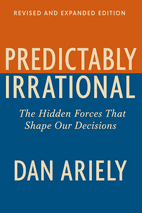
Predictably Irrational, Revised and Expanded Edition — Interactive Mindmaps

Predictably Irrational, Revised and Expanded Edition by Dan Ariely Book Cover

by Dan Ariely

Dan Ariely's Predictably Irrational, Revised and Expanded Edition reveals the systematic irrational biases driving our decisions through clever experiments, exploring concepts like the power of free and anchoring. It's essential for anyone in business or policy seeking to understand real human behavior.

On Insta.page you also get an Apply This Book tool that lets you combine insights from up to 3 books to solve your specific situation.

Chapter mindmaps

Free preview: chapters 1–4 are fully interactive. Click any node to expand or collapse. Subscribe to unlock the rest.

Chapter 1: Chapter 1: The Truth about Relativity: Why Everything Is Relative—Even When It Shouldn’t Be

Key concepts: Chapter 1: The Truth about Relativity: Why Everything Is Relative—Even When It Shouldn’t Be

1. Chapter 1: The Truth about Relativity: Why Everything Is Relative—Even When It Shouldn’t Be

The Economist's Pricing Puzzle

  • Three subscription options created a strategic pricing structure
  • Print-only option priced identically to print-and-Internet package served as a decoy
  • The decoy made the combined package appear irresistibly superior
  • Marketers intentionally leveraged human psychology to guide choices

How Relativity Guides Our Choices

  • Humans lack an internal 'value meter' for absolute assessments
  • We rely on relative comparisons to determine worth
  • Decoy options create easy comparisons that bypass complex decision-making
  • Our brains prefer simple relative judgments over difficult calculations

The Role of Context in Decision-Making

  • We often don't know what we want until we see alternatives
  • External reference points shape our judgments and preferences
  • Context provides relative markers like runway lights for navigation
  • Comparisons influence choices from products to life goals

Experimental Evidence of Relativity Effects

  • MIT experiment showed dramatic choice shifts when decoy was removed
  • Without print-only option, more students chose Internet-only subscription
  • Unselected options still powerfully influence decision patterns
  • Visual illusions demonstrate how context affects perception of size and value

Real-World Applications of Relativity

  • Real estate: flawed homes make similar flawless ones stand out
  • Dating: decoy profiles make 'regular' options appear more desirable
  • Retail: high-priced items boost sales of cheaper alternatives
  • Social settings: contrast effects can enhance personal appeal

Downsides and Ethical Considerations

  • Relativity fuels envy in executive salary comparisons
  • Public disclosure of peer salaries can drive compensation inflation
  • Using relativity in dating risks damaging relationships
  • Ethical pitfalls exist when manipulating comparisons for advantage

Strategies to Counteract Relativity Bias

  • Consciously choose reference points and avoid tempting comparisons
  • Recognize that identical savings feel different in different contexts
  • Consider broader uses for money rather than narrow comparisons
  • Break the cycle of relative judgments by shifting perspective

The Psychology of Visual Relativity

  • Identical circles appear different sizes based on surrounding context
  • Our minds instinctively evaluate options through comparison rather than absolute assessment
  • This comparative tendency applies to physical objects, experiences, and abstract concepts
  • Relativity shapes consumer choices and personal judgments automatically

Decoy Effect in Major Life Decisions

  • Real estate choices are influenced by decoy options that make similar alternatives stand out
  • Honeymoon decisions can be swayed by adding inferior versions of attractive destinations
  • The flawed colonial house serves as decoy that highlights the perfect colonial's superiority
  • Decoys simplify complex decisions by creating clear comparative advantages

Experimental Evidence of Relativity in Dating

  • MIT students preferred undistorted photos when presented with distorted decoy versions
  • The decoy effect increased selection of similar undistorted photos by 75%
  • Direct unfavorable comparisons make similar options appear more desirable
  • Physical attraction judgments are heavily influenced by relative context

Consumer Psychology and Social Strategies

  • Williams-Sonoma used expensive bread maker as decoy to boost cheaper model sales
  • Consumers use decoys to justify choices when uncertain about product categories
  • Social settings allow strategic use of less attractive friends to enhance personal appeal
  • These strategies raise ethical considerations about manipulating comparisons

Negative Consequences of Relativity

  • Public CEO salary disclosure fueled envy-driven compensation inflation
  • Executives now earn 369 times average worker due to comparative pressures
  • Doctors abandon research for Wall Street when comparing incomes to peers
  • Social comparisons often override rational assessment of personal satisfaction

Strategies for Managing Relativity

  • Consciously choose reference points to avoid unfavorable comparisons
  • Avoid exposure to options beyond realistic budget constraints
  • Recognize irrational weighing of savings across different price contexts
  • Broaden perspective beyond local comparisons to make more rational decisions

Financial Decision-Making and Relative Value

  • People evaluate savings relatively rather than considering absolute dollar amounts
  • Same $7 saving feels significant on $25 pen but trivial on $455 suit
  • Upgrade decisions vary based on percentage of total cost rather than utility
  • Narrow relative thinking prevents consideration of alternative uses for money

Breaking the Cycle of Escalating Want

  • James Hong downsized from Porsche to Prius to escape comparative dissatisfaction
  • Wanting escalates with possession in relative comparison cycles
  • Contentment requires conscious rejection of relative comparison traps
  • Breaking free from social comparison enables more authentic satisfaction

Social Applications and Ethical Considerations

  • Dating strategy using less attractive friends can damage relationships if revealed
  • Susan's confession while intoxicated undermined friendship trust
  • Relativity-based social strategies require discretion to maintain relationships
  • Social perceptions are shaped by contrast effects that can be ethically problematic

Context-Dependent Human Connections

  • Intense bonds form in foreign environments due to relative scarcity of connections
  • Barcelona friendship lost magic when context changed to familiar environment
  • Profound connections in unusual settings may be fleeting due to relative context
  • Managing expectations requires recognizing how environment shapes relationship value

The Psychology of Relative Comparison

  • Our brains are wired to make relative comparisons rather than absolute assessments
  • This cognitive tendency leads us to focus on narrow comparisons that often distort reality
  • Relative thinking creates a perpetual cycle of wanting more by constantly shifting our reference points

Breaking the Cycle of Relative Wanting

  • James Hong's downsizing demonstrates conscious effort required to escape relative thinking traps
  • Shifting from relative to absolute judgments requires deliberate cognitive reframing
  • Escaping the 'more' mentality involves recognizing when relative comparisons serve no real purpose

Strategic Use of Relativity in Social Contexts

  • Dating scenarios show how relativity can be leveraged strategically for advantage
  • Social relationships require discretion when employing relative positioning tactics
  • The effectiveness of relative positioning depends on context and relationship dynamics

The Illusion of Travel-Induced Bonds

  • Intense connections formed during travel are products of relative circumstances
  • These bonds often fail to translate to everyday life contexts
  • Travel experiences create artificial comparison frames that magnify emotional intensity

Practical Applications and Limitations

  • Understanding relativity helps identify when comparisons lead to irrational decisions
  • The challenge lies in recognizing relative thinking in real-time decision making
  • Some contexts benefit from relative thinking while others require absolute assessment

Chapter 2: Chapter 2: The Fallacy of Supply and Demand: Why the Price of Pearls—and Everything Else—Is Up in the Air

Key concepts: Chapter 2: The Fallacy of Supply and Demand: Why the Price of Pearls—and Everything Else—Is Up in the Air

2. Chapter 2: The Fallacy of Supply and Demand: Why the Price of Pearls—and Everything Else—Is Up in the Air

The Fallacy of Traditional Supply and Demand

  • Market prices can shape consumer demand rather than just respond to it
  • Supplier-suggested prices manipulate consumer willingness to pay
  • Memory of past prices creates price sensitivity, not inherent preferences
  • Classic economic models fail to account for psychological anchoring effects

The Pearl King's Marketing Strategy

  • Salvador Assael transformed unwanted Tahitian black pearls into luxury items
  • Strategic partnership with high-end jewelers like Harry Winston
  • Exorbitant pricing and glossy advertising created artificial scarcity
  • Proved that desire flares when items seem exclusive and difficult to obtain

Anchoring and the Gosling Effect

  • Human decision-making parallels gosling imprinting behavior
  • Initial price exposures create lasting anchors for future decisions
  • First impressions shape long-term value perceptions
  • Anchors persist even when new reference points are introduced

The MIT Social Security Experiment

  • Arbitrary numbers (social security digits) influenced real bidding behavior
  • Higher-ending digits led to bids 300%+ more than lower digits
  • Demonstrated irrational anchoring in economic decision-making
  • Showed perceived value can be completely detached from rational assessment

Arbitrary Coherence Principle

  • Initial anchors may be arbitrary but create logical frameworks
  • Related choices become coherent within the anchored system
  • Price references establish consistent valuation patterns
  • Geographic price differences require conscious recalibration to overcome

Self-Herding Behavior

  • People repeat their own past decisions to form habits
  • First purchase sets anchor, subsequent purchases reinforce it
  • Starbucks example: expensive coffee becomes normalized through repetition
  • Strategic environmental design shifts price expectations upward

Implications for Market Efficiency

  • Irrational anchoring undermines free market efficiency
  • Trades may not maximize real utility due to misleading anchors
  • Highlights need for regulation in critical sectors like healthcare and education
  • Tax sensitivity depends on memory of previous prices rather than inherent value

Practical Applications and Solutions

  • Questioning repeated behaviors enables more deliberate choices
  • Recognizing emotional decisions often rationalized after the fact
  • Conscious awareness of anchoring can improve decision-making
  • Initial anchors should be critically examined rather than automatically accepted

Arbitrary Coherence in Decision Making

  • Initial prices are arbitrary but create coherent frameworks for related decisions once established
  • Anchors only take effect when we actively consider a purchase, becoming reference points for future choices
  • Participants consistently bid more for premium items, showing anchors establish logical relative value
  • The anchoring effect functions like a bungee cord pulling decisions back to the original reference point

Real-World Anchoring in Housing Markets

  • People moving between cities maintain spending anchored to previous housing costs rather than adjusting to local prices
  • Those from expensive cities maintain high spending even in cheaper areas without conscious intervention
  • Renting for a year helps recalibrate anchors to new markets, showing persistence without active adjustment

The Persistence of First Anchors

  • First anchors maintain lasting impact even when new anchors are introduced later
  • Experimental groups maintained their original price anchors (10-cent vs 90-cent) throughout subsequent phases
  • First anchors function like goslings' imprinting, creating long-term loyalty to initial reference points

From Herding to Self-Herding Behavior

  • Herding involves following others' actions while self-herding bases decisions on one's own past behavior
  • Initial expensive purchases set anchors that subsequent visits reinforce into habits
  • Self-herding explains how arbitrary initial choices evolve into long-term behavioral patterns

Starbucks Habit Formation Strategy

  • Repeated visits reinforce initial decisions, creating self-perpetuating behavioral cycles
  • Starbucks deliberately designed stores to feel distinct from competitors to shift price anchors
  • European-inspired ambience and unique branding helped establish new premium price references
  • Customers begin to see expensive coffee habits as genuine preferences rather than anchored behaviors

Poetry Reading Experiment Insights

  • Initial hypothetical anchors (paying vs being paid) heavily influenced actual bidding behavior
  • Arbitrary initial impressions shape subsequent decisions regardless of objective value
  • Mirrors Tom Sawyer's manipulation, showing how framing creates coherent behavioral patterns
  • Decisions reflect initial anchors rather than independent assessment of value

Economic Implications of Anchoring

  • Challenges traditional supply-demand models by showing interdependence between price and demand
  • Supplier-suggested prices manipulate consumer willingness to pay, reversing assumed causality
  • Market prices themselves influence demand rather than demand determining prices
  • Demand reflects distorted preferences shaped by external anchors rather than pure utility

Memory's Role in Price Sensitivity

  • Price changes affect demand primarily through memory of past prices, not inherent preferences
  • Consumers react to price changes by comparing them to established anchors
  • Over time, consumers adjust to new prices and consumption may revert to near-original levels
  • Demand sensitivity reflects coherence with past decisions rather than true utility maximization

Limitations of Free Market Efficiency

  • Arbitrary anchors undermine the assumption that trades maximize utility and pleasure
  • Decisions swayed by misleading anchors may lead to suboptimal trade outcomes
  • Suggests need for regulation in essential markets to protect against irrational behaviors
  • Free trade doesn't always lead to optimal outcomes when decisions are anchor-driven

Rationalization in Decision Making

  • People often rationalize decisions after the fact rather than discovering true preferences
  • Tools and processes are used to confirm pre-existing inclinations with rational veneers
  • Illustrated by car buying example where emotional desires were justified through manipulated rational processes
  • Gut feelings often drive decisions that are later supported by seemingly rational justifications

The Psychology of Anchoring

  • Initial decisions create cognitive anchors that influence subsequent choices through self-herding behavior
  • Arbitrary starting points can establish lasting patterns that persist even when circumstances change
  • Anchors create coherence in decision-making, making us repeat behaviors that align with initial choices

Market Price as Behavioral Driver

  • Supply-side factors like marketing and presentation can establish price anchors that dictate consumer demand
  • Traditional supply-demand independence is challenged when prices themselves influence perceived value
  • Advertising and positioning create reference points that shape willingness to pay

Memory-Based Price Sensitivity

  • Consumer reactions to price changes depend more on memory of past prices than inherent preferences
  • Price sensitivity is constructed through recall rather than being an objective measure of value
  • This memory-driven approach can lead to market inefficiencies and irrational responses to price fluctuations

The Rationalization Process

  • People use analytical tools and processes to justify decisions that are fundamentally emotional
  • Post-hoc reasoning masks true preferences and the emotional drivers behind choices
  • We create narratives that make our decisions appear more rational than they actually are

Overcoming Behavioral Biases

  • Questioning repeated behaviors and examining first decisions can reveal anchoring effects
  • Self-awareness helps mitigate irrational influences in both personal and economic contexts
  • Deliberate examination of decision patterns encourages more conscious and rational choices

Chapter 3: Chapter 3: The Cost of Zero Cost: Why We Often Pay Too Much When We Pay Nothing

Key concepts: Chapter 3: The Cost of Zero Cost: Why We Often Pay Too Much When We Pay Nothing

3. Chapter 3: The Cost of Zero Cost: Why We Often Pay Too Much When We Pay Nothing

The Psychological Power of Zero Cost

  • FREE! acts as an emotional trigger that eliminates perceived risk of loss
  • Zero cost causes irrational choices that defy logic and value calculations
  • The psychological leap from almost-free to completely free is enormous
  • FREE! operates in a unique psychological category that disrupts rational decision-making

Experimental Evidence of Zero Cost Effect

  • Chocolate experiment: 69% chose free Hershey's Kisses over better-value Lindt truffles
  • Halloween candy exchange: 70% of children chose free small Snickers over better deal
  • Behavior changes dramatically when FREE! is introduced, even when value differences remain constant
  • FREE! overrides clear value calculations in both adults and children

Business Applications and Market Impact

  • Amazon's free shipping dramatically increased sales while small charges had no impact
  • AOL's shift to flat-rate pricing doubled usage as customers behaved like it was free
  • Companies leverage the psychological difference between almost-free and completely free
  • FREE! serves as powerful marketing tool that drives consumer behavior

Negative Consequences of Zero Cost Attraction

  • Choosing 'free' checking accounts with hidden fees that ultimately cost more
  • Opting for mortgages with no closing costs but higher interest rates
  • Making major purchases based on insignificant free offers rather than actual needs
  • Overlooking true costs and value in favor of immediate free benefits

Non-Monetary Applications of Zero Effect

  • People wait excessively for free items despite time cost exceeding value gained
  • 'Zero calorie' and 'zero trans fat' labels create stronger appeal than low-number alternatives
  • FREE! influences health decisions through psychological labeling effects
  • Zero effect extends beyond money to time, health, and other non-monetary contexts

The Pain of Paying and Diminishing Sensitivity

  • Psychological discomfort from spending money affects decision-making
  • Each additional dollar causes less pain (diminishing sensitivity)
  • Group payment strategies can reduce overall discomfort and strengthen relationships
  • Real behavior often prioritizes free options over rational cost-benefit calculations

Strategic Positive Applications

  • Making health screenings free increases participation rates
  • Eliminating fees encourages adoption of beneficial technologies like electric vehicles
  • Understanding zero cost psychology allows for beneficial behavioral interventions
  • FREE! can be strategically used to promote positive social and health outcomes

Strategic Applications of Zero Cost

  • Making health screenings free dramatically increases participation rates
  • Eliminating electric vehicle registration fees boosts adoption more than price reductions
  • Zero operates in a different psychological category than other discounts
  • Free offerings are perceived as fundamentally different, not just cheaper

The Pain of Paying in Social Settings

  • Pain of paying diminishes with each additional dollar due to diminishing sensitivity
  • Single person paying full bill creates less total pain than equal splitting among group
  • Pain disappears completely when someone else pays (zero cost scenario)
  • Rotating who pays maximizes emotional benefits despite occasional financial imbalances
  • This approach strengthens friendships by reducing collective psychological discomfort

Zero Cost vs Rational Economic Theory

  • Rational theory assumes choices based on net benefit (pleasure minus cost displeasure)
  • When prices drop equally, rational theory predicts no change in preference
  • Real behavior shows people often choose free options even when superior alternatives exist
  • Zero cost has a magnetic pull that disrupts pure cost-benefit analysis
  • Standard economic models fail to capture the irrational appeal of free offerings

Chapter 4: Chapter 4: The Cost of Social Norms: Why We Are Happy to Do Things, but Not When We Are Paid to Do Them

Key concepts: Chapter 4: The Cost of Social Norms: Why We Are Happy to Do Things, but Not When We Are Paid to Do Them

4. Chapter 4: The Cost of Social Norms: Why We Are Happy to Do Things, but Not When We Are Paid to Do Them

The Social-Market Norms Distinction

  • Social norms govern friendly, reciprocal interactions without immediate payback expectations
  • Market norms involve transactional exchanges with clear cost-benefit calculations
  • Blending these norms often backfires, damaging relationship dynamics
  • We navigate both worlds daily but must keep them separate for smooth functioning

Experimental Evidence of Norms Clash

  • Circle-dragging experiments showed unpaid participants outperformed paid ones
  • Even small payments trigger market norms, reducing intrinsic motivation
  • Social norms inspire greater effort and engagement than monetary incentives
  • The introduction of money transforms social exchanges into transactional ones

Gifts as Social Norms Bridges

  • Gifts maintain social norms unless their market value is highlighted
  • Gifts of equivalent value to cash produce different behavioral outcomes
  • Explicitly stating gift costs transforms them into market transactions
  • Gifts serve as social lubricants that cash cannot replicate

Psychological Impact of Money Priming

  • Simply thinking about money shifts people into market-norm mode
  • Money-primed individuals become more self-reliant and less helpful
  • Financial reminders foster individualism and reduce prosocial behaviors
  • Money thinking creates psychological distance in collaborative situations

Real-World Consequences of Norms Confusion

  • Day care fine backfired by transforming social obligation into payable service
  • Corporate cost-cutting erodes employee loyalty and transforms relationships
  • Romance suffers when market norms clash with intimacy expectations
  • Education faces pitfalls when testing overshadows purpose and pride

Practical Applications and Solutions

  • Symbolic gestures reinforce social norms better than cash bonuses
  • Linking activities to broader societal goals ignites intrinsic motivation
  • Gift-based economies enhance creativity and connection without money
  • Emphasizing social norms cultivates loyalty, satisfaction, and resilience

The Day Care Center Experiment

  • Imposing fines for late pickups transformed social norm compliance into market transactions
  • Parents shifted from feeling guilty to viewing tardiness as a payable service
  • Late arrivals increased after fines were introduced and persisted even after fines were removed
  • Mixing social and market norms caused long-term damage to the social contract
  • Once market norms replace social norms, rebuilding relationships becomes extremely difficult

Corporate Shift to Market Norms

  • Companies prioritizing short-term profits erode employee benefits and social contracts
  • Reduction in benefits like child care and medical coverage transforms relationships into transactional exchanges
  • Market norm adoption leads to decreased employee loyalty and increased turnover
  • Corporate loyalty becomes contradictory when social exchanges are replaced by market-driven interactions
  • The erosion of social norms in workplaces reduces productivity and commitment

Gifts vs. Cash in Employee Motivation

  • Symbolic gifts and experiences often strengthen social bonds more effectively than cash
  • Personalized gifts reinforce social relationships and foster long-term commitment
  • Companies like Google use perks to build goodwill through social norms rather than financial incentives
  • Social norm emphasis encourages flexibility and willingness to go above and beyond
  • Emotional impact of gifts often outweighs the economic efficiency of cash bonuses

Social Norms in Education

  • Overreliance on market norms like standardized testing undermines social aspects of learning
  • Fostering purpose and mission is more effective than financial incentives in education
  • Linking curricula to societal goals provides deeper motivation for students and teachers
  • Education should be intrinsically rewarding rather than transactional
  • Passion-driven learning mirrors successful approaches in sports and hobbies

Burning Man: A Moneyless Society

  • Demonstrates a society operating successfully on social norms rather than market norms
  • Gift-based economy fosters community built on generosity and trust
  • Reducing market norms enhances satisfaction, creativity, and social connections
  • Provides a model for integrating more social norms into daily life
  • Highlights how social norm emphasis can restore civility and fulfillment

The Power of Gifts in Social Exchanges

  • Gifts serve as crucial social lubricants despite economic inefficiency
  • Thoughtful gifts convey care and strengthen bonds in ways cash cannot
  • Offering money shifts interactions into market norms, making favors transactional
  • Gifts foster reciprocity and long-term social connections
  • Symbolic gestures yield significant social returns that justify their 'inefficiency'

Market Norms Clashing with Romance

  • Introducing market norms into romantic relationships leads to dysfunction
  • Mixing professional and personal relationships creates conflicting norm expectations
  • Romantic relationships thrive on social exchanges of trust and mutual care
  • Explicit financial deals undermine the foundation of intimate relationships
  • Pop culture examples illustrate the incompatibility of market norms in romance

Continue exploring Predictably Irrational, Revised and Expanded Edition